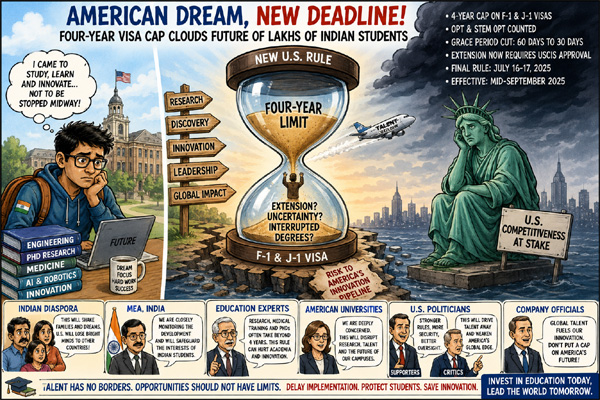
- Four-year cap on F-1 and J-1 visas could reshape study-abroad plans, with Indian students—the largest international cohort in the U.S.—likely to feel the biggest impact
- Indian diaspora body FIIDS urges Washington to pause implementation, warning of disruptions to degrees, research, innovation and the U.S. talent pipeline
- S. higher education leaders, medical institutions and universities caution that doctoral, medical and STEM programmes often exceed four years
- DHS says fixed-duration policy will strengthen immigration oversight, programme integrity and national security through greater monitoring
- India’s Ministry of External Affairs says it is closely monitoring developments and remains committed to safeguarding the interests of Indian students abroad
- Education experts advise students and parents not to panic but to plan early, verify programme timelines and monitor official immigration updates before taking admission decisions
NE EDUCATION BUREAU
WASHINGTON/NEW DELHI, CHENNAI, JULY 20
For generations of Indian families, an American university has symbolised the pursuit of academic excellence, cutting-edge research and global career opportunities. But a proposed shift in U.S. immigration rules has triggered fresh uncertainty, particularly for Indian students who form the largest international student community in the United States. While the U.S. government says the move is intended to improve immigration oversight and programme integrity, education leaders, universities and the Indian diaspora warn that it could make long-duration academic programmes significantly more uncertain.
The Foundation for India and Indian Diaspora Studies (FIIDS) has urged elected representatives, the U.S. Citizenship and Immigration Services (USCIS) and the Department of Homeland Security (DHS) to defer implementation of the new rule, which would replace the decades-old “Duration of Status (D/S)” framework with a maximum four-year admission period for F-1 and J-1 visa holders. According to the organisation, the rule was finalised on July 17 and is scheduled to take effect in mid-September, subject to the U.S. regulatory process.
Why Indian Students Could Be Hit the Hardest
India has overtaken several countries to become the largest source of international students in the United States, with particularly strong representation in engineering, computer science, artificial intelligence, biotechnology, management, medicine and doctoral research. A substantial number of these programmes—including Ph.Ds., medical residencies, research fellowships and many STEM pathways—typically extend well beyond four years.
Under the proposed framework, students whose programmes exceed four years would generally need to secure an Extension of Stay from USCIS or seek re-entry into the U.S., introducing additional procedural requirements and uncertainty.
What FIIDS Says
Calling the proposal “a self-inflicted wound on U.S. competitiveness,” FIIDS Chief of Policy and Strategy Khanderao Kand said:
“A four-year cap misaligns with how modern degrees actually work. Students will be forced out mid-program or mid-research, laboratories will lose critical talent, and America risks handing its innovation pipeline to competitors.”
FIIDS noted that the median completion time for many bachelor’s programmes is already around 52 months, while doctoral programmes often take 5.7 years or longer. The organisation has appealed for restoration of the Duration of Status system, automatic extensions for students in good academic standing, exclusion of OPT and STEM OPT from the four-year calculation and restoration of the 60-day grace period after course completion.
DHS Defends the Rule
The Department of Homeland Security has defended the policy, saying it is designed to strengthen immigration oversight, close loopholes, improve compliance, reduce visa abuse and enhance national security. Officials argue that a fixed period of admission provides greater transparency and accountability than the existing open-ended Duration of Status framework.
American Universities and Education Bodies Raise Concerns
Several prominent American higher education organisations have expressed reservations.
The Association of American Medical Colleges (AAMC) said many medical residency, doctoral and biomedical research programmes routinely exceed four years and warned that replacing Duration of Status with a fixed-term system could:
- reduce America’s ability to attract global talent,
- increase financial and administrative burdens,
- disrupt scientific research, and
- ultimately affect healthcare and innovation.
Universities including Yale University, Carnegie Mellon University, Brown University and the University of Pennsylvania have informed international students that they are carefully reviewing the new regulations and will issue detailed guidance before the rule takes effect in September.
Indian Government’s Position
The Ministry of External Affairs (MEA) has consistently maintained that the welfare of Indian students abroad remains a priority and that Indian missions continue to engage with host governments whenever issues affecting Indian students arise. Officials have indicated that developments relating to the new visa framework are being closely monitored and that necessary assistance would be extended through Indian diplomatic missions wherever required. (As of Monday, there was no detailed country-specific advisory on this particular rule.)
Indian Diaspora Reaction
Indian diaspora organisations have voiced concern that additional procedural hurdles could discourage talented students from choosing the United States and instead push them towards countries such as Canada, Australia, the United Kingdom, Germany and Singapore, all of which are actively competing for international talent.
Several diaspora leaders have argued that reducing certainty for international students could ultimately weaken America’s innovation ecosystem, particularly in research-intensive sectors.
Political Reactions in the U.S.
The policy has drawn mixed political reactions.
Supporters of the Trump administration say stricter visa rules are necessary to strengthen border security, reduce visa misuse and ensure that immigration laws are enforced consistently.
Critics—including several higher education organisations and immigration experts—argue that the changes impose unnecessary bureaucracy on genuine students while making the United States less attractive in the global competition for talent.
What Students and Parents Should Do
Education consultants and university advisers recommend that prospective applicants:
- carefully evaluate the normal duration of their intended academic programme;
- monitor official announcements from DHS, USCIS and their universities;
- apply well in advance to minimise processing delays;
- maintain valid immigration status at every stage; and
- avoid making decisions based solely on social media speculation.
Experts emphasise that the rule is not a ban on Indian students, nor does it prevent admissions. Rather, it changes how long students may remain in the U.S. before requiring additional immigration approval if their academic programmes extend beyond the prescribed period.
For India’s vast community of aspiring international students, the message is clear: the American Dream remains alive—but navigating it may soon require greater planning, documentation and vigilance than ever before.