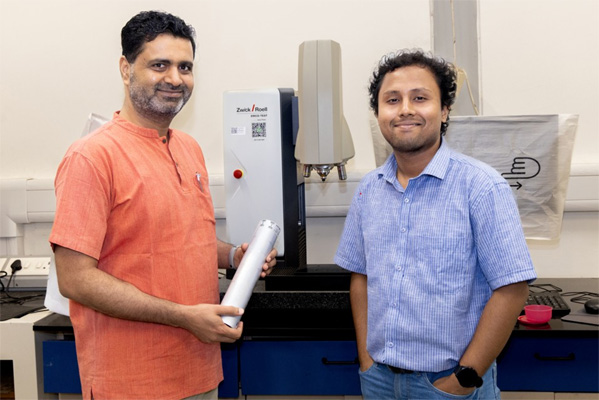

- Larry Kaufman Scholarship 2026 brings global acclaim to IITGN PhD scholar Sagar Kumar Deb
- Simulation-designed alloy promises to replace imported high-performance aluminium in defence, aerospace and strategic sectors
- Patent filed; technology advances towards industrial-scale validation under Ministry of Mines-backed project
- Research strengthens Make in India and Atmanirbhar Bharat with next-generation materials engineering
- International honour underscores India’s growing leadership in computational thermodynamics and advanced manufacturing
NE SCIENCE & TECHNOLOGY BUREAU
GANDHINAGAR, AUG. 6
In a scientific breakthrough with far-reaching implications for India’s strategic autonomy, researchers at the Indian Institute of Technology Gandhinagar (IITGN) have computationally designed an indigenous high-strength aluminium alloy capable of reducing the nation’s dependence on imported materials used in defence, aerospace and other critical sectors. The innovation, already earning international recognition, represents a significant leap towards strengthening India’s self-reliance in advanced engineering materials while accelerating the country’s march under the Make in India and Atmanirbhar Bharat missions.
The pioneering research has earned Sagar Kumar Deb, a PhD scholar at IIT Gandhinagar, the prestigious Larry Kaufman Scholarship 2026, presented annually by CALPHAD Inc. to only about 20 outstanding young researchers worldwide for exceptional contributions to computational materials thermodynamics. Deb is among the very few Indians—and the first IITGN PhD scholar—to receive the coveted global honour. The award enabled him to present the research before leading scientists at the 53rd CALPHAD Conference in Quebec, Canada.
The three-year project, funded by the Ministry of Mines and led by Prof Amit Arora of IITGN’s Department of Materials Engineering, seeks to address India’s dependence on imported AA6082 aluminium alloy tubes widely deployed in strategic applications including radar telescopic masts, bomb disposal robots, airport lighting systems, structural frames and aerospace components.
Deb’s research has resulted in a novel Aluminium-Magnesium-Silicon (Al-Mg-Si) based 6xxx-series alloy that eliminates copper and zinc while delivering superior strength, excellent corrosion resistance and improved ductility. The alloy offers an indigenous alternative capable of outperforming conventional AA6082 without compromising durability, making it ideally suited for long-term strategic applications.
Unlike conventional alloy development that depends on years of costly laboratory experimentation, the IITGN team first designed the material through sophisticated CALPHAD (CALculation of PHAse Diagrams) simulations before validating it experimentally using X-ray diffraction and electron microscopy. This virtual-first approach drastically cuts research time, development costs and material wastage while enabling precise optimisation of alloy compositions.
The innovation has already reached Technology Readiness Level (TRL) 4, confirming successful laboratory validation. The project is now progressing towards industrial-scale validation through collaboration with the Jawaharlal Nehru Aluminium Research Development and Design Centre (JNARDDC), Nagpur, and Siddhi Engineers, Ahmedabad, where the alloy has already been processed for further evaluation. A provisional Indian patent has also been filed.
Commenting on the significance of the research, Prof Amit Arora, Associate Professor, Department of Materials Engineering at IITGN, said: “Developing indigenous high-performance aluminium alloys is an important step towards strengthening India’s manufacturing ecosystem and reducing reliance on imports for strategic applications. Sagar’s work demonstrates how computational materials engineering can accelerate materials discovery while addressing real industrial challenges. It exemplifies the kind of translational research we strive to promote at IIT Gandhinagar—research that combines scientific excellence with tangible industrial and national impact.”
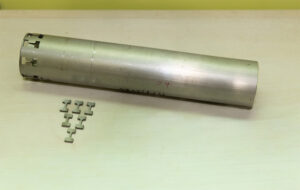
Beyond scientific excellence, the project has the potential to transform India’s manufacturing landscape. Once commercialised, the alloy could enable domestic production of advanced aluminium components, reducing imports while enhancing fuel efficiency, lowering manufacturing costs, conserving materials and cutting carbon emissions across multiple industries.
Speaking about the road ahead, Sagar Kumar Deb said: “The immediate goal is to complete industrial-scale validation of the alloy for cold-drawn tubes, secure the complete patent, and transfer the technology to the Indian aluminium industry.”
Reflecting on his achievement, Deb added: “I hope my journey inspires more students from Northeast India and other underrepresented regions of our country to pursue advanced scientific research despite resource and financial constraints.”