NE DEFENCE BUREAU
NEW DELHI, AUG 6
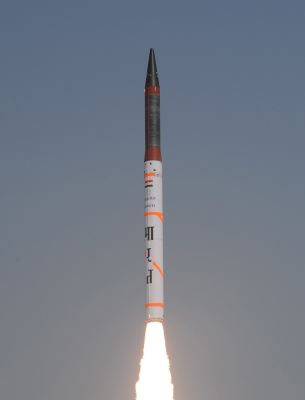
India on Thursday successfully carried out the user trial of its nuclear-capable Agni-4 Medium Range Ballistic Missile (MRBM) from the Integrated Test Range (ITR), Chandipur, off the Odisha coast, marking another significant milestone in the country’s strategic missile programme. The launch was conducted under the supervision of the Strategic Forces Command (SFC) and successfully validated all operational and technical parameters.
The successful test reinforces India’s credible minimum nuclear deterrence and demonstrates the reliability and operational readiness of one of the country’s most important strategic missile systems amid a rapidly evolving regional security environment.
Key Highlights
- Missile: Agni-4 (Medium Range Ballistic Missile)
- Launch Site: Integrated Test Range (ITR), Chandipur, Odisha
- Conducted by: Strategic Forces Command
- Developer: Defence Research and Development Organisation (DRDO)
- Range: Around 4,000 km
- Propulsion: Two-stage solid-fuel missile
- Warhead: Capable of carrying conventional and nuclear payloads
- Purpose: User trial to validate operational readiness
- Result: Mission successfully met all technical and operational objectives.
What Makes Agni-4 Important?
The Agni-4 bridges the capability gap between the shorter-range Agni-II and the longer-range Agni-V, providing India with the ability to strike strategic targets across much of Asia.
With a strike range of nearly 4,000 kilometres, the missile can reach critical strategic locations while remaining deployable on a road-mobile launcher, enhancing survivability and operational flexibility. The latest test confirms that the missile continues to meet the stringent requirements of the Strategic Forces Command.
Advanced Technologies
Agni-4 incorporates several advanced indigenous technologies, including:
- Ring Laser Gyroscope-based inertial navigation
- High-performance onboard computer
- Composite rocket motor
- Advanced avionics
- Highly accurate guidance and control systems
- Re-entry heat shield capable of withstanding extremely high temperatures during atmospheric re-entry.
These technologies significantly improve the missile’s precision, reliability and survivability.
Why the Test Matters
The successful launch comes at a time of heightened geopolitical tensions in the Indo-Pacific and West Asia.
Defence experts say the test:
- Strengthens India’s long-range precision strike capability.
- Reinforces the country’s nuclear deterrence posture.
- Demonstrates the operational readiness of the Strategic Forces Command.
- Highlights the maturity of India’s indigenous missile development programme led by DRDO.
- Sends a message of sustained strategic preparedness.
Agni Missile Family
India’s Agni series forms the backbone of its strategic missile force.
| Missile | Approximate Range |
|---|---|
| Agni-I | 700–900 km |
| Agni-II | 2,000 km |
| Agni-III | 3,000+ km |
| Agni-IV | 4,000 km |
| Agni-V | 5,000+ km |
Technical Specifications of Agni-4
- Type: Medium Range Ballistic Missile (MRBM)
- Range: Approximately 4,000 km
- Length: Around 20 metres
- Launch Weight: Around 17 tonnes
- Stages: Two-stage solid propellant
- Launch Platform: Road-mobile launcher
- Payload: About 1 tonne (conventional or nuclear)
- Guidance: Advanced inertial navigation with high-accuracy systems
- Role: Strategic nuclear deterrence.
Strategic Significance
The Agni-4 is an integral component of India’s credible minimum deterrence doctrine. Positioned between the Agni-III and Agni-V in terms of range, it offers the armed forces greater operational flexibility and strengthens India’s second-strike capability as part of its nuclear triad. The latest successful user trial further confirms the missile’s operational reliability and readiness for deployment.