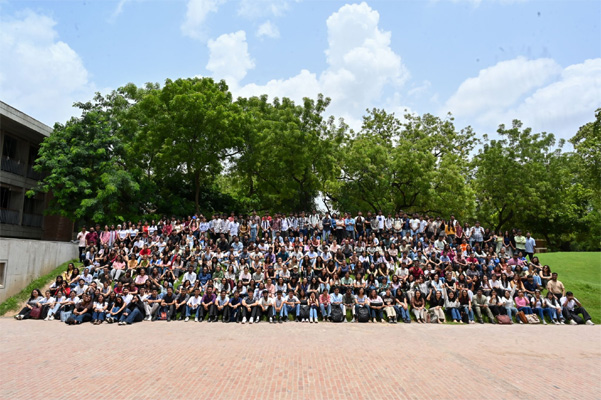

- Lawyers, archaeologists, sociologists and engineers join architects and designers in CEPT University’s 2026 postgraduate cohort
- About 470 students from 25 States and Union Territories enter 17 postgraduate programmes across five Faculties
- Women account for 57% of the incoming cohort, including traditionally male-dominated fields such as structural engineering and construction management
- More than 200 institutions contribute students, underscoring CEPT’s expanding national footprint in postgraduate education
- New MBA in Real Estate attracts its first cohort from an unusually diverse academic spectrum
NE EDUCATION BUREAU
AHMEDABAD, AUG 8
Who gets to shape a city—the architect who designs it, the engineer who builds it, the lawyer who regulates it, the sociologist who understands its people, or the archaeologist who protects its past? CEPT University’s latest postgraduate cohort suggests the answer is increasingly: all of them.
With about 470 students enrolling in 17 postgraduate programmes across its five Faculties—Architecture, Planning, Design, Management and Technology—the 2026 cohort of CEPT University is reflecting a significant broadening of the academic backgrounds feeding into India’s built-environment ecosystem.
The incoming students come from 25 States and Union Territories and more than 200 institutions, extending CEPT’s national footprint while revealing an increasingly interdisciplinary appetite for postgraduate education in architecture, planning, design, technology, management and urban development.
Gujarat and Maharashtra remain the two largest contributors, together accounting for 40% of the cohort. But the geographical spread extends well beyond the western region, with students from Tamil Nadu, Karnataka, Kerala and Telangana, as well as Assam, Manipur, Tripura and Jammu and Kashmir.
The numbers point to a larger transformation: the built environment is no longer being viewed as the exclusive preserve of architects and engineers. Increasingly, professionals trained in law, sociology, economics, geography, archaeology and other disciplines are entering fields that determine how cities grow, how infrastructure is managed and how communities interact with their surroundings.
Women strengthen their presence across the spectrum
Women constitute 57% of the incoming postgraduate cohort, continuing a multi-year trend of women forming a majority among CEPT’s postgraduate students.
Significantly, the trend is also visible in programmes that have traditionally attracted more male students, including Structural Engineering Design, Construction Engineering and Management, and Urban Planning.
The shift is significant not merely as an enrolment statistic but as an indication of a changing talent profile in sectors that will increasingly determine India’s infrastructure and urban future.
Planning remains the biggest draw
Among individual programmes, the Master’s in Planning programmes attracted the largest enrolment, accounting for more than a fifth of the incoming cohort.
They were followed by the Master’s in Construction Engineering and Management and the Master’s in Urban Design.
The enrolment pattern points towards continuing student interest in the complex challenges confronting India’s rapidly expanding cities—from urban infrastructure and mobility to land use, housing, construction and sustainable development.
CEPT’s two specialised MBA programmes—the MBA in Real Estate and the MBA in Urban Management—also underline the growing demand for management education tailored to the built environment.
Real estate classroom gets an unconventional makeover
The most striking example of this interdisciplinary shift is CEPT’s newest academic offering, the MBA in Real Estate, launched in January 2026.
Its inaugural cohort brings together an unusually wide range of academic backgrounds, including an archaeologist, lawyers, architects, designers and civil engineers.
That mix offers a glimpse of how the real-estate sector itself is evolving. Beyond construction and property transactions, the sector increasingly intersects with heritage, regulation, design, urban planning, finance, technology and community development.
The decade-old Master’s in Urban Management, now titled MBA in Urban Management, continues its focus on preparing professionals for careers spanning urban infrastructure, policy and governance.
Its latest cohort similarly cuts across architecture, planning, civil and mechanical engineering and interior design, reinforcing the importance of multidisciplinary thinking in managing increasingly complex urban systems.
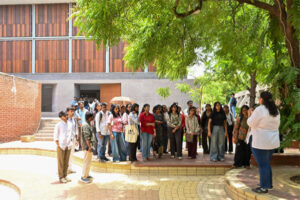
A national classroom for India’s urban future
The diversity of CEPT’s 2026 postgraduate cohort is ultimately about more than where students come from or what they studied as undergraduates. It reflects a widening recognition that the challenges of India’s cities cannot be solved from a single professional lens.
With more than 11,000 alumni worldwide, CEPT University continues to build its legacy of preparing professionals for the built environment through academic rigour, ethical practice and creative inquiry.
The new cohort, meanwhile, brings something equally valuable to that legacy: a broader set of perspectives.
As architects sit alongside lawyers, engineers alongside sociologists and designers alongside archaeologists, the classroom itself is becoming a laboratory for the kind of cross-disciplinary thinking that India’s rapidly changing cities increasingly demand.