HARI IYER
What if, in our rush to give the next generation everything modern, we accidentally leave them with nothing ancient to remember? In an age when a family photograph can live forever in the cloud but a centuries-old ritual can disappear within a generation, preserving tradition is no longer simply about protecting the past—it is about giving the future an identity.

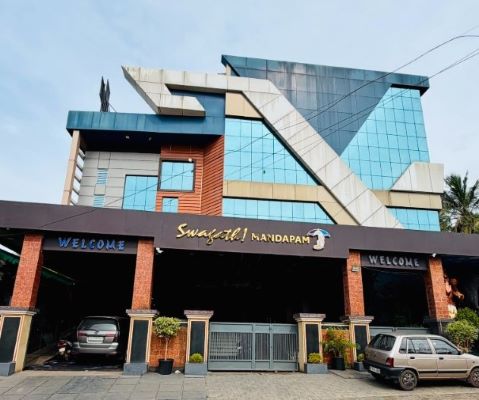
As Onam approaches, with Kerala once again preparing to celebrate its rich cultural inheritance through family gatherings, feasts, rituals and community traditions, the story of Swagath! Kalyana Mandapam at Puduppariyaram, Palakkad, offers a thought-provoking lesson.
- As Onam approaches, a Palakkad wedding destination offers a larger lesson: traditions survive only when the next generation understands their meaning
- Swagath! Kalyana Mandapam’s 25-year journey shows how rituals, food, family and hospitality can remain relevant without becoming museum pieces
- From sattvic feasts on banana leaves to sacred ceremonies, every tradition carries a story of health, community and spiritual continuity
- Kalpathy’s living heritage offers younger generations a window into an India where culture was lived every day—not merely displayed on special occasions
- In an era of digital invitations, virtual celebrations and instant gratification, traditional ceremonies can become powerful bridges between generations
- Navjeevan Express presents this eye-opening Onam-season feature to encourage families, young readers and culture enthusiasts to rediscover the significance behind inherited traditions
For 25 years, the venue has built its identity around traditional Brahmin weddings and celebrations. But its larger significance lies in what such spaces can do: keep rituals alive by allowing younger generations to experience them rather than merely read about them.
A wedding, after all, is not just an event. It is a living classroom where children see grandparents perform rituals they once learnt from their own elders; where sacred chants, music, food, attire and customs become part of memory; and where a family discovers that tradition can coexist comfortably with contemporary life.
When a ritual becomes a bridge between generations
There is a particular silence before the muhurtham at a traditional Brahmin wedding. The nadaswaram pauses. The priest continues his chants. Three generations may sit together in one frame.
For a few moments, the digital world seems to disappear.
What remains is the ritual, the family and the feeling that something timeless is unfolding.
That is the experience Swagath! Kalyana Mandapam has sought to preserve since 1999—not by turning tradition into a spectacle, but by understanding what traditional celebrations require and creating a setting where their significance can be experienced.
At the entrance stands a 15-foot Hanuman Vigraham, offering an immediate sense of auspiciousness. Inside the main wedding hall, a 20-foot depiction of Lord Vishnu reclining on Aadisheshan in Anantashayanam presides over the space.
For a younger generation accustomed to screens and virtual experiences, such surroundings can offer something fundamentally different: an opportunity to understand that symbols are not merely decorative. They carry stories, beliefs and collective memory.
Why tradition must be explained, not merely preserved
The greatest danger to tradition may not be modernisation itself. It is meaninglessness.
A ritual survives when a child understands why it is performed. A traditional meal becomes meaningful when a young person learns why it is served in a particular manner. A temple festival becomes more than a colourful procession when its history is understood.
That is why traditional spaces and family celebrations have a role extending beyond hospitality. They can become informal classrooms in which culture is transmitted naturally—from grandparents to parents, parents to children and one generation to the next.
The challenge before families today is therefore not to reject technology or modern lifestyles, but to ensure that convenience does not erase cultural memory.
The banana leaf has a story too
Consider the traditional wedding feast.
At Swagath!, meals are rooted in a sattvic approach, with food prepared without meat, onion, garlic and artificial stimulants. Pure ghee sweets are prepared in-house, while sambar and payasam form part of the traditional spread.
The meal is served on banana leaves, connecting food with ritual and hospitality.
The larger lesson is worth carrying beyond the wedding hall. Traditional food practices often encode ideas about seasonality, preparation, sharing and moderation. When younger people participate in such meals, they inherit not just recipes but memories.
In a world increasingly concerned with wellness and mindful living, some of these traditions deserve to be examined with curiosity rather than dismissed as old-fashioned.
A house for life’s sacred milestones
Swagath! is designed not only for weddings but for a range of traditional milestones: Thottil, the sacred cradle ceremony welcoming a new life; Upanayanam, the thread ceremony; Vidyarambham, marking a child’s first letters; engagements; milestone birthdays; wedding anniversaries; Sashtiapthapoorthi, marking 60 years; Sathabhishekam, celebrating the completion of 80 years; housewarmings and family reunions.
Each represents a different stage of life.
In an increasingly individualistic age, such ceremonies remind families that life is not merely a series of personal achievements. It is also a journey shared with parents, grandparents, children, relatives and the wider community.
That continuity is precisely what younger generations risk losing if traditional ceremonies become reduced to photographs and social-media posts.
When a wedding becomes a cultural journey
Swagath! offers a main air-conditioned banquet hall with seating for 1,000 guests and floating capacity of 1,500, besides Maruthi Hall for 325 and a conference hall for 200. Accommodation includes 37 air-conditioned rooms attached to the mandapam, a private villa opposite that accommodates 25 and two residential flats in Kalpathy that can house 18 each.
The venue also coordinates transportation from Coimbatore, Calicut and Cochin airports and Palakkad railway station, along with family commuting arrangements.
For families travelling from outside Kerala, including NRIs reconnecting with their roots, the experience can extend beyond the ceremony to include Kalpathy heritage village, Sree Viswanatha Swamy Temple, Malampuzha Gardens and Dam, Palakkad Fort and the Western Ghats.
That creates another opportunity to teach culture: a celebration can become a journey through the geography, architecture, history and traditions of a region.
Kalpathi: Where heritage is still alive
Perhaps the most powerful reminder lies just minutes away.
Kalpathy, Kerala’s first declared heritage village, carries the legacy of Tamil Brahmin communities who settled there after migrating from Thanjavur in the 1790s. Its agraharams, temples, streets and traditional practices preserve a distinctive cultural landscape.
The Sree Viswanatha Swamy Temple, built in 1425 AD and associated with the Kashi Viswanatha tradition, stands at the heart of this heritage.
The old saying—“Half of Kashi is in Kalpathy”—captures the spiritual importance attached to the village.
And every November, the Kalpathi Ratholsavam brings enormous decorated temple chariots through its ancient streets, transforming the village into the setting for one of Kerala’s most magnificent cultural celebrations.
For a young person, witnessing such a festival can accomplish something that no textbook can: it can make history tangible.
‘I want every detail to be thought of’
Hari Iyer, Founder, Swagath! Kalyana Mandapam, believes the preservation of tradition requires both respect and execution.
“I have worked across India and the Gulf for many years. What I saw everywhere was families compromising on their traditions because the right space did not exist. That is why I built Swagath!. When a family walks in here, I want them to feel that every detail has been thought of, every ritual will be respected, every guest will be looked after. A wedding happens once. It must be done with full heart.”
That philosophy speaks to a larger cultural truth.
Tradition cannot be preserved simply by telling young people to respect it. They must be allowed to experience it, question it, understand it and eventually make it their own.
Onam: A time to ask what we are passing on
Onam is an especially appropriate moment for that reflection.
The festival is celebrated with food, flowers, family gatherings, cultural performances and a powerful sense of community. Yet its deeper value lies in the stories, values and collective memory that travel from one generation to another.
In today’s digital age, young people are not disconnected from the world; they are connected to several worlds simultaneously. The challenge is to ensure that their own cultural world does not become the one they know least about.
Tradition need not compete with technology. It needs to be given meaning.
A child who understands why a ritual is performed is more likely to carry it forward. A young person who knows the story behind a festival is more likely to value it. A family that explains its customs rather than merely enforcing them gives tradition a chance to evolve without disappearing.
And perhaps that is the real lesson of places such as Swagath! and heritage landscapes such as Kalpathy: the past remains alive not because we preserve it behind glass, but because we continue to live it.
A message from Navjeevan Express
“With Onam Festival coming around, Navjeevan Express presents this eye-opening article for the benefit of all stakeholders, especially young generation and culture vultures. We solicit articles from our readers for the betterment of the society.”
— R Arivanantham, Executive Editor, Navjeevan Express
(Hari Iyer, Founder of Swagath Kalyana Mandapam, Palakkad, brings years of experience across India and the Gulf and writes from a deep engagement with traditional celebrations, hospitality and the preservation of cultural practices for future generations. He can be contacted – Mobile: 98473 76784 and 0491 296 3737 Mail: hariswagathcatering@gmail.com) Website: https://swagathcatering.com/