R ARIVANANTHAM
CHENNAI, AUG 12
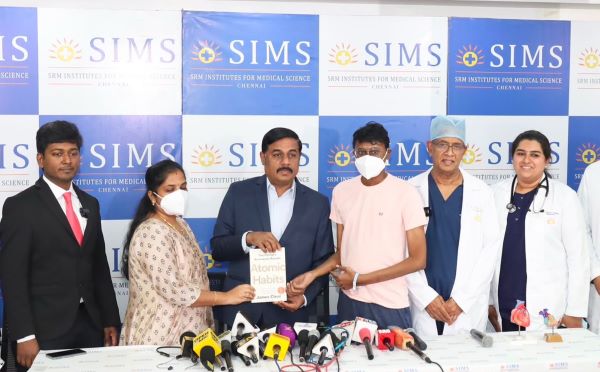
For SIMS Hospital, a new heartbeat has marked a historic beginning. In its first-ever heart transplantation, SIMS Hospital has given a new lease of life to a 31-year-old patient from Puducherry suffering from end-stage heart failure caused by inherited dilated cardiomyopathy.
- Hospital achieves landmark first heart transplantation with donor heart reaching Chennai in just 20 minutes
- 31-year-old Puducherry patient receives life-saving transplant after inherited dilated cardiomyopathy progresses to end-stage heart failure
- Four-hour surgery follows cardiac arrest and meticulous multidisciplinary preparation
- Dr Bashi calls for wider legal validation of Donation after Circulatory Death to expand India’s heart-donor pool
- SIMS Chairman Dr Ravi Pachamuthu to take DCD proposal to Government to help thousands awaiting transplants
The landmark transplant was made possible when a heart from a 23-year-old brain-dead donor from a Chennai-based hospital became available through the State’s organ-sharing network within 4 days of registration and was transported to SIMS Hospital in just 20 minutes—a race against time that culminated in a successful four-hour transplantation.
The achievement marks a significant milestone in SIMS Hospital’s journey in advanced cardiac care while simultaneously spotlighting the urgent need to expand India’s heart-donor pool.
A first that opens a new cardiac chapter
The patient had developed severe breathing difficulties earlier this year, eventually finding it difficult to lie flat and carry out routine activities. Investigations revealed severe left ventricular dysfunction, while cardiac MRI confirmed dilated cardiomyopathy (DCM) with heart failure.
The condition, inherited from his father who is also undergoing treatment, had progressively weakened the patient’s heart. During hospitalisation, he suffered a cardiac arrest but was successfully resuscitated and stabilised.
With transplantation identified as the best treatment option, the patient was placed on the transplant waiting list while the team searched for a compatible donor.
When a suitable donor heart became available, the transplant team moved swiftly. The donor hospital was reached early in the morning and the precious organ was brought to SIMS within 20 minutes.
Meanwhile, another surgical team had already begun removing the patient’s diseased heart and placed him on cardiopulmonary bypass. The transplant was completed in approximately four hours, followed by seven days of intensive-care monitoring.
Dr Bashi, Chief Cardiac Surgeon and Director, ICAD, led the transplant team comprising Dr Rajeev Thilak Chellasamy, Heart Transplant Surgeon; Dr Mohammed Ibrahim, Cardiac Surgeon; Dr Shilpa Menon, Heart Failure Cardiologist; Dr Aju Jacob, Chief Cardiac Anaesthetist; Dr Arunkumar, Cardiac Anaesthetist; and Dr Kishore, Cardiac Anaesthetist.
The landmark procedure also prompted Dr Bashi to call for policy intervention to widen the legal framework for Donation after Circulatory Death (DCD) heart donation, which could potentially provide additional opportunities for organ donation when brain-death criteria are not met.
Talking to navjeevanexpress.com, SIMS Hospital Chairman Dr Ravi Pachamuthu said the management would take the doctors’ suggestion on DCD forward with the Government, noting its potential to give a second chance to thousands of heart patients awaiting transplantation.
Precision After a Cardiac Arrest
Dr Rajeev Thilak Chellasamy said the patient’s cardiac arrest during hospitalisation made meticulous planning essential.
“Since the patient had suffered a cardiac arrest during hospitalisation, we meticulously planned every aspect of the transplant. Both the transportation of the donor heart and the transplant surgery were carried out with utmost precision and care. Following the surgery, the patient will require close monitoring for the next six months, as the risk of organ rejection is highest during this period.”
Dr Shilpa Menon stressed that advanced heart-failure management extends beyond transplantation.
“The management of advanced heart failure extends far beyond transplantation. Every patient undergoes a comprehensive evaluation to determine the most appropriate treatment, which may include optimized medical therapy, device-based treatment, mechanical circulatory support or heart transplantation. A multidisciplinary approach is essential to achieving the best possible outcomes.”