- New Policy Research and Analytics for Governance initiative seeks to bridge the gap between technology, evidence and real-world policymaking
- Raj Kumar, J P Gupta and experts call for granular data, grounded research and policy experiments before scaling interventions
- Panel explores AI-powered analytics, smart-meter data, integrated governance datasets and outcome-based evaluation
- Proposed Gujarat Policy Innovation Lab and Data & Governance Observatory could create new government–academia collaboration models
NE EDUCATION BUREAU
GANDHINAGAR, AUG 14
What happens when an engineering institute stops asking only “What can technology do?” and starts asking the more consequential question—“What should governance do with it?”
That question took centre stage at IIT Gandhinagar, which has launched the Policy Research and Analytics for Governance (PRAG, प्राग) Initiative, bringing technology, public policy and governance onto a common platform to address challenges of effective governance and sustainable development.
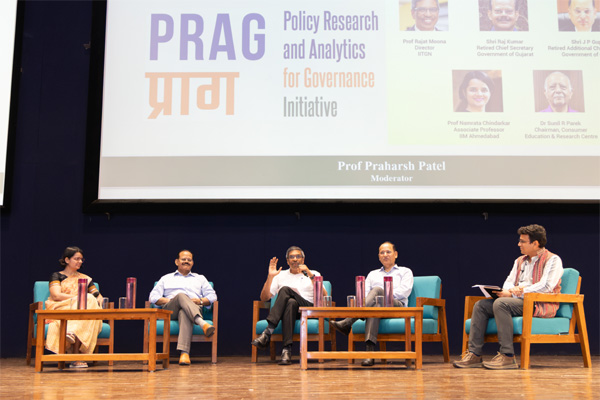
Launched on August 11, 2026, as part of IITGN’s Foundation Programme, the initiative seeks to create a bridge between technical expertise, evidence-based research, government experience and policy implementation. Its launch featured a high-level panel discussion on “The Role of Technology Institute in Public Policy and Governance”, bringing together former senior government officials, academics and professionals.
The central message emerging from the discussion was clear: technology can improve governance only when data is translated into evidence, evidence into policy and policy into measurable outcomes on the ground.
From algorithms to administration
Prof Rajat Moona, Director, IIT Gandhinagar, underlined the role of technology institutes in preparing students to address problems that do not fit neatly into a single discipline. He emphasised the importance of encouraging students to take knowledge beyond the classroom and apply it to wider social and national challenges.
Prof Praharsh M Patel and Prof Deepak Singhania are coordinating the PRAG Initiative. Prof Deepak introduced the initiative, stressing the need for a platform where technical expertise can engage more closely with the realities of policymaking and administration. Prof Praharsh moderated the panel, which examined research, education and experiential learning as well as opportunities for deeper engagement with government and other stakeholders.
The panel featured Raj Kumar, former Chief Secretary, Government of Gujarat; J P Gupta, former Additional Chief Secretary, Government of Gujarat; Prof Namrata Chindarkar, JSW School of Public Policy, IIM Ahmedabad; Prof Rajat Moona; and Dr Sunil R Parekh, Chairman, Consumer Education and Research Centre (CERC) and Member, Senate, IITGN. Dr Parekh participated through a recorded video message.
Raj Kumar’s call: Stop governing by averages
Taking up the question of evidence-based policymaking, Raj Kumar highlighted the challenge of “bounded rationality”—the reality that policymakers often have to take decisions with limited information, time and cognitive capacity.
Using the example of free or highly subsidised electricity for farmers, he pointed to the unintended consequences that can emerge from well-intentioned policies, including groundwater depletion, distorted incentives and financial pressure on power distribution companies.
“The most important problem can be faced in order to learning stages evidence-based policy,” he said, underscoring the need for stronger evidence and analysis throughout policy design and implementation.
He also cautioned against relying excessively on district- or state-level averages.
“Conditions can vary dramatically within the same administrative area,” he said, citing crop insurance as an example. Rainfall and crop damage can vary significantly even within the same district, while a single aggregate figure may conceal those differences.
Better local-level and granular data, he suggested, can enable policymakers to design more targeted interventions and deploy public resources more effectively.
J P Gupta: Let smart meters become smart policy tools
J P Gupta shifted the discussion towards the practical use of data in policymaking, stressing that the value of data depends not simply on its availability but on whether the right data is identified, analysed and interpreted in accordance with the objective of a policy.
He illustrated the potential through the electricity sector. Granular consumption data from smart meters, when combined with AI-based models, could help identify patterns in electricity demand and align consumption more effectively with periods of high solar generation.
Such data-driven interventions could encourage consumers to shift their electricity use, improve utilisation of renewable energy and help address demand-supply challenges.
The proposition reflects the broader potential of data analytics to support public-sector planning, policy evaluation, resource allocation and predictive decision-making.
Prof Chindarkar: India has data—but is it being used enough?
Prof Namrata Chindarkar focused on another crucial dimension of the data revolution: how existing data is accessed and used.
India already generates vast quantities of high-quality data, she noted, but its value can increase substantially when relevant datasets are responsibly made available to researchers and others capable of applying them to important policy questions.
She also stressed the need for policy, technology and public-policy research to inform one another, particularly in sectors such as energy, healthcare and infrastructure.
The point is significant: collecting more data alone does not guarantee better governance. The real dividend comes when data can be responsibly integrated, analysed and converted into insights that policymakers can act upon.
Prof Moona: A number without context can mislead
Prof Moona illustrated the issue through engineering concepts, where the same numerical measure can have very different implications depending on the circumstances.
Using temperature as an example, he noted that 45°C in summer in one place may not mean exactly the same thing in another, just as 45°C sustained for two minutes is fundamentally different from the same temperature continuing for an hour.
The same principle, he suggested, applies to public policy.
A policy cannot be judged merely by a single number such as the amount of money spent. What matters is the impact created over time and the lives affected.
It is a distinction between measuring inputs and measuring outcomes—and one that could become central to the PRAG Initiative’s research agenda.
Dr Parekh: Test policies before taking them to scale
Taking the discussion from policy research to implementation, Dr Sunil R Parekh called for greater emphasis on ground-level experimentation and policy pilots before interventions are scaled up.
He proposed establishing a Gujarat Policy Innovation Lab, through which IIT Gandhinagar and the state government could jointly design pilot interventions, establish baselines, measure outcomes and determine which approaches should be scaled up—and which should be discontinued.
“There is no shortage of good policies in Gujarat, but the bigger question remains what actually works on the ground, and how effectively,” he said.
Dr Parekh also proposed a Gujarat Data and Governance Observatory to bring together administrative data spanning sectors such as health, education, agriculture, water and social welfare.
Much of this information currently remains within departmental silos, he noted. Integrating, analysing and visualising such data could help governments move towards evidence-led decision-making and measurable outcomes rather than an input-focused approach.
Raj Kumar: Governance has no single-variable solution
Towards the close of the discussion, Raj Kumar returned to the need to view governance as a connected system, rather than a collection of isolated policy decisions.
He cited the transition from polluting autorickshaws to cleaner vehicles to illustrate the challenge. Simply removing older vehicles could affect drivers’ livelihoods and create pressure elsewhere on welfare systems.
A more practical solution, he suggested, could combine environmental objectives with financial support enabling drivers to transition to electric vehicles.
“There is no absolute right or wrong solution. We need to figure out what is the best solution within those constraints,” he said.
That may well be the defining philosophy behind PRAG: policy is rarely a clean equation with one correct answer; it is an exercise in balancing competing realities with the best available evidence.
Technology needs a reality check
The discussions surrounding the launch converged on one powerful proposition: technology should not replace human judgement in governance—it should make that judgement better informed.
For IIT Gandhinagar, PRAG could become a platform where researchers, students, government officials, policymakers and practitioners jointly examine complex public problems, test solutions, learn from failures and build evidence before recommending scale.
In an era of AI, big data and digital governance, the most visionary policy may therefore not be the one that uses the most technology.
It may be the one that asks the right question, finds the right evidence and produces the right outcome for the citizen.