R ARIVANANTHAM
CHENNAI, AUG 14
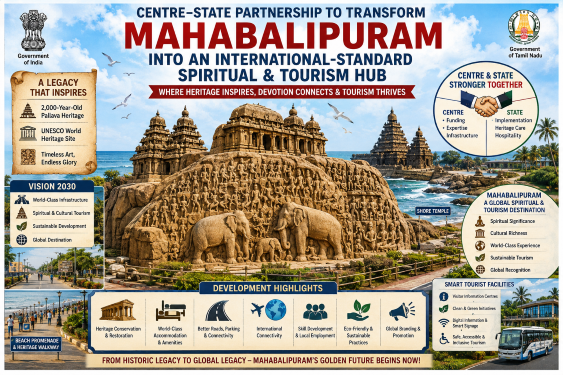
Where the waves of the Bay of Bengal meet the timeless granite of the Pallavas, Tamil Nadu is preparing to give Mahabalipuram a new role—not merely as a monument on the tourist map, but as a global gateway where spirituality, history, culture and contemporary tourism converge.
- Historic Pallava town to be developed as an international-standard spiritual and tourism hub in Centre–State partnership
- Union Finance Minister Nirmala Sitharaman announces ₹200-crore allocation; another ₹60 crore earmarked for river tourism in Tamil Nadu
- Integrated pilgrimage circuit to connect Velankanni, Nagore and Thirukadaiyur in a multi-faith tourism push
- Medical tourism, agri-tourism and hill trekking emerge as new pillars of Tamil Nadu’s diversified tourism strategy
- State trains multilingual guides to turn local storytellers into a bridge between global visitors and Tamil Nadu’s living heritage
- Government targets a global tourism footprint built around the State’s 2,000–3,000-year-old cultural, spiritual and archaeological legacy
Tamil Nadu Tourism Minister S Rajesh Kumar on Friday announced a ₹200-crore allocation for transforming the historic coastal town of Mahabalipuram into an international-standard spiritual and tourism hub, in collaboration with the Union Government.
The announcement adds a fresh dimension to efforts to position the UNESCO World Heritage-listed Group of Monuments at Mahabalipuram as a destination capable of attracting both heritage enthusiasts and spiritually inclined travellers from across the world. The monuments—including the Shore Temple and the celebrated rock-cut and monolithic structures—represent the remarkable architectural legacy of the Pallava period.
₹200 crore for a heritage powerhouse
Addressing a press conference in Chennai, Kumar said Union Finance Minister Nirmala Sitharaman had announced the major allocation for Mahabalipuram, while around ₹60 crore has separately been earmarked for river tourism projects in Tamil Nadu.
The Mahabalipuram investment is envisioned as a Centre–State partnership aimed at strengthening infrastructure and visitor facilities while preserving the town’s extraordinary archaeological and cultural character.
The move comes against the backdrop of Tamil Nadu’s growing emphasis on heritage-led tourism. Mahabalipuram’s monuments, carved largely from granite and dating to the Pallava era, are recognised globally for their architectural and artistic significance.
Pilgrimage circuit to weave faiths together
The State is also preparing a major integrated pilgrimage tourism circuit linking prominent spiritual destinations, including Velankanni, Nagore and Thirukadaiyur, with funds being designated for the initiative.
The proposed circuit seeks to turn Tamil Nadu’s extraordinary spiritual geography into a connected tourism experience, bringing together destinations associated with different religious traditions.
The initiative could give travellers a broader understanding of Tamil Nadu’s pluralistic spiritual heritage—where temples, churches, mosques and centuries-old traditions coexist within a remarkably compact cultural landscape.
Tourism beyond the conventional
Kumar underlined the State’s intention to diversify tourism beyond conventional sightseeing.
“Tourism is not confined to just a single sector,” the Minister said.
The government is accordingly expanding its tourism canvas to include medical tourism, agri-tourism and hill trekking, creating new avenues for visitors while opening opportunities for local communities and enterprises.
District-wise details of the proposed projects and allocations will be unveiled during the Tourism Department’s demand for grants in the Tamil Nadu Legislative Assembly.
When local guides speak the world’s language
In another significant initiative aimed at international travellers, the Tourism Department is training and certifying local tour guides in international languages.
The objective is to create a cadre of professionally trained guides who can narrate Tamil Nadu’s history, architecture, traditions and destinations directly to overseas visitors while acting as a crucial link between tourists and the Tourism Department.
This approach could transform local knowledge into a tourism asset—putting residents themselves at the centre of the visitor experience.
2,000 years of living heritage
Kumar said Tamil Nadu’s tourism vision is rooted not simply in monuments but in its living culture and archaeological heritage stretching back 2,000 to 3,000 years.
That positioning gives the State a formidable tourism proposition: ancient architecture alongside vibrant festivals, cuisine, classical arts, spirituality, traditional occupations and contemporary experiences.
For Mahabalipuram, the proposed ₹200-crore push could therefore mark a pivotal moment—from a magnificent monument destination to an integrated global tourism experience where the past is not preserved behind glass, but experienced amid the living rhythms of Tamil culture.