- Anupriya Patel calls for a national AI ecosystem as India seeks to turn its pharma prowess into a research and innovation powerhouse
- ‘AI must complement, not replace, human clinical judgement’; Minister urges government, academia, industry, startups and tech companies to collaborate across the AI lifecycle
- ₹5,000-crore PRIP scheme, digital health foundations and AI capabilities to propel innovation-led pharma growth
- IIMA Healthcare Summit 2026 brings 500+ healthcare leaders together to debate AI, policy, diagnostics, pharma, talent and equitable access
- India Pharma Archives launched to preserve 125 years of pharma history; ‘From Labs to Jabs’ documents the nation’s COVID-19 vaccine journey
- Industry leaders call for responsible AI, stronger research capabilities, ethical adoption and partnerships to build a healthier India by 2047
R MANICKAVASAGAM
AHMEDABAD, AUG 22
India’s healthcare transformation may no longer be a question of whether artificial intelligence will change the sector, but whether the country can harness it fast enough—and responsibly enough—to transform itself from the world’s pharmacy into its laboratory.
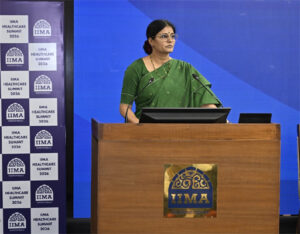
That larger challenge took centre stage at the third IIMA Healthcare Summit 2026 in Ahmedabad on Saturday, where Union Minister of State for Health & Family Welfare and Chemicals & Fertilisers Anupriya Patel issued a powerful call for India to move beyond its established pharmaceutical identity and become a global hub for healthcare research, innovation and AI-led solutions.
“The Indian Pharmaceutical Industry must move beyond being ‘Pharmacy of the World’ to become the ‘Laboratory of the World’,” Patel said, urging government, industry, academia, research institutions, healthcare providers, technology companies and startups to work together to build a national AI ecosystem.
The summit, organised by the Indian Institute of Management Ahmedabad (IIMA) around the theme “Advancing AI in Healthcare”, brought together more than 500 industry leaders, policymakers, healthcare professionals, academicians, technologists and other stakeholders to examine how AI can reshape India’s healthcare landscape. IIMA says the summit is aligned with the Government of India’s IndiaAI Mission and the vision of a healthy, developed India by 2047.
AI as the force multiplier for universal healthcare
Delivering the keynote address as Chief Guest, Patel described AI as a potential “force multiplier” for a country confronted by enormous population, geographical and healthcare-delivery challenges.
“With a vast population and geographical diversity in India, the ambitious goal of attaining universal health is not an easy target. Hence, technology adoption is one of our priorities to address challenges, and AI comes as a force multiplier in healthcare management and delivery,” she said.
AI, she pointed out, could enable doctors, scientists and researchers to process vast quantities of information and help ensure that patients receive the right treatment at the right time, including those living in remote areas.
But technological acceleration, she cautioned, cannot come at the expense of safety.
“We also have to remember that we need to move towards safe and responsible AI,” Patel said.
She highlighted the potential of AI in drug discovery, personalised treatment, screening, clinical decision support, disease surveillance, risk prediction, remote monitoring and personalised follow-up.
Current reporting from the summit also highlighted Patel’s warning that “AI must complement, rather than replace, human clinical judgement”, placing human oversight and patient privacy at the heart of AI adoption.
From generic strength to innovation leadership
Patel linked the AI agenda directly to India’s ambition to evolve from a predominantly cost-competitive pharmaceutical manufacturing base into an innovation-led global healthcare powerhouse.
She cited government initiatives including the ₹5,000-crore Promotion of Research and Innovation in Pharma-MedTech Sector (PRIP) scheme and the National Biopharma Mission as important mechanisms for strengthening research and connecting academic institutions with industry.
“The objective is very clear; we don’t want our pharma industry to just manufacture medicines which have been discovered elsewhere,” she said.
The next phase, she added, must be to build AI capabilities on India’s existing digital foundations, including the Ayushman Bharat Digital Mission, to create stronger and more responsive healthcare systems.
Patel also called for collaboration across the complete AI lifecycle—from identifying a healthcare problem and finding a solution to implementation, monitoring outcomes and scaling successful interventions.
“All key stakeholders, including the government, healthcare institutions, academia, tech companies, or startups, must collaborate across the entire AI lifecycle… to attain the goal of Universal Health Coverage,” she said.
Her call was for an AI-enabled healthcare system that is “not just innovative but responsible, not just advanced but inclusive, technology-driven but fully grounded in health priorities.”
IIMA positions AI at the heart of healthcare’s next chapter
Opening the summit, Prof. Bharat Bhasker, Director, IIMA, described healthcare as a rapidly expanding global industry and emphasised the transformative potential of AI and data analytics.
“With India being a globally prominent provider of generic drugs and vaccines and a hub for medical tourism, we stand at the forefront of a revolutionary transformation,” he said.
“Advanced technologies like AI and data analytics will play a crucial role in meeting this growing demand. Rapid integration of AI in healthcare promises improved diagnostics, personalised treatment, and enhanced patient care.”
He said IIMA was pleased to create a platform where healthcare leaders could explore innovative solutions and forge collaborations capable of propelling India towards a healthier future.
IIMA’s Centre for Management of Health Services (CMHS), which played a key role in organising the summit, also contributes to healthcare research and public-policy thought leadership. The institute has been strengthening its engagement at the intersection of healthcare and AI, including through its institutional AI capabilities.
‘Innovation and responsibility’ must travel together
Delivering the inaugural address, Pankaj Patel, Chairperson, IIMA Board of Governors and Chairperson, Zydus Lifesciences, said India stood at a pivotal point where healthcare innovation and responsibility must advance together.
He said AI could enhance patient outcomes, streamline healthcare operations and accelerate innovation in drug development, but stressed that the technology must be deployed ethically and effectively.
“We can lead this change by building robust research capabilities, harnessing the digital ecosystem, prioritising ethical practices and equitable access, and creating opportunities to collaborate for healthcare providers, tech innovators, and regulatory bodies,” Patel said.
Senior government officials Punya Salila Srivastava, Secretary, Ministry of Health & Family Welfare, and Manoj Joshi, Secretary, Department of Pharmaceuticals, also addressed the summit, outlining government initiatives and the evolving regulatory landscape.
Joshi highlighted the expanding use of AI across pharmaceuticals—from production and inventory to marketing, distribution and drug discovery. Current reporting said he also pointed to challenges involving capital, software licensing, computing capacity and specialised talent, while emphasising the potential of initiatives such as the IndiaAI Mission and National Biopharma Mission.
Two launches connect India’s healthcare future with its past
The summit also created a bridge between India’s healthcare heritage and its technology-driven future.
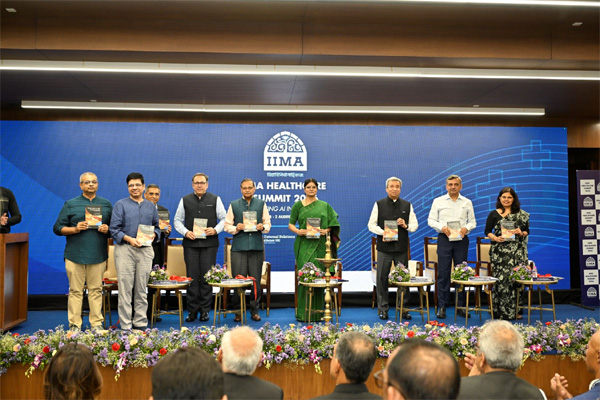
Patel launched the India Pharma Archives, a first-of-its-kind public digital memory initiative chronicling more than 125 years of the Indian pharmaceutical industry.
Patel also released “From Labs to Jabs”, documenting India’s COVID-19 vaccine-development and vaccination journey. The publication is co-authored by Prof. Rajesh Chandwani, Prof. Ranjan Kumar Ghosh and Vinita Sindhwani Satija. IIMA’s own records identify the work as From Labs to Jabs: Scaling up of Covid-19 Vaccination in India, examining the management lessons from the enormous national vaccination effort.
The dual launch was particularly symbolic: one initiative preserves where India’s pharmaceutical industry came from, while the other captures how the country mobilised science, manufacturing, institutions and logistics during one of the greatest health crises of modern times.
AI moves from discussion to organisational imperative
The summit then shifted from policy to implementation through two major panel discussions: “AI in Indian Healthcare – The Policy Imperatives for India @2047” and “Reimagining Healthcare Value Chain and Talent — How AI is Reshaping Diagnostics, Pharma, and Care Delivery.”
The conversations covered AI governance and ethics, healthcare economics, talent and leadership, equitable access, the architecture of integrated health systems and India’s potential role in the global healthcare ecosystem.
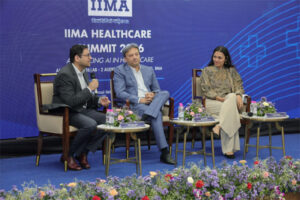
A fireside chat with Sharvil Patel, President, IPA and MD, Zydus Lifesciences, and Ameera Shah, Executive Chairperson, Metropolis Healthcare, moderated by Prof. Tarun Jain, IIMA, examined what it takes to build “AI-ready Healthcare Organisations.”
The summit also featured a Startups Showcase, spotlighting emerging healthcare enterprises using AI to tackle some of India’s most pressing health challenges.
From policy and research to diagnostics, drug discovery, patient care and startups, the message emerging from IIMA was unmistakable: AI is moving from the margins of healthcare to its operating core.
And if Patel’s challenge is achieved, India’s next global healthcare identity may not simply be the country that makes medicines for the world—but the country that invents what the world’s healthcare needs next.
Read also
125 years of innovation, enterprise and healing find a living digital home