- Bharat Discourses on Water @2047 brings policymakers, scientists, grassroots champions and young innovators together for a national water dialogue
- Padma Bhushan Anil Prakash Joshi calls for a mindset shift, warning that water security cannot be created through infrastructure alone
- Padma Shri Umashankar Pandey puts communities at the heart of India’s water future, urging people to reclaim ownership of local resources
- Traditional wisdom—from johads and baolis to kunds and rainwater harvesting—meets climate resilience, groundwater conservation and urban water security
NE ENVIRONMENT & CONSERVATION BUREAU
AHMEDABAD, AUG 22
India’s water crisis may ultimately be decided not in government offices or conference halls, but in the choices made by millions of citizens over every drop they use, conserve and replenish. That message resonated strongly in Ahmedabad on Saturday as water champions, policymakers, scientists and grassroots practitioners came together to ask a deceptively simple question: can India guarantee “Water for All” by 2047?
The answer emerging from the national conference “Water for All: Bharat Discourses on Water @2047” was unequivocal—the challenge demands not merely more infrastructure, but a fundamental transformation in public behaviour, community ownership and the way India values its most precious natural resource.
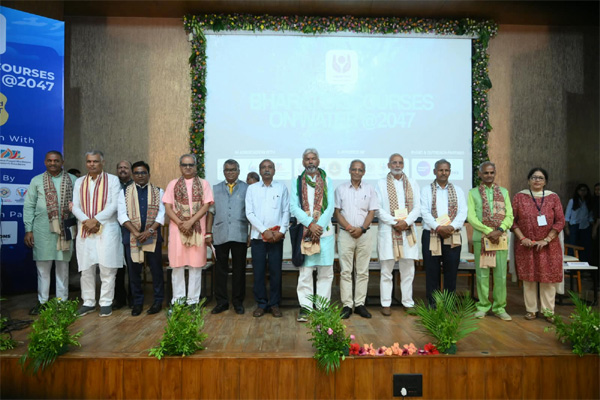
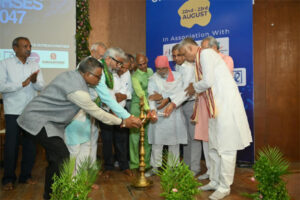
Hosted by Udgam Charitable Trust, in association with the Center for Water Peace (CWP), Dr Syama Prasad Mookerjee Research Foundation (SPMRF) and i-Hub, the conference at KCG Auditorium brought together policymakers, water experts, scientists, industry representatives, grassroots leaders and young innovators to deliberate on India’s water future.
‘Water security cannot be created through infrastructure alone’
Padma Bhushan Dr Anil Prakash Joshi struck the central chord of the deliberations by arguing that water must be understood not merely as a resource, but as the foundation of life, ecology and civilisation.
“The vision must be ‘Water for All’. But this can only become a reality when every individual understands their relationship with nature and takes responsibility for conserving every drop,” he said.
Joshi stressed that infrastructure alone cannot guarantee water security.
“Water security cannot be created through infrastructure alone; it requires a change in our mindset, lifestyle and relationship with our natural resources,” he said, calling for communities, institutions, governments and citizens to work together to ensure water availability for every generation.
His message placed the emphasis squarely on responsibility rather than dependency—a shift that experts increasingly see as essential as climate variability, groundwater depletion, urbanisation and rising demand intensify pressure on India’s water systems.
Villages and communities hold a vital key
Padma Shri Umashankar Pandey underlined the indispensable role of communities in building a water-secure India.
“The solution to India’s water challenges comes from every village. Every community and every citizen has a role to play,” he said.
When people take ownership of their local water resources, protect traditional systems and work collectively, conservation, he said, can become a movement rather than merely a government programme.
Pandey also called for India’s traditional water wisdom to be brought back into everyday life.
“Our traditional wisdom has always taught us to respect and preserve water; we now need to bring that collective spirit back into our everyday lives,” he said.
The deliberations therefore placed community participation alongside technology and policy as a critical pillar of India’s water strategy.
Ancient wisdom meets tomorrow’s water challenge
A distinctive feature of the conference was its effort to bridge India’s traditional knowledge systems with contemporary water science and governance.
Discussions brought the spotlight back on traditional systems such as johads, baolis and kunds, besides indigenous rainwater-harvesting practices that enabled communities for generations to survive in water-stressed environments.
These traditional approaches were discussed alongside some of the country’s most pressing contemporary challenges, including groundwater conservation, climate resilience, river rejuvenation, urban water security, water governance and technological innovation.
The underlying message was that India’s water future need not mean choosing between tradition and technology. Instead, the country could combine time-tested community wisdom with modern science, data, innovation and institutional capacity.
From conference halls to communities
Dr Mayur Joshi, Managing Trustee, Udgam Charitable Trust, emphasised that governments alone cannot deliver water security.
“Water security cannot be achieved by governments alone. It requires awareness, behavioural change and collective action,” he said.
The objective, he added, was to take the water conversation “from conference halls to communities” and make conservation a shared responsibility.
The conference drew an eminent cross-section of public figures and water advocates, including Vinay Sahasrabuddhe, former Member of Parliament, Rajya Sabha and former President, ICCR; Binay Kumar Singh, Director, SPMRF; Padma Shri Sathpal Singh; Dr Vivek Kumar, Head, Centre for Rural Development and Technology, IIT Delhi; Prof (Dr) Ami Upadhyay, Vice Chancellor, BAOU; Dilip Rana IAS, Commissioner, Higher Technical Education, Government of Gujarat; Umakant Umrao, Senior IAS and Principal Secretary, Government of Madhya Pradesh; Padma Shri Mahesh Sharma; Chiranjivi Patel; and Vijay Baghel, popularly known as the ‘Greenman of India’.
The presence of leaders working at different levels—from policy and academia to villages and grassroots conservation—gave the conference a distinctly multidisciplinary character.
A manifesto for India’s water future
The deliberations are expected to feed into a proposed ‘Bharat Water Manifesto 2047’, envisaged as a broader framework for strengthening awareness, conservation and sustainable water management as India moves towards the centenary of Independence.
The conference’s larger message was both simple and profound: India cannot build a resilient future while treating water as an inexhaustible commodity.
Every restored pond, protected aquifer, revived river, harvested rainwater system and responsible household can become part of a national water-security movement.
The journey towards Water for All by 2047, the participants suggested, does not begin in 2047.
It begins with the next drop we save today.
C