
• About Us
  • Our Team
  • Advertising
  • Careers
  • Contact
Wednesday, August 26, 2026
  • Login
No Result
View All Result
Navjeevan Express
  • Gujarat
    • Ahmedabad
    • Vadodara
    • Surat
    • Rajkot
    • Saurashtra
    • Kutch
    • Central Gujarat
    • South Gujarat
  • National
    • Andhra Pradesh
    • Rajasthan
    • Maharashtra
    • Pondicherry
    • Tamil Nadu
    • OTHER STATES
  • Politics
  • Business
    • Companies
    • Personal Finance
  • Sports
    • Cricket
    • Hockey
    • Football
    • Badminton
    • Other Sports
  • Entertainment
    • Arts and Culture
    • Theatre
    • Cinema
    • Photos
    • Videos
  • Lifestyle
    • Fashion
    • Health & Environment
    • Food and Beverages
    • Spirituality
    • Tourism and Travel
  • World
  • More
    • Science and Technology
    • Legal
    • Opinion
    • Student’s Corner
    • Youth
Navjeevan Express
  • Gujarat
    • Ahmedabad
    • Vadodara
    • Surat
    • Rajkot
    • Saurashtra
    • Kutch
    • Central Gujarat
    • South Gujarat
  • National
    • Andhra Pradesh
    • Rajasthan
    • Maharashtra
    • Pondicherry
    • Tamil Nadu
    • OTHER STATES
  • Politics
  • Business
    • Companies
    • Personal Finance
  • Sports
    • Cricket
    • Hockey
    • Football
    • Badminton
    • Other Sports
  • Entertainment
    • Arts and Culture
    • Theatre
    • Cinema
    • Photos
    • Videos
  • Lifestyle
    • Fashion
    • Health & Environment
    • Food and Beverages
    • Spirituality
    • Tourism and Travel
  • World
  • More
    • Science and Technology
    • Legal
    • Opinion
    • Student’s Corner
    • Youth
No Result
View All Result
Navjeevan Express
No Result
View All Result
ADVERTISEMENT
Home National Gujarat Ahmedabad

When milk comes with a question: Is our chai worth a calf’s right to live?

A viral KBC conversation has taken a powerful new turn on the streets of Vadodara, where young activists are asking India to look beyond the glass of milk and confront the ethical, environmental and public-safety questions surrounding dairy

by Nav Jeevan
1 hour ago
in Ahmedabad, Animal Husbandry & Dairy, Arts and Culture, Breaking News, consumers, Entertainment, Gujarat, Health & Environment, Human Interest, Launchpad, National, Social Clubs, Student's Corner, Vadodara
Reading Time: 4 mins read
0
0
When milk comes with a question: Is our chai worth a calf’s right to live?

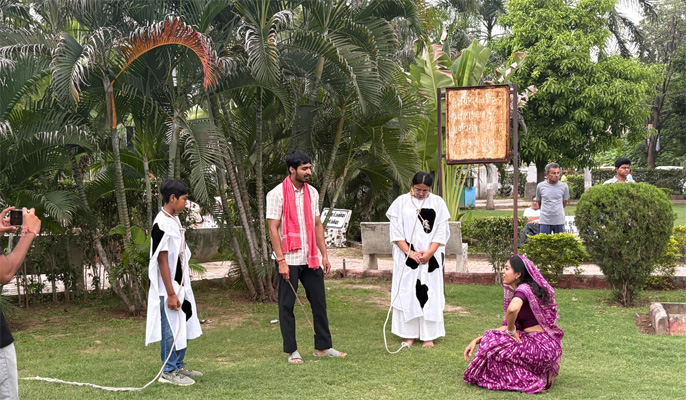
A Nukkad Natak at Subhanpura Garden brings the ethical concerns surrounding India’s dairy industry into the public square, urging people to rethink the treatment of cows, buffaloes and their calves — NE Photo

ADVERTISEMENT
NE Photo
  • A Viral KBC Conversation Takes a Powerful Turn on Vadodara’s Streets
  • Young Activists Use a 10-Minute Nukkad Natak to Question India’s Age-Old Dairy Habits
  • From Calf Separation to Abandoned Cattle, the Dairy Debate Moves Beyond Animal Welfare
  • Public Safety, Environment and Ethics Converge in a Growing Call to Rethink What We Put in Our Cups

NE ENVIRONMENT BUREAU

VADODARA, AUG 26

What if the most uncomfortable question about your morning chai is not how much sugar it contains, but whose milk is in it?

That question is now spilling out of television studios and social-media screens and onto the streets of Vadodara.

Against the backdrop of International Youth Day, young activists staged a 10-minute Nukkad Natak at Subhanpura Garden, turning a viral conversation from Kaun Banega Crorepati into a street-level conversation about the price animals may pay for a product humans regard as an everyday necessity.
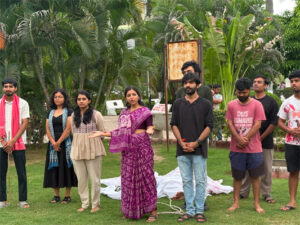
A powerful street play in Vadodara asks an uncomfortable question: when milk reaches our chai, do we also remember the calf it was produced for? — NE Photo

The street play, part of a campaign across 10 Indian cities, sought to make people pause and rethink familiar assumptions about dairy — particularly the treatment of cows, buffaloes and their calves.

At the heart of the campaign is the widely circulated KBC exchange between host Amitabh Bachchan and contestant Siddharth Sharma, a vegan for seven years. Sharma explained why he avoids animal-derived products, including dairy, and told Bachchan that animals, like humans, have a desire to live.

“Milk is made for the calf only… no species can stay constantly pregnant their whole lifetime, they are artificially inseminated. I don’t find it ethical,” Sharma said during the conversation. Bachchan, visibly affected by the explanation, responded that Sharma had “opened my eyes.”

That televised exchange has since become a springboard for activists seeking to move the dairy debate from screens to public spaces.

“The overwhelming response to this clip suggests that many young Indians are re-examining long-held assumptions about the dairy industry. Our Nukkad Natak was designed to bring those conversations into public spaces,” said event organiser Gaurav.

From a glass of milk to the life behind it

For generations, milk has occupied an almost unquestioned place in Indian households — poured into tea, added to sweets, used in cooking and associated with nourishment and tradition.

The activists, however, are asking a more fundamental question: what happens before the milk reaches the kitchen?

Their argument is not simply about whether people should or should not consume dairy. It is about whether consumers are sufficiently aware of the systems that produce it — and whether the welfare of the animal is given equal consideration alongside productivity.

The debate becomes particularly difficult when cows and buffaloes are viewed primarily through their economic usefulness.

What happens to an animal when milk production falls?

Who takes responsibility for animals that can no longer generate income?

And what happens when those animals are abandoned on roads, streets and highways?

These are no longer questions confined to animal-rights campaigns.

When animal welfare becomes a public-safety issue

The Supreme Court recently drew attention to the consequences of abandoned cattle, observing that animals discarded after they cease to serve an economic purpose can become a serious public-safety hazard. The Court described stray cattle on roads and highways in stark terms, emphasising the risk of potentially fatal collisions.

The issue therefore extends beyond the moral treatment of animals.

A cow abandoned after years of productive service does not simply disappear from the dairy system. She may end up navigating traffic, feeding on roadside waste or becoming part of an increasingly dangerous human-animal interface.

In its recent observations, the Supreme Court stressed that owners who release animals after they cease to be economically useful should be held responsible and should ensure their safe transfer to appropriate shelters.

“This Naatak was a way to connect with the public, especially youngsters who care, in the most direct and accessible way possible, while ensuring that the unethical realities of dairy are heard out loud,” said Gurjot.

The environmental question behind the ethical one

The dairy debate also has a wider environmental dimension.

Animal agriculture brings questions of land, water, feed, waste management, emissions and resource use into the conversation. That means the decision about what appears on a dinner table or in a cup of tea can also intersect with questions about sustainability.

For the young campaigners, therefore, animal welfare is not an isolated concern. It sits at the intersection of ethics, food choices, public health, road safety and environmental responsibility.

Their message is deliberately provocative: before asking whether milk is nutritious, should society also ask whether the system producing it is compassionate and sustainable?
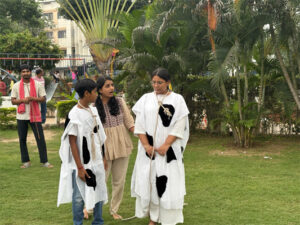
The dairy debate moves beyond animal welfare as concerns over abandoned cattle, road safety and the environmental footprint of animal agriculture come under the spotlight — NE Photo

Can India rethink the dairy equation?

The campaign is calling on policymakers, institutions and consumers to encourage the growth of plant-based food systems, presenting them as one possible route towards reducing dependence on animal agriculture and addressing concerns relating to animal welfare, human wellbeing and the environment.

But perhaps the most significant outcome of the Vadodara street play is not whether everyone watching it immediately gives up milk.

It is whether they begin asking questions.

Because somewhere between the cow and the cup, the calf can disappear from the story.

The activists want to put that calf back into the picture.

And their question to India is deceptively simple:

When we lift the next glass of milk, will we see only what is inside it — or will we also think about the life behind it?


Tags: abandoned cows IndiaAmitabh Bachchan KBC veganismanimal cruelty awarenessanimal rights Indiabuffalo welfarecow welfare Indiadairy farming ethicsdairy industry animal welfaredairy industry environmentmilk and animal welfareplant-based food systemsSiddharth Sharma KBCstray cattle Supreme CourtVadodara Nukkad Natakveganism India
ADVERTISEMENT
Previous Post

When ‘Tom’ meets ‘Cherry’, Gujarati cinema gets a new-age family spark

Next Post

‘Decoded with Chandni Kapadia’: What if your next question could take India to another world?

Nav Jeevan

Nav Jeevan

Next Post
‘Decoded with Chandni Kapadia’: What if your next question could take India to another world?

‘Decoded with Chandni Kapadia’: What if your next question could take India to another world?

Leave Comment
ADVERTISEMENT

Recommended

Gujarat tops Niti Aayog’s Export Preparedness Index 2020

Gujarat tops Niti Aayog’s Export Preparedness Index 2020

6 years ago
Reliance Retail brings Europe’s No. 1 cosmetics brand ‘Essence’ to India

Reliance Retail brings Europe’s No. 1 cosmetics brand ‘Essence’ to India

9 months ago
ADVERTISEMENT

Recent Posts

  • ‘Decoded with Chandni Kapadia’: What if your next question could take India to another world?
  • When milk comes with a question: Is our chai worth a calf’s right to live?
  • When ‘Tom’ meets ‘Cherry’, Gujarati cinema gets a new-age family spark

Category

Contact Us

Email:
ne.gowri1964@gmail.com

Phone:
9643255068

Editorial and Administrative Office:
Block No 1 Flat No 4C
Wipro Street, Sholinganallur
Off Old Mabalipuram Road
Chennai 600119, Tamil nadu

Registered Office :

96, First Floor, Srinathnagar Society,
(Landmark: Near Panchdev Mandir,
Karmacharinagar Vibhag-I),
Ghatlodia, Ahmedabad-380 061

  • About Us
  • Our Team
  • Advertising
  • Careers
  • Contact

© 2021 all right reserved by Navjeevanexpress.com. Consulted by MediaHives.com

No Result
View All Result
  • Gujarat
    • Ahmedabad
    • Vadodara
    • Surat
    • Rajkot
    • Saurashtra
    • Kutch
    • Central Gujarat
    • South Gujarat
  • National
    • Andhra Pradesh
    • Rajasthan
    • Maharashtra
    • Pondicherry
    • Tamil Nadu
    • OTHER STATES
  • Politics
  • Business
    • Companies
    • Personal Finance
  • Sports
    • Cricket
    • Hockey
    • Football
    • Badminton
    • Other Sports
  • Entertainment
    • Arts and Culture
    • Theatre
    • Cinema
    • Photos
    • Videos
  • Lifestyle
    • Fashion
    • Health & Environment
    • Food and Beverages
    • Spirituality
    • Tourism and Travel
  • World
  • More
    • Science and Technology
    • Legal
    • Opinion
    • Student’s Corner
    • Youth

© 2021 all right reserved by Navjeevanexpress.com. Consulted by MediaHives.com

Welcome Back!

Login to your account below

Forgotten Password?

Retrieve your password

Please enter your username or email address to reset your password.

Log In