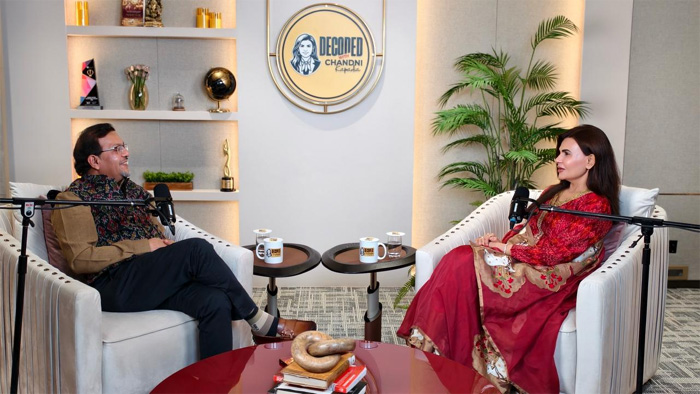

- PRL Director Prof. Anil Bhardwaj takes GLS University students beyond rockets and missions into the real world of scientific curiosity
- From ISRO and Chandrayaan to Mangalyaan, a scientist’s journey reveals how audacious questions become national capabilities
- Why failure, uncertainty and risk are not roadblocks to discovery but essential ingredients of frontier science
- Students hear a larger call: protect Earth even as humanity reaches for the Moon, Mars and worlds beyond
- A conversation on science, evidence and imagination challenges young minds to think beyond textbooks and conventional boundaries
NE EDUTAINMENT BUREAU
AHMEDABAD, AUG 26
The next great Indian space mission may not begin on a launchpad. It may begin inside the mind of a student who dares to ask a question nobody has asked before.
That was the powerful message emerging from a special edition of “Decoded with Chandni Kapadia” at GLS University, where Prof. Anil Bhardwaj, Director, Physical Research Laboratory (PRL), Ahmedabad, took students on a journey that went far beyond rockets, satellites and planetary missions.
In an engrossing conversation with Chandni Kapadia, Executive Director, GLS University, Prof. Bhardwaj opened the window to the less visible side of scientific achievement — the curiosity before the discovery, the uncertainty behind the breakthrough, the failures that test teams and the leadership that keeps them moving when the answers are still unknown.
For students dreaming of becoming scientists, engineers, innovators and future leaders, the conversation offered something more valuable than a catalogue of India’s space achievements: a glimpse into the mindset that makes those achievements possible.
The question before the answer
Prof. Bhardwaj’s own journey — from an early fascination with physics and space science to decades of work at the intersection of planetary and space research — became a living illustration of how curiosity can evolve into a life’s mission.
His experiences connected several defining chapters of India’s scientific journey, including work associated with ISRO, NASA, Chandrayaan, Mangalyaan and planetary science.
But the larger lesson was not about the missions themselves.
It was about the questions that gave birth to them.
Every unexplored planet, every mysterious space environment and every scientific puzzle represents an invitation to investigate. And according to Prof. Bhardwaj, the ability to remain curious — even when the answer is not immediately visible — is one of the most powerful qualities a young researcher can possess.
“Science is driven by curiosity. The questions we ask today become the discoveries of tomorrow. Exploration is not only about reaching new worlds; it is also about expanding our understanding of ourselves and the universe around us.”
The Mangalyaan lesson: Think beyond the obvious
The discussion also examined India’s distinctive approach to ambitious space exploration.
The success of Mangalyaan demonstrated that extraordinary scientific objectives can be pursued through innovation, determination, teamwork and intelligent use of resources.
For the students, the message carried implications far beyond space science.
The ability to solve a seemingly impossible problem with available resources — rather than waiting for ideal conditions — is equally relevant to technology, medicine, climate science, engineering and entrepreneurship.
The real competitive advantage, the conversation suggested, lies not merely in having more resources, but in thinking differently about the resources one has.
Can failure be a scientific superpower?
One of the most compelling strands of the conversation centred on risk.
Scientific exploration, by its very nature, ventures into territory where outcomes cannot always be predicted. Experiments can fail. Missions can encounter unexpected obstacles. Hypotheses can collapse.
Yet uncertainty is precisely what makes discovery possible.
The discussion recalled the emotionally challenging period following Chandrayaan-2, highlighting the importance of leadership and institutional support when a mission encounters difficulty.
The lesson for tomorrow’s scientists was unmistakable: a setback must not be allowed to become the end of a scientific question.
Teams need the confidence to experiment, learn from what went wrong and return to the problem with greater understanding.
That culture of resilience could ultimately determine how far India’s next generation of scientists is willing to venture.
Moon, Mars — and the Earth beneath our feet
As the conversation moved towards humanity’s future beyond Earth, another profound question surfaced.
If humans are preparing to explore the Moon, Mars and potentially other worlds, what responsibility do they have towards the planet they already inhabit?
Space exploration and environmental responsibility, the discussion underlined, need not be competing ambitions.
In fact, understanding other planets can deepen humanity’s appreciation of the extraordinary conditions that make Earth habitable.
For young minds fascinated by Mars, the Moon or distant worlds, the message was therefore equally about protecting the blue planet from which every journey begins.
Science needs evidence, not easy answers
An especially thought-provoking segment explored the relationship between scientific temperament and traditional beliefs, including conversations around astrology and evidence-based thinking.
Prof. Bhardwaj stressed the importance of questioning, observation and scientific methodology, while recognising the distinction between personal belief and conclusions supported by evidence.
For students, this was perhaps one of the most important lessons of the session.
Science does not ask young minds to stop questioning.
It asks them to question better.
It teaches them to test assumptions, seek evidence, examine observations and remain prepared to change a conclusion when new evidence emerges.
The next mission may be sitting in the audience
Looking back on more than three decades of India’s scientific transformation, Prof. Bhardwaj reflected on the growing interest among young Indians in science and technology.
But interest alone, he suggested, must evolve into deeper research, innovation and scientific thinking.
Interacting with students, he encouraged them to remain curious, continue learning and develop the confidence to explore ideas beyond conventional boundaries.
The message resonated with the very purpose of “Decoded with Chandni Kapadia” — bringing accomplished personalities into direct conversation with young minds so that students encounter not merely their achievements, but the thinking, struggles and choices behind them.
Kapadia emphasised the importance of creating such platforms to connect students with individuals who have shaped their respective fields.
Such conversations, she noted, encourage students to think differently, cultivate curiosity and gain insights that traditional classroom learning alone may not provide.
The event concluded with an engaging interaction between Prof. Bhardwaj and students, with discussions continuing around leadership, innovation, scientific thinking and the possibilities that lie ahead.
Perhaps the most important takeaway was also the simplest: The future of science does not belong only to those who know the answers. It belongs to those courageous enough to keep asking better questions.
And somewhere in a classroom, laboratory or university auditorium today, India’s next scientist, space explorer or scientific leader may already be asking one.