- A memorial, a message, a national memory: Defence minister Rajnath Singh pays tribute to Goa’s liberation martyrs at the re-developed Hutatma Smruti Smarak in Patradevi
- From peaceful resistance to military resolve: Patradevi’s legacy reflects both the power of satyagraha and the nation’s determination to protect its territorial integrity
- 1961 meets 2026: Singh links the courage of Operation Vijay to the preparedness demonstrated by the armed forces during Operation Sindoor
- “Being Indian” binds us all: Defence minister calls national unity the enduring force above regional, communal and caste identities
- History as a compass for tomorrow: Singh urges young people to visit the memorial and understand the sacrifices that secured Goa’s liberation
NE DEFENCE BUREAU
GOA, AUG 27
At Patradevi, where the tricolour once advanced into Portuguese-held Goa amid the thunder of machine-gun fire, history came alive again on Wednesday — not merely as a remembrance of martyrs, but as a powerful reminder of a nation’s enduring resolve to defend its sovereignty.
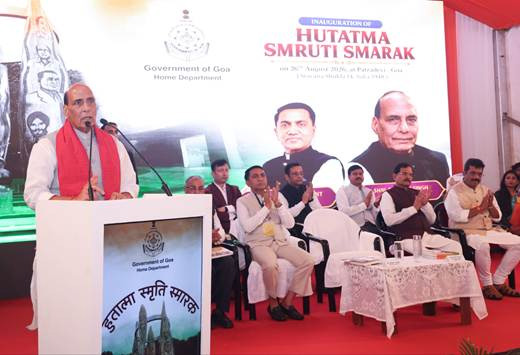
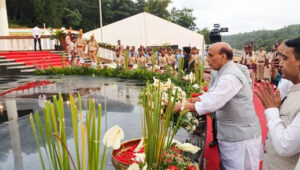
Defence minister Rajnath Singh inaugurated the newly re-developed Hutatma Smruti Smarak at Patradevi, a site etched into the history of Goa’s liberation struggle. Paying tribute to the Satyagrahis who laid down their lives for Goa’s freedom, Singh drew a striking line from the peaceful resistance of the 1950s and the military liberation of 1961 to the contemporary strength demonstrated by India’s armed forces during Operation Sindoor.
Where sacrifice crossed every boundary
The Patradevi memorial commemorates a movement that transcended geography, language and regional identity. Singh paid tribute to Satyagrahis including Karnail Singh from Punjab, Sahodra Devi from Madhya Pradesh and Madhukar Damodar Chaudhary from Maharashtra, underlining that Goa’s liberation was not merely a regional movement but an expression of India’s national consciousness and unity.
The site carries a particularly poignant history. On August 15, 1955, thousands of volunteers from different parts of India participated in a peaceful Satyagraha in Goa. The first group of Satyagrahis entered Goa through Patradevi carrying Indian flags, where Portuguese forces opened machine-gun fire. Several lost their lives at Patradevi, while others were martyred at different locations during the liberation movement.
Against that backdrop, Singh said:
“National unity is above narrow-minded thoughts such as regionalism, communalism, and casteism.”
He said Patradevi sends a powerful message that despite India’s diverse regional, social and cultural identities, “being Indian” is the bond that unites the nation.
The Satyagrahis, he noted, demonstrated that India could assert its rights through peaceful means. But when the territorial integrity of a sovereign nation is threatened and peaceful efforts reach their limits, he said, a nation also has the right to exercise its full strength.
From Operation Vijay to Operation Sindoor
Singh recalled the professionalism, courage and discipline displayed by India’s armed forces during Operation Vijay in 1961, which brought an end to Portuguese rule in Goa.
The operation, he said, established a tradition of confidence and preparedness that continues to shape India’s defence posture.
Drawing a direct connection with the present, Singh said Operation Sindoor demonstrated that India’s armed forces possess the capability to respond decisively when the nation’s security is threatened.
“Op Sindoor is proof that our Defence Forces are capable of giving a befitting reply to those who cast an evil eye on India.”
For Singh, therefore, the liberation of Goa is not simply a chapter of military history to be recalled with pride. It is also a reminder that India must remain vigilant, capable and prepared to safeguard its sovereignty and territorial integrity.
A transformed defence power
Reflecting on India’s transformation since 1961, Singh pointed to the growing technological and industrial capabilities of the armed forces.
“Our defence forces are today protecting national interests with state-of-the-art equipment such as warships, fighter aircraft, advanced radar systems, network-centric warfare capabilities, and long-range air power.”
He said all three services are moving towards greater jointness and integration, while India’s expanding economy, talented youth and rapidly developing defence-industrial ecosystem are strengthening the country’s ability to build indigenous capabilities.
Singh highlighted the transformation from a major defence importer into an increasingly significant defence manufacturing and exporting nation. According to the figures cited by him, defence exports have risen from around Rs 600 crore before 2014 to more than Rs 38,000 crore, while defence production has climbed from around Rs 40,000 crore to a record Rs 1.81 lakh crore.
He also underlined the expanding role of Nari Shakti, noting that women who once stood at the forefront of India’s freedom struggle are today flying fighter aircraft, assuming leadership roles in the armed forces, contributing to space missions and driving innovation and entrepreneurship.
Freedom carries a responsibility
Singh also used the occasion to broaden the meaning of freedom for younger generations.
Freedom, he said, is not merely the right to express oneself. It comes with the responsibility to preserve national unity, constitutional values and the rule of law, while placing national interests above personal gains.
That responsibility, he stressed, belongs not only to the present generation but also to those who will inherit the country’s future.
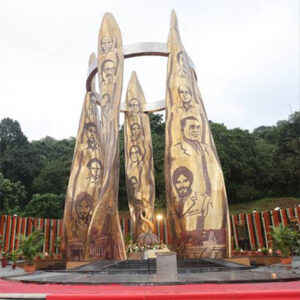
The newly redeveloped memorial is intended to help ensure that the sacrifices associated with Patradevi remain accessible to generations that did not witness the liberation struggle. The redevelopment, undertaken by the Goa State Infrastructure Development Corporation at a cost of approximately Rs 9.50 crore, has transformed the site into an immersive educational and commemorative space featuring a redesigned central monument, sculptures, information hubs and murals depicting the liberation struggle.
“History can steer the future”
Perhaps the strongest message of the occasion was Singh’s appeal to young Indians not to allow the stories of Goa’s liberation martyrs to fade into textbook footnotes.
He said the lives, struggles, courage and sacrifices of the martyrs should inspire today’s youth.
“Our youth must visit this memorial when they travel to Goa, and understand the price at which our nation’s integrity was secured. A generation that understands its history can steer its future in the right direction.”
The appeal gives Patradevi a significance beyond its physical memorial structure. It becomes a place where the ideals of sacrifice, national unity, peaceful resistance, courage and sovereignty converge.
As India remembers the Satyagrahis who marched into Goa carrying the national flag and honours the armed forces that completed the liberation struggle in 1961, Patradevi’s message remains strikingly contemporary: freedom may be won by one generation, but preserving it is the responsibility of every generation that follows.