
- A hobby with a purpose: Deen Dayal SPARSH Yojana seeks to take philately beyond stamp albums and into classrooms, encouraging curiosity, research and independent learning among Classes VI–IX students.
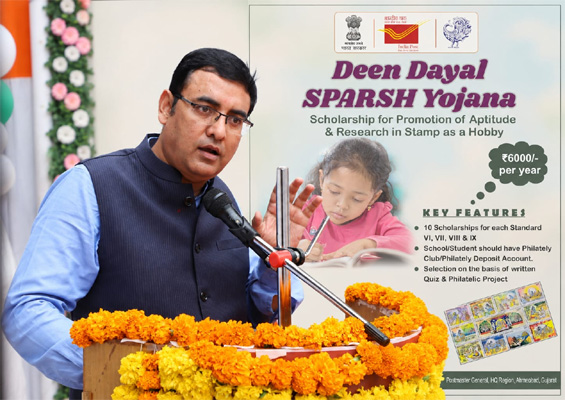
- ₹6,000 scholarship up for grabs: Meritorious students can receive ₹500 a month, paid quarterly, for developing their interest in stamps and philatelic research.
- Quiz first, creativity next: Students will face a 50-question divisional-level quiz before presenting a 500-word philately project featuring 16 postage stamps.
- September 10 is the deadline: Students with at least 60% marks can apply; SC/ST candidates get a five-per-cent relaxation in the qualifying marks.
NE EDUTAINMENT BUREAU
AHMEDABAD, AUG 27
What if a tiny postage stamp could open the door to a scholarship, spark a child’s curiosity about history and geography, and turn screen-weary youngsters into enthusiastic explorers of the world?
India Post is betting that it can.
For students of Classes VI to IX, an old-fashioned hobby is being given a distinctly new-age purpose under the Deen Dayal SPARSH Yojana — Scholarship for Promotion of Aptitude and Research in Stamps as a Hobby. The initiative combines academic merit with philately, inviting young learners to discover the stories, people, places, cultures and milestones captured on postage stamps.
Under the scheme, meritorious students can compete for an annual scholarship of ₹6,000, while gaining an opportunity to turn their stamp collections into a gateway for research and creative learning.
Postmaster General, North Gujarat Region, Ahmedabad, Krishna Kumar Yadav, said the initiative was aimed at bringing philately into the mainstream of education and nurturing an interest in research among children.
From stamp albums to a world of discovery
Launched in 2017 for students of Classes VI to IX, Deen Dayal SPARSH Yojana is designed to make philately more than a pastime. A stamp can tell a story about India’s freedom struggle, a scientist, an artist, wildlife, architecture, sports, heritage or an important national event — making each collection a miniature archive of knowledge.
Yadav said the scheme seeks to encourage children to develop philately as a hobby from an early age, particularly among Gen Alpha, and provide them with a meaningful, educational and stress-free activity.
The annual scholarship is ₹6,000, payable at the rate of ₹500 per month on a quarterly basis.
Each Postal Circle will award up to 40 scholarships — 10 each for students of Classes VI, VII, VIII and IX.
Who can apply?
The opportunity is open to students studying in recognised schools in India.
A key eligibility requirement is that the student’s school should have a Philately Club, and the applicant should be a member of it. If the school does not have a Philately Club, a student who maintains a Philately Deposit Account can also be considered.
Such an account can be opened at a Post Office with a minimum deposit of ₹200.
Academic performance also matters. Applicants must have secured at least 60% marks or an equivalent grade/grade point in their most recent final examination. SC/ST students receive a five-per-cent relaxation in the qualifying marks.
First conquer the quiz, then tell a stamp’s story
The scholarship selection process is designed to test both knowledge and creativity.
The first hurdle is a 50-question multiple-choice written quiz, which will be conducted at the divisional level on September 27, 2026.
Students who qualify will then have to demonstrate their research and presentation skills by submitting a philately project of not more than 500 words, accompanied by 16 postage stamps, by the first week of November.
A Circle-level committee comprising postal officials and eminent philatelists will evaluate the projects before the final selection.
The results are scheduled to be announced on December 1, 2026.
Selected students will subsequently be required to open a joint account with their parents at a Post Office or India Post Payments Bank for receiving the scholarship.
The deadline young stamp explorers cannot miss
For students fascinated by stamps — or those looking for an unusual way to combine academics, creativity and research — the first date to circle is September 10, 2026, the last date for submitting applications in the prescribed format.
The scheme offers something beyond the monetary value of the scholarship.
It encourages children to look closely, ask questions, research independently and connect seemingly small objects with much larger stories.
In an age in which young people are surrounded by instant digital information, philately offers the opposite experience: pause, observe, investigate and discover.
And that may be precisely what makes a postage stamp surprisingly relevant to the Gen Alpha learner.
As Yadav put it, the objective is to encourage children to develop philately from an early age so that the hobby becomes a “relaxing, stress-free, and educational experience.”
For today’s students, the next big discovery may not begin with a search engine. It could begin with a stamp.