
- A degree is not the destination: Amit Shah urges 900 graduates to turn education into a mission for society and the nation
- 11 gold medallists join the ranks of achievers as Gujarat Vidyapith celebrates its 72nd convocation
- “True education” must blend skills, sensitivity, knowledge and conscience, says Shah
- From “self” to “others”: Graduates urged to pursue goals that serve the nation, society and the poor
- Gandhi’s message remains relevant for the next 100 years because it is rooted in India’s values and traditions
- Mother tongue, skills, multidisciplinary learning and Indian knowledge tradition highlighted as pillars of modern education
NE EDUCATION BUREAU
AHMEDABAD, AUG 28
What if the real measure of a degree is not the salary it commands, but the difference its holder makes to society? That question echoed through Gujarat Vidyapith’s 72nd convocation as 900 graduates stepped out of the campus armed not merely with degrees, but with a larger call to serve.
Addressing the convocation as chief guest, Union Home Minister and Minister of Cooperation Amit Shah placed Gandhian education, national service, Indian values and purposeful ambition at the heart of his message to the graduating students.
His most striking formulation captured the essence of the convocation:
“True education is that which gives skill to the hands, sensitivity to the heart, and knowledge along with conscience to the mind.”
The message was particularly resonant at Gujarat Vidyapith, founded by Mahatma Gandhi on October 18, 1920, as an institution envisioned to experiment with and develop an Indian model of education.
Gujarat Governor Acharya Devvrat and several dignitaries were present at the ceremony.
A degree — and then a purpose
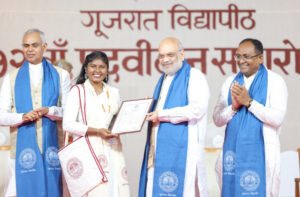
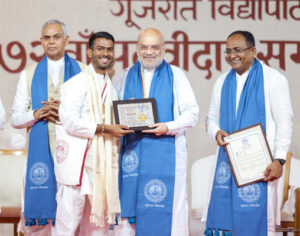
For the 900 graduates receiving their degrees and the 11 meritorious students receiving gold medals, the convocation marked the transition from campus life to a larger social responsibility.
Shah urged the students to define their life’s goals before leaving the campus — but cautioned them against making those goals narrowly personal.
His appeal was direct: dream beyond yourself.
“Appeal to the youth: Set goals not merely for yourself, but for the nation, society and the poor, no matter how many difficulties arise, you will never become disheartened.”
The underlying message was that when an individual’s ambition is connected to a larger social purpose, setbacks become challenges rather than reasons for surrender.
Gujarat Vidyapith’s philosophy of Basic Education, with its emphasis on village-centric development and the transition from “self” to “others”, provided the backdrop to this call.
Gandhi’s message — still ahead of its time
Shah said Gandhi’s ideas have retained their relevance because they are deeply anchored in India’s way of life, values and traditions.
“Indian way of life, values and traditions form the foundation of Mahatma Gandhi’s message; therefore, his message will never become outdated.”
Gujarat Vidyapith, he said, was born from Gandhi’s determination to create an education system suited to India’s own needs.
The institution subsequently became a centre of experimentation in education and a laboratory for translating ideas of Indian identity, social responsibility and national reconstruction into practice.
For the graduating students, the message was clear: education should not merely prepare individuals for careers; it should prepare them to rebuild communities and strengthen the nation.
When education meets conscience
Shah underlined that knowledge without wisdom can produce arrogance, while knowledge enriched by discernment creates humility and scholarship.
That philosophy, he said, calls for an education that develops the hands, heart and mind together.
The National Education Policy (NEP) 2020, he said, reflects five broad pillars — mother tongue, skills, multidisciplinary learning, the Indian knowledge tradition and holistic personality development.
The emphasis on skills and holistic learning also echoes Gujarat Vidyapith’s long-standing effort to integrate education with practical life and social responsibility.
Language is more than words
The convocation also became a powerful reminder of the cultural dimension of education.
Shah said Gandhi believed that freedom could not be complete without one’s own language, culture, labour and national objectives.
“There is no mindset more sinful than the one that says, ‘If I speak in my own language, I will become inferior.’”
He stressed that language connects people with the values, history and roots of their country.
Learning languages from around the world, he said, should never come at the cost of undervaluing one’s own language.
Khadi, Swadeshi and the economy of self-reliance
For Shah, Gandhi’s legacy also extends beyond classrooms into economic self-reliance.
Recalling his own childhood association with khadi, he said:
“My mother made me take a lifelong pledge to wear khadi,”
He pointed to the dramatic rise in the turnover of Khadi and Village Industries — from ₹31,000 crore in 2013–14 to ₹1.87 lakh crore in 2025–26 — as an indicator of the growing economic dimension of the Swadeshi ethos.
He stressed that khadi should not be viewed merely as fabric or an economic activity, but as an idea of embracing Swadeshi in everyday life.
Gandhi’s emphasis on Gram Swaraj, Gram Samriddhi and cooperation, he added, remains relevant to contemporary nation-building.
FROM “Navnirman” to “Punar-Nirman”
Another striking theme was Gandhi’s concept of reconstruction.
Shah said Gandhi did not speak merely of Navnirman but of “Punar-nirman” — reconstruction rooted in the country’s civilisational foundations while embracing modernisation.
“Gandhi Ji spoke not of ‘Navnirman’, but of ‘Punar-nirman’, guided by this spirit, the Modi Government is taking the country forward by making culture, prosperity, security, self-reliance, and ethics in leadership the foundation of its progress.”
He said the country should aspire to become a global leader while ensuring that its strength, prosperity and influence are guided by wisdom, responsibility and concern for humanity.
For the young graduates, the convocation thus ended with a challenge larger than academic achievement: carry knowledge into society, transform skills into service and turn ambition into a force for the greater good.