- Five-day PIB study tour takes journalists to Jammu’s landmark projects, research institutions, healthcare hubs and heritage sites
- From Chenab Bridge and Salal hydropower project to AIIMS Vijaypur and Biotech Park, delegation to witness transformation first-hand
- IIT/IIM Jammu, NHAI Udhampur and CSIR-IIIM among key stops on immersive development and governance itinerary
- Heritage, border realities and public infrastructure woven into a tour designed to deepen evidence-based reporting
- Why PIB conducts such tours: Taking journalists beyond official briefs to independently understand, verify and communicate development on the ground
NE NEWS SERVICE
AHMEDABAD, AUG 30
What changes when a journalist stops reading about a project and actually stands before it? What does a bridge look like before it becomes a statistic, a research laboratory before its breakthroughs become a headline, or a border before it is reduced to a few lines in a news report?
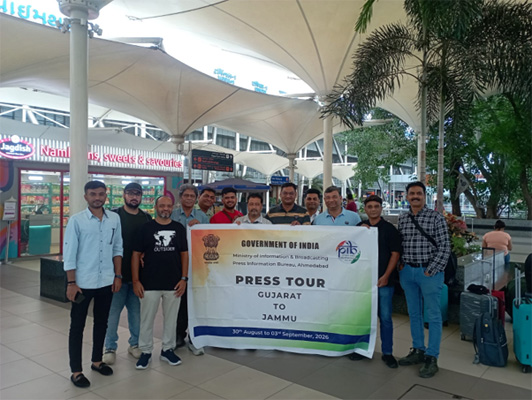
Seeking to bridge precisely this gap between information and experience, the Press Information Bureau (PIB), Ministry of Information and Broadcasting, has organised a five-day study tour to Jammu for a delegation of journalists from Gujarat from August 30 to September 3, 2026.
The tour is designed to give journalists first-hand exposure to development projects, infrastructure, healthcare, scientific research, heritage conservation and governance initiatives being undertaken in Jammu and surrounding areas.
Rather than relying exclusively on official releases, presentations or data, the journalists will have an opportunity to visit project sites and institutions, interact with officials and understand the larger context in which these initiatives are being implemented.
From documents to the ground reality
The significance of the PIB initiative lies in one fundamental principle of public-interest journalism: development is best understood where it is actually happening.
Government schemes and projects often arrive in newsrooms as statistics, press notes, photographs and official statements. Study tours allow journalists to add another dimension—ground-level observation.
For PIB, such exposure programmes are intended to familiarise media professionals with major government initiatives and enable them to report them with greater context and accuracy.
For journalists, the exercise can provide an opportunity to examine the scale of projects, understand their objectives, see implementation first-hand and ask questions that may not emerge from a conventional press briefing.
The ultimate objective is not merely to showcase projects but to strengthen informed, contextual and evidence-based communication with citizens.
Jammu’s heritage opens the journey
The delegation’s first day will combine heritage with an introduction to Jammu’s distinctive historical and cultural landscape.
The journalists will visit Bawe Mandir/Pir Kho and the Amar Mahal Museum, gaining insights into the region’s history, architecture, cultural traditions and heritage conservation efforts.
The heritage component is significant because Jammu’s development story extends beyond roads, bridges and institutions.
Its cultural inheritance forms an equally important part of the region’s identity—and understanding that context can help journalists place contemporary development within a much longer historical narrative.
From classrooms to connectivity
The itinerary subsequently moves into education, institutional development and infrastructure.
The delegation will visit PIB Jammu, IIT Jammu, IIM Jammu and the National Highways Authority of India (NHAI), Udhampur.
The institutional visits are expected to provide journalists with an overview of developments in higher education, professional training, research, institutional capacity-building and large-scale infrastructure.
The NHAI visit, in particular, will offer an opportunity to understand the infrastructure ecosystem supporting connectivity in the strategically important region.
For journalists, seeing how such institutions function can turn broad policy terminology such as “infrastructure development”, “institution building” and “capacity creation” into tangible stories.
Where science meets society
The tour will also take the journalists into the world of scientific research and innovation.
The delegation will visit the CSIR-Indian Institute of Integrative Medicine (CSIR-IIIM), an institution engaged in research in areas connected with medicinal plants, natural products, drug discovery and related scientific domains.
The visit is expected to give the media delegation a closer understanding of India’s research ecosystem and the interface between laboratory research, innovation and public benefit.
The delegation will also visit Suchetgarh border, providing journalists with an opportunity to understand the distinctive realities of a border region and the social, strategic and developmental dimensions associated with it.
The juxtaposition is deliberate: one stop represents India’s scientific frontier; another, its geographical frontier.
The engineering marvel that redefined the landscape
The third day is expected to be among the most visually and journalistically significant segments of the programme, with visits to the Chenab Bridge and Salal Hydroelectric Project.
The Chenab Bridge has emerged as one of India’s most spectacular infrastructure landmarks, while the Salal project represents the country’s long-standing investment in hydropower.
A site visit allows journalists to move beyond engineering statistics and examine how such projects interact with geography, connectivity, energy requirements and regional development.
The Chenab Bridge, in particular, offers a compelling illustration of how engineering, terrain and strategic connectivity intersect in Jammu and Kashmir.
Healthcare and biotech: The final leg
The final day will shift the focus towards healthcare, biotechnology and emerging research capabilities.
The delegation will visit AIIMS Vijaypur and the Biotech Park at Kathua, where journalists will be briefed on developments in healthcare delivery, biotechnology, research and innovation.
The AIIMS visit is expected to provide insights into the expansion of advanced healthcare infrastructure in the region, while the Biotech Park will offer a window into the growing ecosystem around biotechnology, entrepreneurship, research and technology-led development.
The delegation will subsequently return from Jammu, carrying with it not merely photographs and official briefings, but first-hand observations that can inform subsequent reporting.
Why does PIB take journalists on such tours?
This is perhaps the most important question behind the itinerary.
A government development project does not become meaningful to citizens merely because an official announcement has been issued about it.
Someone has to explain what it means, whom it serves, what has changed, what remains unfinished and why it matters.
That is where journalism enters the picture.
PIB’s study tours are intended to create a direct interface between journalists and the people, institutions and projects involved in major government initiatives. Such programmes can help journalists understand the policy rationale, implementation process, achievements, constraints and wider public impact of projects instead of relying solely on second-hand information.
They can also encourage more nuanced reporting by exposing journalists to the geographical, social, economic and technological context surrounding government programmes.
In an era of instant social-media updates, misinformation and fragmented information, first-hand exposure can be particularly valuable.
A journalist who has physically visited a project site is better placed to distinguish between what exists on paper and what exists on the ground, provided the visit is followed by independent verification, questioning and critical reporting.
That is why such programmes matter not only to government communication but also to the larger ecosystem of public information and accountable journalism.
From exposure to public knowledge
The five-day programme brings together seemingly different subjects—heritage, higher education, highways, scientific research, border areas, bridges, hydropower, healthcare and biotechnology.
But they collectively tell a larger story about how a region is being connected, institutionalised, modernised and integrated into India’s broader development framework.
The journalists are expected to use their observations and interactions to develop news reports and features that communicate these developments to a wider audience through their respective media platforms.
The real test of the tour, therefore, begins after the delegation returns.
Will the visit produce more informed questions, richer ground reports and sharper public-interest journalism?
That is ultimately the value of taking journalism beyond the press release.
And perhaps the most powerful story a study tour can produce is not simply what the journalists were shown—but what they subsequently chose to ask, verify and report.