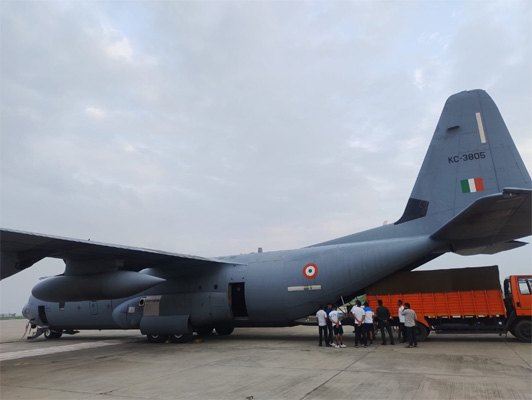
- 11-member specialised rescue team and 5.5 tonnes of essential medicines sent as India deepens humanitarian response to Nepal’s catastrophic floods
- More than 68 tonnes of emergency relief already rushed to neighbouring nation, including food, blankets, sleeping bags, tarpaulins, hygiene kits, medicines and generators
- Indian technical teams join tunnel rescue operations while forensic experts help identify victims through DNA analysis
- Nepal’s death toll rises to 1,127 as rescue teams race against time to trace the missing and recover bodies from devastated river corridors
NE DEFENCE BUREAU
NEW DELHI, SEPT 2
When floodwaters tear through homes, roads and lives, relief is more than cargo—it is a message that the wounded will not be left alone. As Nepal struggles to recover from one of its most devastating Himalayan disasters, India has sent its fifth relief aircraft, carrying an 11-member specialised rescue team, advanced equipment and 5.5 tonnes of essential medicines, reinforcing a humanitarian response that is moving from emergency supplies to rescue, medical support and forensic assistance.
External Affairs Minister S. Jaishankar announced the latest deployment on Wednesday, saying:
“The fifth Indian aircraft has departed for Nepal. It is carrying a 11-member rescue team with specialised equipment, and 5.5 tonnes of essential medicines.”
The latest mission comes as Nepal confronts the devastating consequences of the August 26 flash floods in the Bhotekoshi and Trishuli river corridors. The disaster has killed more than 1,100 people, while thousands remain unaccounted for, leaving rescue teams facing an enormous search-and-identification challenge.
India’s relief corridor keeps moving
With the fifth aircraft now on its way, India has already delivered more than 68 tonnes of emergency relief material and specialised assistance to Nepal.
The relief consignments include blankets, sleeping bags, heavy-duty tarpaulins, plastic sheeting, hygiene kits, food packets, essential medicines, solar lamps, water-purification tablets and portable generators.
Nepal’s Foreign Ministry has confirmed that an Indian team of 11 specialised tunnel-rescue experts is working with Nepali authorities, alongside technical teams from China and South Korea, particularly at hydropower projects affected by the floods.
India’s fourth relief flight had already delivered 11 tonnes of emergency material, including search-and-rescue equipment, tarpaulins, plastic sheets, sleeping bags, blankets and sanitary kits.
The successive airlifts underline the breadth of India’s response—from immediate survival supplies to specialised rescue capabilities.
From rescue tunnels to the search for identities
The humanitarian response has also moved into a deeply sensitive phase: identifying those who did not survive.
An Indian forensic team specialising in DNA analysis has arrived in Nepal to assist Nepali experts in identifying victims. Nepal’s Foreign Ministry has confirmed the presence of the Indian forensic specialists and continuing coordination on victim identification.
The assistance is particularly significant because bodies are being recovered from multiple disaster-hit districts, while many families continue to await confirmation about missing relatives.
The search is especially difficult at hydropower projects along the Bhotekoshi and Trishuli corridors, where workers are feared to have been trapped inside tunnels. Indian technical experts are working alongside Nepali authorities to tackle these dangerous underground rescue operations.
A tragedy measured not only in numbers
Nepal Police reported 1,127 deaths as of September 2, with bodies recovered across several affected districts. Earlier figures had placed the toll lower as rescue and recovery operations continued; the number has steadily risen with the recovery of more victims.
The disaster has also left thousands missing. The scale of the uncertainty is particularly painful for families waiting for news of loved ones, including foreign nationals caught in the catastrophe.
Nepal’s authorities have been coordinating search operations across difficult terrain, while international technical assistance is being deployed where specialist capabilities are required.
Neighbourhood First, humanity first
India’s response is unfolding under its broader Neighbourhood First approach and its Humanitarian Assistance and Disaster Relief framework.
India had moved quickly after the disaster struck, with the Government publicly expressing solidarity with Nepal and monitoring the situation along vulnerable border areas. The Ministry of Home Affairs said India “stands with Nepal in this hour of crisis”, while rescue teams and the NDRF were placed on alert in potentially affected border regions.
The response has since expanded into a multi-layered humanitarian operation: relief supplies for survivors, specialised equipment for rescuers, medicines for the injured, technical expertise for tunnel operations and forensic assistance for families searching for closure.
Healing beyond the floodwaters
The immediate emergency may be measured in tonnes of relief material and numbers of rescue personnel. But the deeper humanitarian challenge is what comes after the waters recede.
Nepal faces the daunting task of recovering bodies, locating the missing, restoring damaged infrastructure and supporting communities whose livelihoods and homes have been swept away.
India’s continuing assistance therefore carries significance beyond the fifth aircraft. It represents a neighbour responding across the full arc of disaster relief—from the first blanket and medicine to the difficult search underground, and finally to the scientific identification of victims.
As Nepal begins the painful journey from rescue to recovery, India’s message is increasingly clear: in a Himalayan tragedy of this scale, relief must reach not only the living, but also the families waiting for answers.