NE NEWS SERVICE
NEW DELHI, SEPT 3
A relationship once symbolised by diamonds is being recast around defence, technology, trade and strategic security, as India and Belgium move to build a substantially broader partnership with a 10-year horizon of cooperation across critical sectors.
India-Belgium ties are entering an ambitious new phase.
Today, during the talks with PM Bart De Wever, we agreed to deepen cooperation across trade, defence, clean energy, critical minerals, semiconductors, research and talent mobility.
We have also established an Investment… pic.twitter.com/BtMxqWyy3S
— Narendra Modi (@narendramodi) September 3, 2026
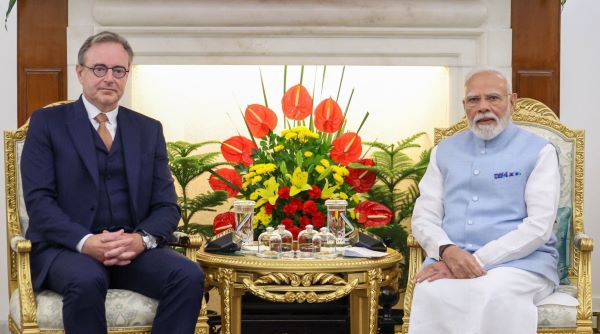
Prime Minister Narendra Modi and Belgian Prime Minister Bart De Wever on Thursday gave a major strategic push to bilateral relations, spanning defence and security, trade and investment, semiconductors, critical minerals, clean energy, ports, maritime cooperation, research, education and people-to-people ties.
- Modi, De Wever set sights on a deeper partnership spanning defence, trade, technology, clean energy and maritime security
- Two sides agree to double bilateral trade in five years as India-Belgium Strategic Dialogue opens a new channel for sustained engagement
- Defence cooperation gets sharper focus with military exchanges, training, intelligence sharing, co-development and co-production
- Belgium backs India’s candidature for permanent UN Security Council membership; both sides seek stronger multilateralism
- Semiconductors, critical minerals, green hydrogen, ports and emerging technologies emerge as new engines of bilateral cooperation
- Shared commitment to counterterrorism, maritime security, dialogue and diplomacy anchors the expanding India-Europe partnership
The Belgian Prime Minister’s September 2-4 visit to India—his first since taking office in February 2025—has produced a series of decisions aimed at converting the long-standing relationship into a more comprehensive strategic partnership. The two leaders also looked ahead to 2027, when India and Belgium will mark 80 years of diplomatic relations.
At the heart of the engagement is a recognition that the old pillars of the relationship are no longer sufficient to define its future.
“Today, the scope of our cooperation has expanded beyond traditional sectors to strategic areas such as defence and clean energy,” Modi said, pointing to cooperation on advanced defence equipment, including the Zorawar tank, and the development of one of the world’s largest green ammonia projects in Kakinada, Andhra Pradesh.
Defence moves to the centre
Had a very productive meeting with the Defence and Trade Minister of Belgium, Mr @FranckenTheo in New Delhi today.
We reviewed the entire spectrum of Defence relations and Defence Industrial Cooperation between India and Belgium. Multiple MoUs and contracts under the Defence… pic.twitter.com/Rlzyv1iq9l
— Rajnath Singh (@rajnathsingh) September 3, 2026
Defence and security have emerged as a key pillar of the rapidly expanding partnership.
Defence Minister Rajnath Singh held bilateral talks with Belgium’s Minister of Defence and Foreign Trade Theo Francken in New Delhi on Thursday, with both sides reviewing the full spectrum of defence and defence-industrial cooperation.
The two ministers agreed to expand bilateral ties through defence cooperation dialogue, high-level visits, training and capacity building. They also discussed regional peace and security and the need for enhanced maritime security cooperation in the Indo-Pacific.
The bilateral engagement builds upon the understanding reached between the two countries’ Defence Ministers in March 2025 to institutionalise and strengthen defence cooperation.
The two Prime Ministers welcomed the signing of a Letter of Intent between the two Ministries of Defence, providing a framework for regular exchanges, staff talks, education and training, research cooperation and defence-industrial partnerships.
The two sides also welcomed growing cooperation in maritime security, emerging technologies, military exchanges and the Indo-Pacific, including plans for the Belgian frigate LEOPOLD I to visit India from November 5 to 8, 2026. The Belgian Defence College is also scheduled to organise its World Study Trip 2027 in India, while India’s College of Defence Management, Secunderabad, is to undertake a study tour of Belgium in October 2026.
India and Belgium are simultaneously seeking to push defence cooperation beyond exercises and exchanges towards industrial collaboration, technology, co-development and co-production.
Both leaders welcomed multiple agreements and partnerships between Indian and Belgian defence industries and encouraged companies on both sides to maintain engagement in defence manufacturing, innovation and advanced technologies.
Trade target: Double it in five years
Economic cooperation is being given an equally ambitious target.
The two Prime Ministers agreed to work towards doubling bilateral trade over the next five years, backed by an Investment Fast-Track Mechanism designed to facilitate Belgian investment in India as well as Indian investment in Belgium.
Modi said India would make the India-Belgium Business Forum a regular mechanism and strengthen coordination among financial, fintech and regulatory institutions.
The two sides also welcomed continuing cooperation in sectors ranging from life sciences, pharmaceuticals and healthcare to energy, defence, aeronautics, space, logistics, ports, cleantech, advanced materials, manufacturing and digital technologies.
The historic Antwerp-Mumbai-Surat diamond connection remains an important economic bridge, but both countries are now seeking to build new corridors of cooperation around technology, investment and strategic industries.
“Diamonds have long been a link between India and Belgium. Today, we are transforming this historic connection into a new and more comprehensive relationship,” Modi said.
Semiconductors, critical minerals join the strategic map
Technology is rapidly emerging as another major pillar.
Belgium’s semiconductor expertise and India’s scale are being positioned as complementary strengths, with the two countries working towards closer links between Belgium’s imec and India’s semiconductor ecosystem.
The leaders encouraged deeper engagement among Indian semiconductor companies, ChipIN Centre, C-DAC, universities and imec to develop partnerships in semiconductor technologies and build resilient advanced technology ecosystems.
Cooperation will also expand in critical minerals processing and recycling, while both sides explore opportunities in sustainable industries, chemicals, advanced materials and manufacturing.
The partnership is thus moving into sectors that are increasingly central to economic security and resilient global supply chains.
Green energy, ports and the maritime connect
Clean energy and maritime cooperation form another important strand of the new partnership.
India and Belgium renewed their MoU on Renewable Energy Cooperation, expanding collaboration in green hydrogen, solar energy, energy storage, offshore wind, bio-energy, small hydropower and pumped storage.
The two countries also agreed to strengthen cooperation across the green hydrogen value chain, including production, transportation, storage and end-use applications.
Maritime and port cooperation is receiving a parallel boost, covering port development, logistics, connectivity, dredging and offshore wind infrastructure.
The two sides also welcomed the prospect of enhanced cooperation between the Antwerp/Flanders Port Training Centre and the Jawaharlal Nehru Port Authority, particularly in training and capacity building for India’s maritime sector. Belgian dredging expertise could also support India’s port infrastructure and offshore renewable-energy projects.
Belgium backs India for permanent UNSC seat
The strategic convergence extends to global governance.
The two leaders called for reformed and effective multilateralism, with the UN Charter at its centre, and stressed the urgent need to reform the United Nations Security Council to make it more representative of contemporary global realities.
Belgium reaffirmed its support for India’s candidature for permanent membership of a reformed and expanded UN Security Council.
Both countries also agreed to support each other’s candidature for non-permanent membership of the Security Council—India for 2028-29 and Belgium for 2037-38.
Counterterrorism and regional security
Security cooperation is also being widened beyond conventional defence.
De Wever conveyed Belgium’s solidarity with India in the fight against terrorism, including cross-border terrorism, and condemned the terrorist attack on civilians in Pahalgam in April 2025.
The two countries reaffirmed their commitment to combating terrorism in all its forms and called for stronger international action against terrorist networks, their safe havens and financing.
They also expressed an intention to explore a Belgium-India Joint Working Group on Counter-Terrorism to enhance cooperation against evolving terrorist threats.
On Ukraine and West Asia, both sides reaffirmed support for efforts towards peace through dialogue and diplomacy, while stressing the importance of secure maritime routes and uninterrupted shipping.
A partnership built for the next decade
The two countries have also widened cooperation in research and higher education, astronomy and space technologies, startups, artificial intelligence, healthcare, skilled mobility and education.
The leaders encouraged Belgian universities to explore opening campuses in India under the National Education Policy, while discussions continue on mobility and migration arrangements.
The newly launched India-Belgium Strategic Dialogue, inaugurated in Brussels on July 15, 2026, is expected to provide a regular mechanism for advancing cooperation across trade, investment, green transition, technology, connectivity, defence, security and people-to-people ties.
India’s engagement with Belgium is therefore acquiring a distinctly strategic character—one that connects defence production with technology, trade with economic security, ports with maritime strategy and diplomacy with global governance.
“I am confident that today’s discussions mark the beginning of a new chapter in our bilateral relations,” Modi said.
For India and Belgium, that new chapter appears to be moving well beyond diamonds.