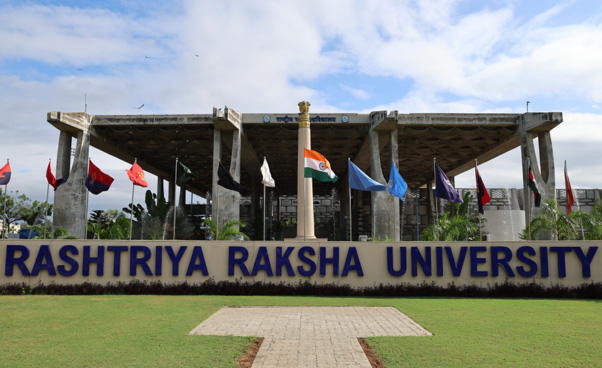
- Gandhinagar’s Rashtriya Raksha University to host five-day BRICS AML/CFT capacity-building programme under India’s 2026 Chairship
- Policymakers, Financial Intelligence Units, regulators, law-enforcement agencies and experts from BRICS nations to decode emerging financial crime threats
- Programme to focus on evolving FATF methodologies, emerging risks and practical best practices for stronger national AML/CFT frameworks
- RRU’s growing global footprint gets another boost as 61 specialised training programmes have brought together over 2,000 participants from 85 countries
NE EDUCATION BUREAU
GANDHINAGAR, SEPT 4
Money no longer moves at the speed of paperwork. Technology, digital networks and sophisticated financial structures can move illicit funds across borders in seconds—making international cooperation not an option, but a security imperative.
It is against this rapidly changing threat landscape that Rashtriya Raksha University (RRU), Gandhinagar, will bring together key stakeholders from the BRICS grouping for a five-day capacity-building programme on combating financial crime.
RRU, an Institution of National Importance under the Government of India, in collaboration with the FATF Cell, Department of Revenue, Ministry of Finance, will host the BRICS AML/CFT Capacity Building Training Programme on “Emerging Risks, FATF Methodologies & BRICS Best Practices” from September 7 to 11, 2026, at its Lavad campus in Gandhinagar.
The programme is being convened under India’s BRICS Chairship 2026, aligned with the broader BRICS agenda of “Building for Resilience, Innovation, Cooperation and Sustainability.”
From money trails to security threats
The programme comes at a time when the boundaries between financial crime, organised crime, terrorism and national security are becoming increasingly interconnected.
With technology transforming financial systems, illicit networks are adopting increasingly sophisticated methods to move and conceal funds across jurisdictions.
Against this backdrop, the training programme will seek to strengthen Anti-Money Laundering (AML) and Countering the Financing of Terrorism (CFT) capabilities among BRICS member states, with particular emphasis on emerging risks, evolving international standards and effective institutional responses.
BRICS experts to turn knowledge into action
The five-day programme will bring together policymakers, Financial Intelligence Units (FIUs), supervisory authorities, law-enforcement and prosecution agencies and subject experts from BRICS member states.
Expert-led sessions, country presentations and interactive discussions will examine emerging financial crime threats and the practical application of Financial Action Task Force (FATF) methodologies.
Rather than limiting the programme to theoretical understanding, the emphasis will be on peer learning, operational knowledge-sharing and practical approaches to strengthening national AML/CFT systems.
The programme will also provide an opportunity for participating institutions to deepen professional networks and exchange experiences on tackling increasingly complex and transnational financial crime.
Technology changes the crime—cooperation must change faster
The growing use of technology, increasingly complex financial networks and the transnational movement of illicit funds have made traditional, isolated responses inadequate.
Effective prevention, detection and enforcement therefore demand closer institutional coordination and systematic exchange of operational experience.
The RRU programme is designed around precisely this requirement—creating a platform where BRICS institutions can compare approaches, understand emerging vulnerabilities and explore stronger mechanisms for cooperation.
RRU emerges as a global security knowledge hub
The programme further strengthens RRU’s expanding role in international security education, training and capacity-building.
Described as the world’s first integrated national security education, research and training ecosystem, RRU has developed a multidisciplinary platform spanning national, internal and allied security domains.
Its international capacity-building record is significant: the University has successfully organised 61 specialised training programmes involving more than 2,000 participants from 85 countries.
Its engagement with the BRICS AML/CFT programme reflects this broader mandate—bringing together education, research, training and international cooperation to address security challenges that increasingly cut across traditional boundaries.
‘RRU fills a critical niche’
The University’s role in the security and allied domains has also received recognition from the Union Finance Minister.
Addressing RRU’s 4th Convocation, she observed: “The institution fills a critical niche by professionally training and certifying stakeholders across internal security, national security, and economic security through domain experts.”
The BRICS programme gives this vision a practical international dimension by bringing economic security and financial crime prevention into a wider multilateral security dialogue.
India’s BRICS chairship gets a capacity-building dimension
The inaugural session of the programme will commence at 9.30 am on September 7 at the RRU campus in Lavad, Gandhinagar.
For India’s BRICS Chairship 2026, the initiative represents a substantive contribution to building technical cooperation, institutional linkages and professional capabilities among member states.
For RRU, it is another opportunity to demonstrate how a modern security university can move beyond classrooms and research laboratories to become a bridge between policy, professional practice and international cooperation.
And in the global fight against financial crime, the message emerging from Gandhinagar is clear: follow the money, share the intelligence and strengthen the institutions before the threat becomes a security crisis.