
R ARIVANANTHAM
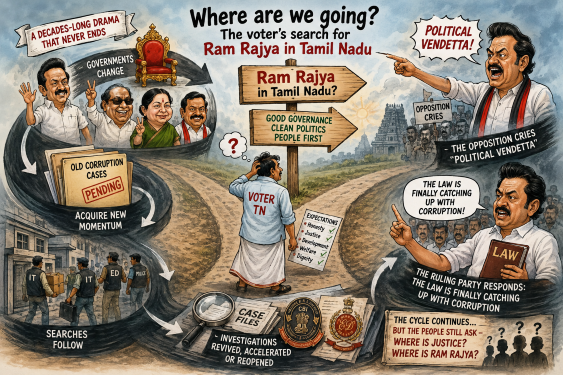
Where are we going?
That is perhaps the most uncomfortable question confronting Indian democracy whenever a government changes and the investigative spotlight turns towards the leaders of the previous regime.
Tamil Nadu has witnessed this political drama repeatedly over the decades. Governments change. Old corruption cases acquire new momentum. Searches follow. Investigations are revived, accelerated or reopened. The Opposition cries “political vendetta”. The ruling party responds that the law is finally catching up with corruption.
- Every change of government should not mean a change in the direction of the corruption probe
- Investigate every credible allegation—but let evidence, not political arithmetic, determine guilt
- The Supreme Court has repeatedly underlined the need for independent, impartial and accountable investigative institutions
- Neither the ruling party nor the Opposition can claim immunity from the law
- For the voter, the ultimate demand is simple: clean governance, integrity in public life and justice without political colour
Then, sooner or later, the political wheel turns again.
And the question remains.
Is the State genuinely fighting corruption—or are successive governments merely inheriting and reusing the same political weapon?
The latest controversy surrounding DVAC searches at premises linked to former DMK minister K N Nehru has once again brought this question into sharp focus. The searches relate to allegations concerning recruitment in the Municipal Administration and Water Supply Department. Nehru and the DMK have questioned the political intent of the action, while the ruling side maintains that the investigation is a lawful process based on complaints and evidence.
Both sides are entitled to their positions.
But neither side should have the final word.
Evidence should.
The citizen is tired of the revolving door
For the ordinary voter, corruption is not an abstract political slogan.
It can mean a government job allegedly being sold to the highest bidder. It can mean a public contract allegedly manipulated. It can mean money intended for roads, schools, hospitals or welfare schemes failing to reach the people for whom it was sanctioned.
It can also mean something more corrosive—the feeling that influence matters more than merit and political connections matter more than citizenship.
The voter therefore has little sympathy for the argument that a politician should not be investigated merely because he belongs to the Opposition.
But the same voter has an equally legitimate question for every government:
Would you pursue the same allegation with the same urgency if the accused belonged to your own party?
That is the credibility test.
An anti-corruption agency cannot become an agency of the ruling party.
Equally, the Opposition cannot demand that its leaders be placed beyond investigation merely because the investigation is politically inconvenient.
The principle must be simple:
No immunity for the powerful. No persecution of the innocent.
The Supreme Court has shown the way
India’s Supreme Court has wrestled with precisely this dilemma for decades.
In the landmark Vineet Narain v Union of India judgment, the Court confronted concerns over investigative agencies being vulnerable to extraneous influence and laid down institutional safeguards aimed at ensuring fair and impartial investigation.
The underlying constitutional message remains relevant: public office is a public trust, and the machinery of investigation cannot be permitted to become captive to political considerations.
At the same time, democratic accountability also demands that genuine allegations of corruption not be buried merely because the accused occupies a high office.
That balance is crucial.
Not “catch everyone who belonged to the previous government.”
Not “protect everyone who belongs to the present government.”
But:
Investigate everyone against whom there is credible material.
The law must be above the Government too
The Supreme Court’s corruption jurisprudence has repeatedly rejected the notion that high office should place an individual beyond scrutiny.
In Subramanian Swamy v Director, CBI, the Constitution Bench struck down the statutory protection that had required prior approval before the CBI could conduct an inquiry or investigation into corruption allegations against senior government officials.
The larger constitutional principle was unmistakable:
However high you may be, the law is above you.
But there is another side to that principle which deserves equal emphasis:
The law must be above the Government too.
That means an investigative agency must have the freedom to investigate those in power, but it must also have the credibility to demonstrate that it is not being used to settle political scores.
The difficult balance in corruption law
The Supreme Court’s more recent jurisprudence has shown how delicate this balance can be.
The debate surrounding Section 17A of the Prevention of Corruption Act reflects a fundamental dilemma: how does the country protect honest public servants from frivolous or malicious investigations while ensuring that procedural safeguards do not become a protective wall behind which genuine corruption can hide?
There is no easy answer.
Honest decision-making must not become a criminal offence merely because a decision later turns out badly.
But corruption cannot be legitimised merely because it was committed in the name of exercising official discretion.
The answer lies in independent scrutiny, credible evidence, due process and judicial oversight.
That is why institutions matter more than personalities.
The agency must answer to evidence, not the election calendar
There is a straightforward test of public confidence in any corruption investigation.
- Was there credible material to begin the investigation?
- Was the same yardstick applied to people across political parties?
- Will the investigation continue even if political circumstances change?
If the answer to all three is yes, an Opposition allegation of vendetta should not be allowed to derail a legitimate investigation.
If there is no credible material, the government has a serious credibility problem.
And if investigations mysteriously accelerate with political changes or election schedules, the government must expect legitimate public scrutiny.
The independence of an investigative agency is not established merely by saying that it is independent.
It has to be demonstrated through conduct.
The political cycle must end somewhere
There is an uncomfortable irony in India’s politics.
The party in Opposition today may become the ruling party tomorrow.
The agency celebrated as fearless today may be condemned as politically motivated tomorrow.
The roles change.
The rhetoric changes.
The citizen does not.
The same taxpayer pays taxes under every government.
The same young person competes for government employment.
The same family depends on public hospitals.
The same commuter travels on public roads.
The same farmer seeks government support.
The citizen is not interested in the political colour of an investigation.
The citizen wants to know whether the government is clean.
Corruption must not change colour
This is where political parties need to introspect.
If corruption is genuinely the enemy, it cannot become acceptable merely because the accused belongs to one’s own party.
If an investigation is genuinely legitimate, it cannot become illegitimate merely because the accused belongs to the Opposition.
And if an investigative agency is genuinely independent, it must be equally fearless when the trail leads towards the corridors of the ruling establishment.
Otherwise, India risks remaining trapped in a cycle:
Government changes → raids begin → Opposition cries vendetta → ruling party cites corruption → cases continue → government changes again → the cycle repeats.
The political protagonists change.
The script remains the same.
The unfinished battle against corruption
Former Prime Minister Indira Gandhi is often attributed with the observation that corruption is a worldwide phenomenon and that India is no exception. The precise wording of the often-repeated quotation is difficult to authenticate from a primary source, but the larger thought remains relevant.
- Corruption is not the property of one party.
- It is not confined to one State.
- It does not disappear merely because one government replaces another.
- It is a problem of governance and public morality.
India cannot claim to have defeated corruption merely because one government arrests, searches or prosecutes alleged corrupt leaders of another.
A genuinely clean government is one that is prepared to investigate its own people with the same determination with which it investigates its political opponents.
That is the real test.
What the voter really wants
Perhaps the most important stakeholder in this entire debate is missing from the political shouting match:
The voter.
- The voter does not want a government that protects corruption.
- The voter does not want a government that selectively pursues corruption.
- The voter does not want investigative agencies to become political instruments.
- The voter does not want powerful Opposition leaders to be immune from scrutiny either.
- The voter wants something much more basic—and much more difficult:
- A clean government.
- An honest government.
- A government where public office is treated as a trust, not a privilege.
- A government where an ordinary citizen does not need political connections to obtain what is rightfully his.
And this is where the timeless ideal of Mahatma Gandhi’s Ram Rajya acquires contemporary relevance.
Ram Rajya, in the Gandhian understanding, was not about establishing a theocratic State or privileging one community. It represented an ethical ideal of governance rooted in truth, justice, equality, accountability and concern for the weakest.
That is precisely what the citizen continues to seek.
Ram Rajya is the destination
At the end of every election, citizens ask for no miracle.
They ask for what Mahatma Gandhi envisioned as Ram Rajya—a system where truth matters, justice is impartial, public office is a trust and the weakest citizen is not compelled to seek political patronage for his rightful due.
- They do not want corruption to change colour when governments change.
- They want corruption to disappear.
- They do not want investigative agencies to become instruments of the ruling party.
- They want institutions strong enough to investigate the ruling party itself.
- They do not want the Opposition to be above the law.
- They do not want the Government to be above scrutiny.
- The ultimate test of democracy, therefore, is not how effectively one political party defeats another.
- It is how effectively the State protects the citizen from corruption, arbitrariness and abuse of power.
- The question arising from every high-profile raid should therefore not merely be:
“Whose house was searched?”
The larger question should be:
“Will the truth be searched for with the same determination?”
That is where Tamil Nadu—and India—must go.
- Not from one political vendetta to another, but from political power to institutional accountability.
- Not merely from one government to another, but towards a government worthy of the people’s trust.
And perhaps, after decades of political promises, that is all the citizen is really asking for: