R ARIVANANTHAM
CHENNAI, SEPT 8
The wind is no longer merely turning turbines—it is turning the wheels of a new Indian industrial opportunity. As the country races towards 100 GW of wind power by 2030, Chennai is preparing to become the meeting point for the manufacturers, technology companies, policymakers and investors who could determine how much of that ambition is built in India, engineered in India and exported from India.
- Windergy India 2026 to put India’s wind manufacturing might, technology and exports in the global spotlight
- Record 6.05 GW addition takes installed wind capacity to 58.14 GW as industry races towards 100 GW by 2030
- Tamil Nadu’s component makers emerge as the backbone of a deeper, more resilient domestic supply chain
- Gearboxes, bearings, advanced materials and high-value components become the next indigenisation frontier
- 7.4 GW ageing Tamil Nadu wind fleet opens a massive repowering opportunity; offshore wind adds another growth avenue
- 20,000-plus industry participants, 350 exhibitors and 30-plus countries to converge at Chennai Trade Centre
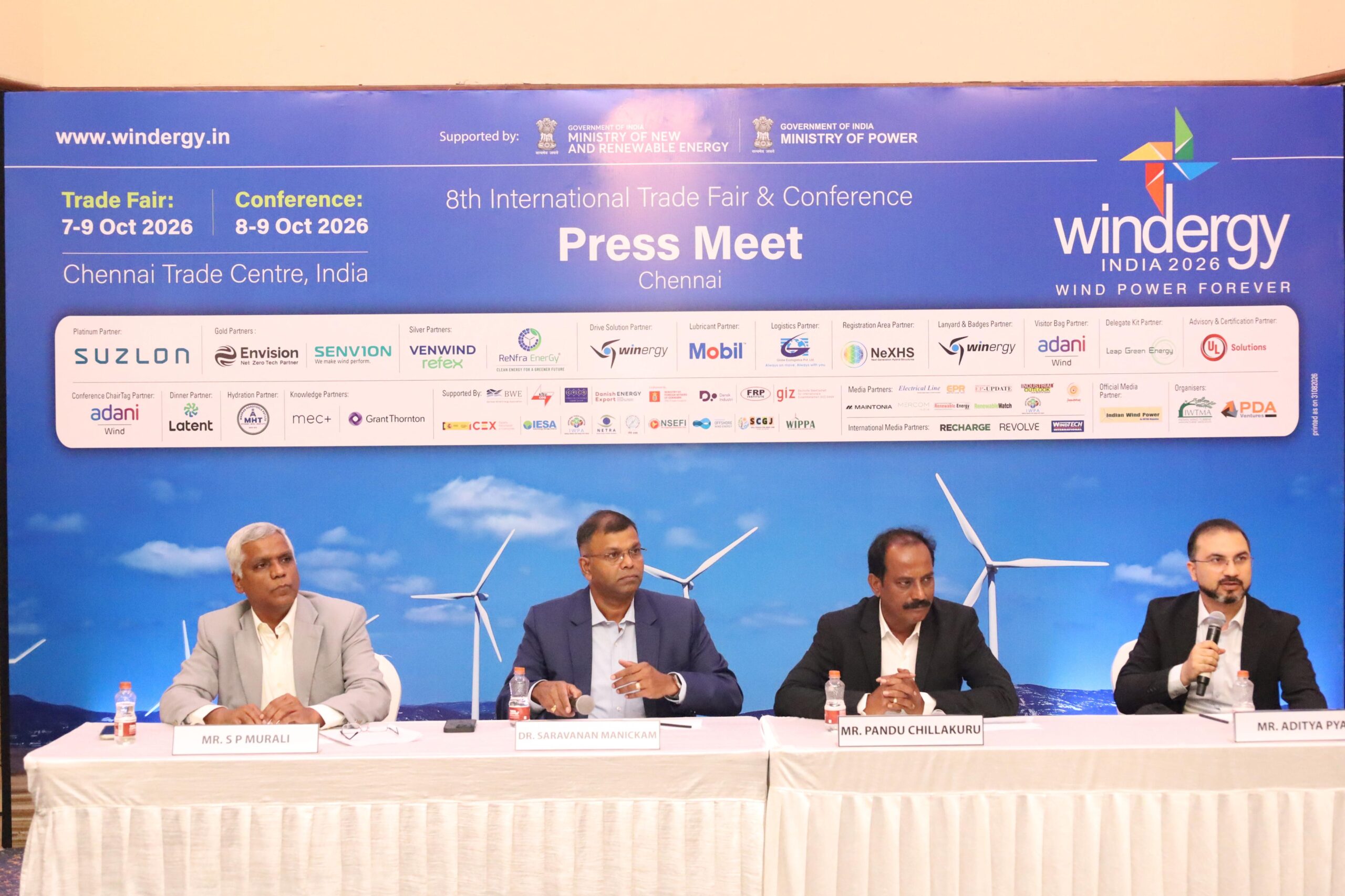
Against the backdrop of India’s strongest-ever annual wind capacity addition, Windergy India 2026: “Wind – Powering India’s Energy Resilience” will bring the country’s wind-energy ecosystem into sharp focus at the Chennai Trade Centre from October 7 to 9, 2026.
India added a record 6.05 GW of wind capacity in FY2025-26, taking cumulative installed capacity to 58.14 GW as of July 31, 2026. With a live construction pipeline of around 43 GW and an industry target of 100 GW by 2030, the next challenge is no longer simply installing turbines—it is building the manufacturing depth and supply-chain resilience to sustain the acceleration.
58 GW today, 100 GW tomorrow—and manufacturing must keep pace
The industry’s growth story is increasingly becoming a manufacturing story.
Domestic turbine manufacturing capacity has risen to 24 GW annually, double the 12 GW level of 2020-21, while wind equipment exports crossed ₹12,000 crore in FY2025-26, registering growth of nearly 50%.
For Tamil Nadu, which hosts a dense ecosystem of wind-turbine and component manufacturers, the opportunity is particularly significant.
“India has made significant strides in wind energy capacity, having nearly doubled in just five years to reach around 58 GW of installed capacity. To sustain this momentum towards 100 GW by 2030, we need to focus equally on manufacturing depth and supply chain resilience. Tamil Nadu’s role in this journey has been significant, and India has made commendable progress in indigenization, with domestic value addition now estimated at 70-80%, but strengthening capability in high-value components such as gearboxes, specialised bearings, and materials will be critical to closing the remaining gap and building a truly self-reliant wind manufacturing ecosystem,” said Dr. Saravanan Manickam, Vice Chairman cum Secretary, IWTMA.
The message is clear: India’s next wind revolution will have to be powered not only by more turbines, but by more Indian technology, deeper supplier networks and greater domestic value addition.
Tamil Nadu’s component makers at the heart of the wind machine
The component industry is emerging as one of the most critical links in India’s wind-energy ambitions.
From gearboxes and bearings to specialised materials and engineering systems, high-value components will determine how successfully India can transition from manufacturing turbines at scale to building a globally competitive wind-energy supply chain.
“Building critical components for wind turbines is about far more than production, it is about engineering the backbone of the next generation of renewable energy infrastructure. That means investing in advanced production technologies, deepening the domestic supplier ecosystem, and building skilled engineering talent that can innovate, not just manufacture. India’s real opportunity lies in creating technologies from India that meet global standards, not merely assembling them here,” said Pandu Chillakuru, Whole-time Director, Flender Drives Private Limited, and Executive Committee Member, IWTMA.
The emphasis is increasingly shifting from capacity alone to quality, technology, reliability and global competitiveness.
“As component manufacturers scale up to meet India’s wind ambitions, the focus must remain on standardization, vertical integration, and process discipline that can deliver dependable, high-performance components at volume. Strengthening the local supply chain in this way is what will support both the industry’s growth and India’s position in the global wind value chain,” added Murali Sivaperumal, Executive Committee Member, IWTMA, and Business Director – Region India and AP Service, ZF Wind Power Coimbatore Private Limited.
Repowering: the sleeping giant in Tamil Nadu’s wind landscape
The next wave of growth may not come only from new wind farms.
Repowering—replacing older, lower-capacity turbines with modern, higher-output machines—could unlock a major new opportunity, particularly in Tamil Nadu.
Of the estimated 25.4 GW of ageing wind capacity nationally eligible for repowering, 7.4 GW is located in Tamil Nadu.
The national repowering opportunity is estimated at around ₹1.4-1.5 lakh crore, making the replacement of older turbines a potentially transformative investment opportunity for developers, equipment manufacturers and the wider component ecosystem.
Tamil Nadu is also positioned prominently in India’s emerging offshore wind programme. Of the government’s first 1 GW of viability-gap-funded offshore wind capacity, 500 MW has been earmarked off the Tamil Nadu coast, with the balance planned off Gujarat.
That creates a second major frontier—one that could eventually expand India’s wind industry from established onshore manufacturing clusters into sophisticated offshore technologies and supply chains.
Industry calls for coordinated push to build resilient ecosystem
The scale of India’s ambition demands closer coordination between turbine manufacturers, component suppliers, technology providers and policymakers.
“India’s next phase of wind growth must be supported by a resilient and globally competitive domestic manufacturing ecosystem. As the industry transitions towards higher-rated turbines, we need to accelerate indigenisation across critical components while simultaneously building the manufacturing capacity required to meet growing demand. This will require coordinated efforts across OEMs, component manufacturers, technology providers and government, with a focus on strengthening supply chains, developing domestic capabilities and enabling scale. Windergy India 2026 provides an excellent platform to bring the ecosystem together,” said Aditya Pyasi, CEO, IWTMA.
That ecosystem approach will be central to Windergy India’s eighth edition, which seeks to connect India’s rapidly expanding wind market with global technology, investment and manufacturing opportunities.
“Windergy India, international trade fair and conference, has grown into a platform that brings the entire wind ecosystem together. As India works towards its capacity targets, we will keep doing our part to give this industry the platform it needs to connect and grow,” said Pradeep Devaiah, Chairman & CEO, PDA Ventures Pvt Ltd.
Chennai ready for a global wind-energy congregation
Organised by IWTMA and PDA Ventures Pvt Ltd, with support from the Ministry of Power and Ministry of New and Renewable Energy (MNRE), Windergy India 2026 is expected to attract 20,000-plus attendees, 400-plus delegates and 350 exhibitors from more than 30 countries.
Suzlon India will be the Platinum Partner, while Envision and Senvion will participate as Gold Partners.
The two-day conference themed “Wind – Powering India’s Energy Resilience” will form a key part of the programme, alongside a dedicated Academia Session aimed at strengthening the connection between industry, technology and future talent.
As India seeks to build 100 GW of wind capacity by 2030, the Chennai meet arrives at a decisive moment. The country’s wind story is moving beyond megawatts to encompass manufacturing depth, technology leadership, exports, repowering, offshore development and supply-chain resilience.
And Tamil Nadu, with its established industrial base and component ecosystem, is positioned to play a starring role.
The wind, quite literally, is blowing in India’s favour. The bigger question now is how much industrial power India can extract from every turn of the turbine.