- Seven Swadesh pavilions bring India’s living traditions of weaving, embroidery, jewellery, painting and silverwork into the heart of contemporary Mumbai
- From Banarasi weaves and Kashmir’s Sozni to Rajasthan’s Pichwai and Odisha’s silver filigree, master artisans turn inherited knowledge into living art
- Rotating seasonal showcases give visitors an intimate view of the hands, techniques and stories behind some of India’s finest crafts
- Beyond displaying finished objects, Swadesh creates direct encounters between artisans and audiences, helping centuries-old skills find new admirers and apprentices
- At NMACC, craft becomes more than heritage on display—it becomes a living conversation between India’s past, present and creative future
NE FEATURES BUREAU
MUMBAI, SEPT 10
What if the most advanced way to preserve India’s craft heritage is not to place it behind glass, but to put the artisan in front of the visitor? At the Nita Mukesh Ambani Cultural Centre (NMACC), Swadesh is doing precisely that—bringing generations of craft knowledge, skill and storytelling alive through the hands of the master artisans who carry them forward.
In an age of mass production, artificial intelligence and digital design, the allure of something made by hand lies in much more than its beauty. Every weave, stitch, carving and embellishment carries a repository of knowledge—techniques refined over generations, shaped by local materials, regional identities and communities that have kept them alive.
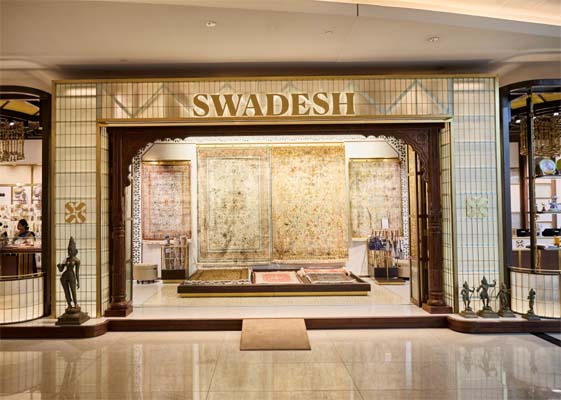
Swadesh, an initiative by Reliance Foundation, brings these living traditions into a contemporary cultural setting, giving visitors an opportunity not merely to admire the finished creation but to witness the skill, patience and human knowledge behind it.
Seven pavilions, a living India
The Swadesh experience unfolds through seven pavilions along NMACC’s concourse, with the featured crafts rotating each season.
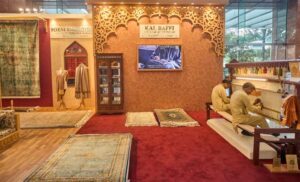
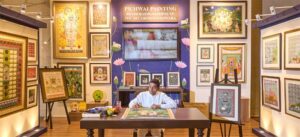
The current line-up traverses India’s remarkable geographical and artistic diversity: Zardozi from Delhi, Uttar Pradesh and West Bengal; Dank Polki jewellery from Telangana and Rajasthan; Pichwai painting and gemstone carving from Rajasthan; Banarasi weaves from Uttar Pradesh; Kal Baffi carpets and Sozni embroidery from Kashmir; and silver smithing from Odisha and Telangana.
Each pavilion offers a different window into India’s craft vocabulary.
But the real attraction is not simply the diversity of the objects. It is the opportunity to see craft in the making.
When the artisan becomes the storyteller
What distinguishes Swadesh is its sense of proximity.
Rather than presenting handicrafts only as finished products, the pavilions bring visitors closer to the people and processes that give them life. Artisans work within the space, allowing audiences to observe techniques and engage directly with practitioners.
An Odisha silversmith draws silver into hair-fine wire before shaping it into intricate filigree.
A Banarasi weaver works across a loom threaded with hundreds of silk strands.
A Pichwai artist translates devotional traditions onto the canvas through intricate detail and colour.
A Sozni artisan patiently builds delicate embroidery stitch by stitch.
Suddenly, the finished object tells only half the story.
The other half lies in the hands that made it.
The knowledge hidden inside every stitch
For traditional crafts, the greatest inheritance is often invisible.
It is the knowledge of how a particular material behaves, how a pattern is formed, how a tool is handled, how much pressure a stitch requires, how a design is adapted to regional aesthetics and how a technique is passed from one generation to the next.
Swadesh brings that intangible heritage into view.
The experience allows visitors to hear artisans speak about the skills and knowledge they have inherited, transforming what might otherwise be seen simply as a beautiful object into a story of time, discipline, community and continuity.
When visibility becomes a lifeline
For several traditional crafts, visibility is not merely about cultural recognition—it can influence whether the skill survives.
Sozni embroidery, for instance, has long been practised by Kashmiri artisans and traditionally provided seasonal work for farming communities during the winter months.
At Swadesh, the craft encounters new audiences in a contemporary cultural environment, helping create renewed interest in traditions that have faced the risk of fading from everyday practice.
That interaction can also matter to the next generation.
When young people see traditional craftsmanship being valued, discussed and experienced by a new audience, an inherited skill can begin to look not simply like a memory from the past, but as a living creative possibility for the future.
Beyond what is made
The deeper proposition of Swadesh is that craft preservation cannot stop at preserving objects.
It must preserve the knowledge, techniques, stories and communities that make those objects possible.
The Swadesh pavilions provide an intimate look at the people and processes behind India’s craft traditions, with artisans working within the space and translating generations of knowledge into embroidery, weaving, jewellery, painting and silverwork.
NMACC, with its focus on Indian art, heritage and contemporary cultural expression, provides a setting where these traditions can be encountered from a fresh perspective.
Here, craft is not frozen in time.
It is being seen, discussed, demonstrated and reimagined.
And perhaps that is the most meaningful way to keep heritage alive: not by asking future generations merely to remember it, but by giving them a reason to engage with it.