- PM welcomes expanded BRICS family, says diversity and cooperation are the grouping’s greatest strengths
- Resilience, Innovation, Cooperation and Sustainability drive India’s agenda for inclusive global growth
- New Delhi Declaration gives “new impetus” to international cooperation and solidarity
- From early-warning systems to startups, digital agriculture and clean energy, BRICS expands practical cooperation
- “Solutions” for Global South must be built “with them”, not merely “for them”, says Modi
NE NEWS SERVICE
NEW DELHI, SEPT 13
India’s BRICS presidency has placed resilience, innovation, cooperation and sustainability at the centre of an ambitious effort to turn the expanded grouping into a practical platform for inclusive global growth, with Prime Minister Narendra Modi asserting that its strength lies not merely in its diversity but in its ability to convert that diversity into solutions for humanity.
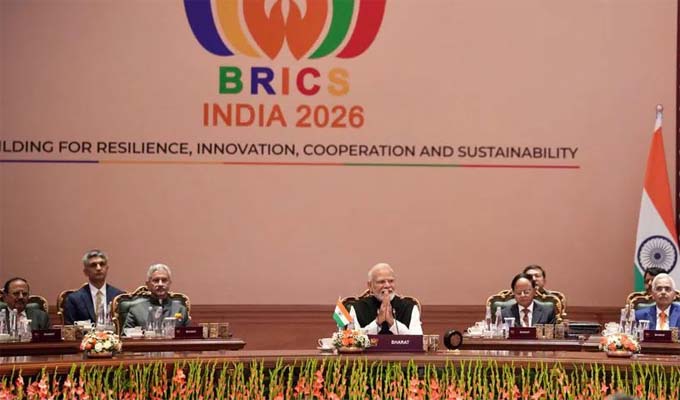
Welcoming leaders of the expanded BRICS family at Bharat Mandapam on Sunday, Modi said the gathering of countries from different continents, cultures and development journeys was a testimony to the grouping’s “growing strength, attraction and unprecedented trust.”
“BRICS ki shakti hamari diversity aur cooperation mein hai,” Modi said, stressing that the four pillars of India’s presidency—Resilience, Innovation, Cooperation and Sustainability—were being translated into practical, win-win initiatives.
The second day of the 18th BRICS Summit brought together United Nations Secretary-General Antonio Guterres, Malaysian Prime Minister Anwar Ibrahim, Ghana President John Mahama, Burundi President Evariste Ndayishimiye, Vietnamese Prime Minister Le Minh Hung, Kazakhstan President Kassym-Jomart Tokayev, Philippines President Ferdinand R. Marcos and Saudi Foreign Minister Faisal bin Farhan Al Saud, among other leaders and representatives.
The leaders of BRICS and outreach nations were scheduled to participate in an open session focusing on the theme “Resilience, Innovation, Cooperation and Sustainability: Shaping the Future for Inclusive Global Growth”, deliberating on areas of mutual interest and ways to deepen cooperation across sectors.
Building resilience against a connected world’s shocks
Modi underlined that rising geopolitical tensions, pandemics, climate disasters and supply-chain disruptions have demonstrated that no crisis remains confined to a single region in an interconnected world.
“Today, the number of tensions in the world is continuously increasing, and they are having a very negative and widespread impact on the lives of ordinary people,” he said.
India’s BRICS initiatives therefore seek to strengthen the grouping’s ability to anticipate and respond to emerging challenges. Among them are the BRICS Integrated Early Warning System for infectious diseases, Early Warning Data Integration Guidelines for disaster management and the BRICS Logistics Supply Chain Cooperation Framework to make supply chains more reliable and resilient.
Innovation that reaches startups, farmers and MSMEs
Under the innovation pillar, Modi highlighted the BRICS Incubator Network, designed to connect startups and incubators across member countries and accelerate innovative, scalable solutions.
India has also proposed a BRICS Startup Innovation Fund, while the BRICS Network on Digital Agriculture seeks to connect artificial intelligence, geospatial technology and Digital Public Infrastructure with the real-world needs of farmers.
Warning that the weaponisation of technology and critical minerals could obstruct shared progress, Modi called for inclusivity in technology adoption.
He also stressed that BRICS cooperation should not remain confined to governments. Entrepreneurs, farmers, researchers, women, youth and ordinary citizens must become active participants.
Initiatives such as BRICS CONNECT seek to promote skills, employability, women’s participation in the workforce, social security and capacity building, while the BRICS MSME Cooperation Portal aims to connect smaller enterprises with knowledge, finance and new markets.
A BRICS Urban Mobility Hub will facilitate the exchange of best practices among cities.
Sustainability as a civilisational responsibility
Modi linked the sustainability pillar to India’s civilisational ethos, noting that Indian culture has long regarded nature as a mother.
“Development and environment are not alternatives to each other; they are complementary,” he said, making the balance between human development and environmental protection the foundation of BRICS’ sustainability agenda.
India has highlighted a BRICS Digital Centre of Excellence for Smart Grids and Energy Storage to make clean-energy systems more reliable, efficient and accessible.
Centres of Excellence in Agro-Ecology and Regenerative Agriculture will seek to connect traditional knowledge with modern science, while principles for community-based climate adaptation will place indigenous knowledge at the heart of climate action.
Global South at the centre of the BRICS equation
The larger message of India’s BRICS presidency was its effort to ensure that the benefits of cooperation extend beyond the grouping itself.
Modi said solutions developed through BRICS should not remain restricted to BRICS countries but should be “adaptable and accessible” to the needs of the Global South.
Drawing on his personal experience, Modi said confidence in BRICS among Global South countries had grown because “their voice is heard, their experience is respected, and solutions are made with them, not for them.”
He concluded with a powerful formulation of the grouping’s larger purpose:
“We may be rooted in different realities, but together, we rise through cooperation, and blossom for humanity.”
He said BRICS’ diversity should remain its identity, cooperation its inspiration and its progress should serve all of humanity.
New Delhi Declaration marks diplomatic breakthrough
The summit’s political momentum was reinforced by the adoption of the New Delhi Declaration on Saturday—the first day of the summit.
The declaration commended India for hosting the Outreach/BRICS Plus Dialogue and said the country’s chairship had injected “new impetus” into strengthening international cooperation and solidarity.
BRICS leaders reaffirmed their commitment to the grouping’s founding spirit of mutual respect and understanding, sovereign equality, solidarity, democracy, openness, inclusiveness, collaboration and consensus.
The early consensus on a Joint Statement was also seen as a significant diplomatic achievement against the backdrop of sharply divergent geopolitical positions among several participating countries.
The New Delhi Declaration said that, building on two decades of BRICS, the expanded grouping would strengthen cooperation around three broad pillars—political and security; economic and financial; and cultural and people-to-people cooperation—while enhancing its strategic partnership in pursuit of peace, a more representative and fairer international order, a reformed multilateral system, sustainable development and inclusive growth.
A gala evening reflecting India’s soft power
The summit’s diplomatic engagements were complemented by a gala dinner hosted by Modi for BRICS leaders on Saturday evening.
Russian President Vladimir Putin, Kazakhstan President Kassym-Jomart Tokayev, Indonesian President Prabowo Subianto, Egyptian President Abdel Fattah el-Sisi and World Health Organization Director-General Tedros Adhanom Ghebreyesus were among the dignitaries who attended.
A specially curated vegan gala dinner showcased India’s culinary diversity while highlighting sustainability, inclusivity and mindful hospitality.
The evening also featured “Navarasa — The Universe of Shared Emotions”, a cultural presentation celebrating India’s artistic traditions, followed by the BRICS Symphony, “One Rhythm, Many Cultures”, bringing together musicians from BRICS members and partner countries.
With the expanded BRICS family now representing a broader spectrum of the Global South and emerging economies, New Delhi’s message was clear: the future of the grouping will be measured not merely by its size, but by its ability to turn diversity into cooperation and cooperation into tangible solutions for a changing world.