- Mazagon Dock signs MoU to anchor proposed Greenfield Shipbuilding Industrial Cluster in Raigad
- Facility envisages at least 1.2 million GT annual capacity for large commercial vessels
- Project aims to deepen domestic maritime ecosystem, skilled jobs and global competitiveness
- Dighi initiative aligns with Centre’s greenfield shipbuilding cluster framework and Maritime Amrit Kaal Vision 2047
NE DEFENCE BUREAU
MUMBAI, SEPT 16
Mazagon Dock Shipbuilders Limited (MDL) has set its sights beyond warships and submarines, signing an MoU to become the Anchor Shipyard for a proposed Greenfield Shipbuilding Industrial Cluster at Dighi in Raigad, Maharashtra, with an envisaged capacity of at least 1.2 million Gross Tonnage (GT) annually and an investment of approximately Rs 15,000 crore.
The strategic move marks a significant expansion of MDL’s shipbuilding ambitions into large-scale commercial vessels, while seeking to build a wider maritime industrial and supply-chain ecosystem around the proposed Dighi facility.
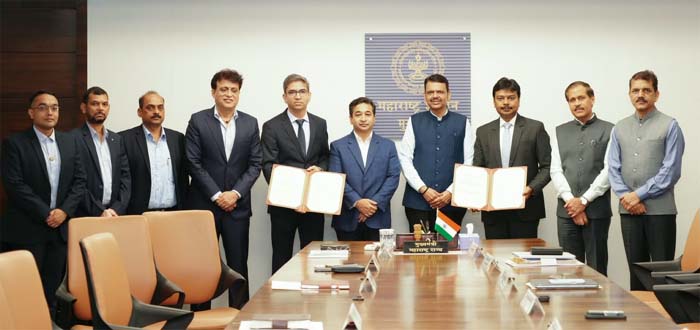
The MoU was signed on Tuesday in the presence of Maharashtra Chief Minister Devendra Fadnavis by Capt. Jagmohan, Chairman & Managing Director, MDL, and Pradeep P., Managing Director, National Shipbuilding & Heavy Industries Park Maharashtra Limited (NSHIPML).
From warships to commercial vessels
Under the proposed arrangement, MDL will participate as the Anchor Shipyard in the Dighi cluster, with the planned facility designed to strengthen India’s capacity to construct large commercial vessels.
Capt. Jagmohan said the agreement represents an important step in expanding MDL’s established capabilities.
“This MoU marks an important step in MDL’s expansion from its established strengths in warship and submarine construction towards large-scale commercial shipbuilding.”
He said MDL would bring to the project its experience in complex ship construction, engineering, project management and development of a strong domestic vendor ecosystem.
“We look forward to working with all stakeholders to create a modern and globally competitive shipbuilding facility,” Jagmohan said.
He also acknowledged the support of the Maharashtra Government and stakeholders, including Chief Minister Fadnavis and Cabinet Minister for Fisheries and Ports Development Nitish Rane.
1.2 million GT capacity on the drawing board
The proposed MDL facility is envisaged with a minimum shipbuilding capacity of 1.2 million GT per annum, backed by an estimated investment of Rs 15,000 crore.
The project is intended to provide modern shipbuilding infrastructure capable of supporting construction of large commercial vessels while strengthening India’s broader maritime manufacturing capabilities.
Beyond the shipyard itself, the Dighi development is expected to catalyse an associated industrial, vendor and supply-chain ecosystem, creating opportunities across engineering, fabrication, logistics, marine equipment and allied sectors.
Building a wider maritime ecosystem
The initiative is being taken forward under the Government of India’s framework for development of greenfield shipbuilding clusters and supports the objectives of Maritime Amrit Kaal Vision 2047.
NSHIPML is the Special Purpose Vehicle (SPV) jointly constituted by the Maharashtra Maritime Board and Mumbai Port Authority for developing the greenfield shipbuilding cluster in the State.
The proposed cluster is expected to contribute to national objectives of expanding indigenous shipbuilding capacity, attracting technology and investment, creating skilled employment and enhancing India’s competitiveness in the global maritime sector.
Five-year MoU framework
The MoU provides the framework for the strategic partnership between MDL and NSHIPML.
It will remain valid for five years from its effective date, or until it is superseded by a comprehensive Concession Agreement, including the Lease Agreement, whichever is earlier.
The Dighi project thus places MDL at the centre of an ambitious effort to expand India’s shipbuilding footprint—from its established defence shipbuilding base towards a larger commercial maritime manufacturing ecosystem.