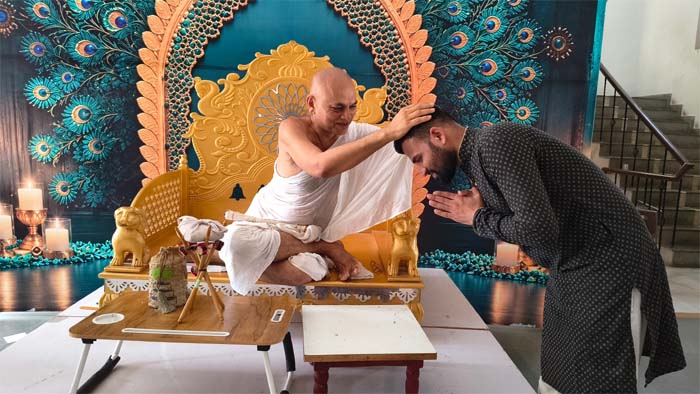
- Can the conquest of a craving become a journey into the self? Jain shravak Nipeksh Sheth prepares to complete a 180-day penance
- Beginning March 24, the 28-year-old has undertaken the extraordinary austerity relying solely on boiled water
- Five Palitana pilgrimages, including climbs up the 3,500 steps, became milestones during the arduous spiritual journey
- Acharya Narratnasurishwarji: “Willpower is the essence” of such prolonged Upvas, leading towards self-purification, detachment and inner awakening
- Medical monitoring continued at regular intervals; Dr Ashishbhai Shah says vital, metabolic, organ-function and nutritional parameters were monitored
NE SPIRITUAL BUREAU
AHMEDABAD, SEPT 16
What happens when hunger stops being an adversary and becomes an exercise in self-discipline? For Jain shravak Nipeksh Sheth, the answer is unfolding through a 180-day penance that has taken him from the beginning of his fast on March 24 to its scheduled culmination at Pankaj Jain Sangh, Bhattha, Paldi, on Sunday, September 20.
What began as an extraordinarily demanding spiritual resolve has, in Sheth’s own words, become “the greatest spiritual journey” of his life—one that he says has taken him beyond physical fatigue towards inner peace, non-violence and self-restraint.
The 28-year-old Ahmedabad-based Jain shravak has undertaken the prolonged penance with boiled water as his sole intake, according to reports on his austerity. Gujarati media has also reported that he completed five pilgrimages to Palitana Giriraj during the penance, including climbs of its approximately 3,500 steps.
The culmination, known as Parna, will be held on September 20 in the presence of Gacchadhipati Param Pujya Acharya Shri Narratnasurishwarji Maharaja, who administered the vows for the penance. The programme will bring together Jain monks and nuns, Shravaks and Shravikas, family members and members of the community.
When willpower becomes the spiritual compass
Blessing Sheth in Ahmedabad and addressing the media, Acharya Narratnasurishwarji Maharaja said the significance of the penance lay not merely in abstaining from food but in the discipline and spiritual intent behind it.
“Today’s youth power is the invaluable heritage of a developed India, tasked with preserving the core values of all communities in the country,” he said.
“In this materialistic era, preserving these values can certainly be achieved through resolute faith, self-restraint, and supreme penance of will power by remaining steadfast for 180 days solely on boiled water.”
The Acharya said fasting should not be viewed merely as physical hardship.
“Fasting is not merely a means of causing hardship to the physical body, but a spiritual process of cleansing the karmic impurities accumulated on the soul,” he said, describing Sheth’s penance as an inspiration for the Jain order and society.
He also underlined the role of dietary discipline in contemporary life, saying improper dietary habits and excessive consumption of junk or frozen food were contributing to health problems. He said, in the Jain spiritual understanding, properly undertaken fasting cultivates self-restraint and self-purification.
‘Willpower is the essence’
Asked by a reporter how the mind overcame the craving for food during such a prolonged fast, the Acharya said:
“Willpower is the essence of such a long Upvas which ultimately helps in undertaking a journey of self-purification, detachment and inner awakening.”
That formulation perhaps captures the essence of Sheth’s journey: the fast is being presented within the Jain tradition not simply as abstinence, but as an exercise in mastering desire.
Five journeys to Palitana
The penance has also had a remarkable physical dimension.
One of the disciples of Acharya Narratnasurishwarji Maharaja said Sheth undertook five pilgrimages to Palitana during the period and climbed the hill to pay obeisance to the presiding deity.
According to the disciple, the pilgrimages included the first day of the penance and subsequent milestones, with Sheth undertaking the climb of about 3,500 steps to the temple complex.
Thus, the journey has had two contrasting dimensions—withdrawal from food and movement towards the sacred.
Medical monitoring alongside spiritual discipline
The prolonged dietary restriction has also been accompanied by medical monitoring.
Commenting on Sheth’s medical history and health profile before the commencement of the 180-day Upvas and at regular intervals, Dr Ashishbhai Shah of Sumandeep University said: “Nipeksh Sheth has been regularly subjected to vital signs, hydration, electrolytes, metabolic parameters, organ function and nutritional status. During this prolonged period, his body has responded well to the extraordinary dietary restriction without any medical issue.”
The medical observation adds another dimension to the account: while the spiritual significance of the penance is understood within Jain religious practice, its physical effects require careful monitoring, particularly during such an extended period of dietary restriction.
‘The greatest spiritual journey of my life’
For Sheth himself, the experience has been as much about the mind and spirit as the body.
“My faith in Jainism, along with the guidance and blessings of my parents and Gacchadhipati Gurudev Param Pujya Acharya Shri Narratnasurishwarji Maharaja, turned this 180-day penance into the greatest spiritual journey of my life,” he said.
“In the initial days, there were physical challenges, but the blessings of Gurubhagwant Param Pujya Acharya Shri Narratnasurishwarji Maharaja, firm faith in the Jinshasan (Jain Order), and the chanting of the Navkar Mantra made physical fatigue vanish.”
His experience, he said, reinforced his belief that mental resolve can shape the response to physical difficulty.
“During this penance, I realized that if the mind is strong, the body can endure any difficult resolve.”
He said the austerity had given him “immense inner peace, non-violence, and a true realization of self-restraint”.
“This achievement is not mine alone, but the result of divine grace from the Guru and the selfless support of my family,” Sheth said.
The final step: Parna
The 180-day penance will reach its formal conclusion on September 20, when Sheth is scheduled to undertake Parna at Pankaj Jain Sangh.
Ahead of that, religious programmes have been scheduled, including Shakrastava Abhishek and Sanji Mehndi on September 18, Tap Vandanavali and other programmes on September 19, followed by Shobhayatra and Sahparanu on September 20, according to the organisers.
After 180 days of restraint, the final act will therefore not simply mark the end of a fast. Within the Jain spiritual framework, it represents the completion of a long discipline—a journey in which the destination is not merely the return to food, but a deeper understanding of restraint, faith and the self.