NE NEWS SERVICE
NEW DELHI, SEPT 19
From Gujarat to Tamil Nadu, the 20th Rozgar Mela’s nationwide reach underscores the expanding role of young Indians in public service, as Prime Minister Narendra Modi distributes over 51,000 appointment letters and calls upon the new recruits to turn governance into a catalyst for opportunity, innovation and citizen-centric development.
India's Yuva Shakti is at the heart of our journey towards a Viksit Bharat. The Rozgar Mela reflects our commitment to creating new opportunities for the youth. https://t.co/lHgFkJ6zmM
— Narendra Modi (@narendramodi) September 19, 2026
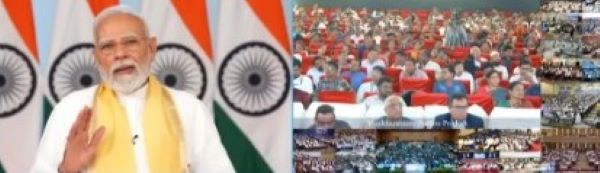
Prime Minister Narendra Modi on Saturday distributed more than 51,000 appointment letters to newly appointed youth in various government organisations through video conferencing at the 20th Rozgar Mela, placing the aspirations, skills and public-service responsibilities of India’s younger generation at the centre of the journey towards a developed nation by 2047.
- Gujarat, Tamil Nadu among states in focus as 20th Rozgar Mela distributes over 51,000 appointment letters
- PM says India’s Yuva Shakti is central to the journey towards a developed nation by 2047
- Free Trade Agreements with around 40 countries open fresh career avenues for young Indians
- Nearly half of India’s recognised startups are now based in Tier 2 and Tier 3 cities
- ₹1 lakh crore employment initiative aims to bring two crore young people into the formal workforce
- New recruits urged to dismantle bureaucratic hurdles, embrace technology and put citizens first
Highlighting the significance of the occasion for thousands of families, Modi said the appointments represented not only the hard work of successful candidates but also the sacrifices made by their parents.
“I wish you all the very best for this new beginning in life,” he said.
Yuva Shakti at the heart of Viksit Bharat
Welcoming the recruits into the Government of India, Modi emphasised that young officials would have a special responsibility in advancing the twin objectives of a developed and self-reliant India.
He said the talent and skills of Indian youth had earned international confidence, with growing expectations from the country’s innovators, entrepreneurs and emerging workforce.
“The world has high hopes from our innovators, our entrepreneurs, and our youth power,” he said.
The Prime Minister urged the new appointees to recognise their responsibility towards fellow young Indians and ensure that administrative decisions create opportunities for them.
Global partnerships, new opportunities
Referring to the recently concluded BRICS Summit, Modi said international cooperation must extend beyond conventional government-to-government engagement.
Initiatives such as BRICS CONNECT and the BRICS MSME Cooperation Portal, he said, were intended to bring entrepreneurs, farmers, women and young people into global partnerships.
“Everyone should become an active participant in this partnership,” he said.
Highlighting India’s expanding economic engagement, Modi said Free Trade Agreements with approximately 40 countries were opening new markets for domestic entrepreneurs and creating additional career possibilities for young Indians.
“These Free Trade Agreements are creating new doors of possibilities for our youth,” he said.
Skills for a changing economy
Emphasising the need to align education and skills with emerging economic requirements, Modi referred to the National Education Policy, Skill India Mission, Pradhan Mantri Kaushal Vikas Yojana and initiatives promoting apprenticeships.
He also highlighted the PM-SETU scheme, which aims to modernise 1,000 government Industrial Training Institutes with an investment of ₹60,000 crore and direct industry participation.
“Our endeavour is that the education and skills of the youth keep pace with the needs of the changing economy,” he said.
Startups spread beyond metros
Pointing to India’s position as the world’s third-largest startup ecosystem, Modi said entrepreneurship was increasingly extending beyond major metropolitan centres.
Nearly half of the country’s recognised startups, he noted, were based in Tier 2 and Tier 3 cities, reflecting the growing participation of young people from smaller urban centres.
“Today the youth from villages, towns, and small cities are also playing a major role in India’s new economy,” he said.
He said young entrepreneurs were developing ideas, building companies and generating employment opportunities for others.
₹1 lakh crore employment push
Turning to formal-sector employment, Modi highlighted the Pradhan Mantri Viksit Bharat Rojgar Yojana, a ₹1 lakh crore initiative aimed at bringing two crore young people into the formal workforce for the first time.
The scheme provides incentives of up to ₹15,000 for eligible first-time employees while also offering financial incentives to employers creating additional jobs.
“The government is working on every front to increase employment in the country,” he said.
Growth, investment and reforms
Linking employment generation with economic expansion, Modi said sustained growth, rising investment and industrial development were essential to creating new opportunities.
He cited India’s reported 7.8% growth rate and a 12% increase in investments during the first quarter, adding that rating agencies were upgrading the country’s economic outlook despite global uncertainties.
“The reforms of the past years have a major contribution behind this growth of India,” he said.
Calling for continued administrative transformation, he urged the new officials to simplify tax compliance, improve the ease of doing business, strengthen education and skilling reforms, and open new sectors to innovation.
“It is necessary that the Reform Express in the country runs continuously at full speed,” he said.
Every file must advance youth aspirations
Invoking his poetic remarks about claiming the sun, the sea, the boat and the sailor to conquer the waves, Modi challenged the recruits to match that spirit by helping realise the aspirations of India’s youth.
He said every administrative decision and file signature should help remove obstacles, encourage innovation and facilitate investment that generates employment.
“Your signature on every file should be one that advances youth aspirations,” he said.
Drawing on the difficulties that young people often encounter while pursuing opportunities, he urged the new officials to use their authority with empathy and work to remove unnecessary bureaucratic barriers.
“Your effort should be that the difficulties you have gone through, other youths should not have to go through them,” he said.
Lifelong learning and citizen-first governance
Modi called upon the recruits to continuously upgrade their skills and master emerging technologies through the Mission Karmayogi framework.
He highlighted the Karmayogi Prarambh module, designed to familiarise new entrants with government systems, and noted that 1.7 crore employees were already on the iGOT platform.
“The more you improve yourself, the better you will be able to serve the citizens of the country,” he said.
Emphasising that public trust was the foundation of effective governance, the Prime Minister pointed to the everyday consequences of administrative work, from processing pensions for senior citizens to scholarships for students and subsidies for farmers.
“Your behavior, your sensitivity, your efficiency, your honesty, all this will determine what that citizen’s experience with the government is like,” he said.
Concluding his address, Modi called upon the new recruits to embrace the philosophy of ‘Nagrik Devo Bhava’ (The Citizen is Divine) and treat public service as national service.
“Your success will be even greater when your work makes a citizen’s life easier,” he said.