- Union Minister Rajiv Ranjan Singh launches four farmer-centric initiatives at NDDB, Anand
- Mother Dairy’s 10-gram butter chiplets, milk adulteration detection kits and mobile milk cooling system unveiled
- IoT-enabled mobile unit aims to bring milk collection, testing and cooling closer to rural producers
- Lalan Singh calls for large-scale implementation, commercialisation and stronger organised dairy markets
- NDDB advances White Revolution 2.0 through cooperatives, indigenous technologies and sustainable production
NE DAIRY BUREAU
ANAND, SEPTEMBER 19
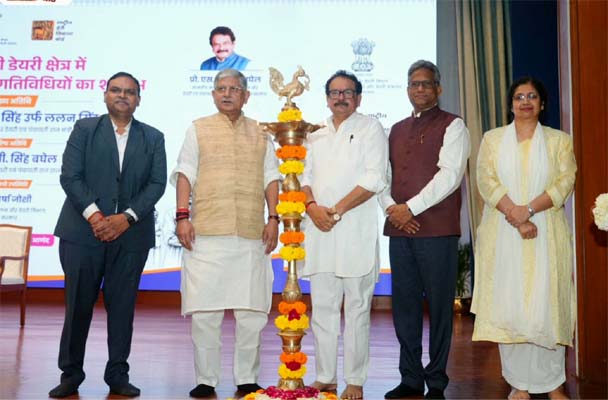
From the village milk collection point to the consumer’s table, the future of India’s dairy economy depends on quality, trust, technology and the farmer’s share in the value chain. Bringing these priorities into focus, Union Minister Rajiv Ranjan Singh alias Lalan Singh on Friday launched four farmer-centric initiatives at Anand, the cradle of India’s White Revolution, aimed at making dairy operations more efficient, transparent and responsive to producers’ needs.
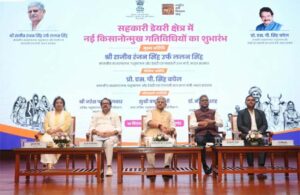
The Union Minister for Fisheries, Animal Husbandry and Dairying and Panchayati Raj launched the initiatives at the National Dairy Development Board (NDDB), Anand, in the presence of Union Minister of State Prof S P Singh Baghel; Naresh Pal Gangwar, Secretary, Department of Animal Husbandry and Dairying (DAHD); Varsha Joshi, Additional Secretary, DAHD; and Dr Meenesh Shah, Chairman, NDDB.
Managing directors of NDDB subsidiaries, officials of DAHD and NDDB, and dairy farmers also attended the programme.
4 innovations across the dairy value chain
The initiatives span consumer products, milk quality testing, rural collection infrastructure and institutional digitalisation.
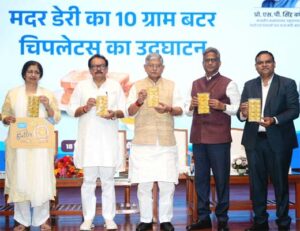
Mother Dairy, a wholly owned subsidiary of NDDB, introduced 10-gram butter chiplets, expanding its butter-category offerings.
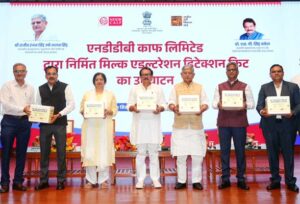
NDDB-developed Milk Adulteration Detection Kits, manufactured by its wholly owned subsidiary NDDB CALF Ltd, are designed to enable convenient and economical testing for adulterants.
A 300-litre mobile milk collection and cooling system, designed by NDDB and manufactured by its wholly owned subsidiary IDMC Limited, runs on a lithium-ion battery and incorporates Internet of Things (IoT) monitoring. The unit is designed to facilitate direct milk collection in rural areas, including weighing, quality testing and receipt generation.
The fourth initiative, DARPAN, is an integrated Document Management System being implemented at NDDB to strengthen digitalised documentation and institutional processes.
Together, the initiatives address different stages of the dairy ecosystem, from collecting and checking milk at the village level to product development and more efficient organisational management.
Minister stresses quality and organised markets
Appreciating NDDB’s work, Lalan Singh said India had emerged as the world’s largest milk producer, while emphasising the challenges of increasing the organised market’s share and ensuring the quality of milk and milk products.
He underscored the importance of quality milk for public health and praised the four initiatives, calling for their large-scale implementation and commercialisation.
The Minister particularly highlighted the potential of Mother Dairy’s 10-gram butter chiplets, the milk adulteration detection kits and the mobile milk collection and cooling system. He also appreciated DARPAN as part of NDDB’s digitalisation efforts.
Baghel highlights cooperatives and technology
Prof S P Singh Baghel said the creation of an independent Department of Animal Husbandry and Dairying, separate from the Ministry of Agriculture, had helped advance the objective of doubling farmers’ income.
Noting India’s first-place position globally in milk production, he recalled that the White Revolution had been launched from Anand. He also observed that India’s per capita milk consumption was higher than the global average.
Baghel particularly appreciated NDDB’s ET, IVF and sex-sorted semen technologies, describing them as initiatives close to his heart.
He stressed the need to strengthen existing dairy cooperative societies and establish new ones, with the objective of bringing more of the unorganised dairy sector into organised structures and addressing its shortcomings and challenges.
White Revolution 2.0: Strengthening the farmer-owned model
Dr Meenesh Shah, Chairman, NDDB, said the programme reflected the board’s commitment to supporting farmers and strengthening the cooperative movement.
He noted that Anand’s legacy was intrinsically linked to India’s dairy cooperative movement, with NDDB helping producer-owned institutions adopt modern technology and management practices.
Under White Revolution 2.0, NDDB is prioritising the establishment of new dairy cooperatives and the strengthening of existing ones in partnership with state governments and milk unions.
Shah said NDDB was also working with DAHD to promote advanced indigenous technologies, including artificial insemination, sex-sorted semen, embryo transfer and IVF, and genomic selection for animals.
Sustainability and energy self-reliance
Shah emphasised that the future of dairying would also depend on sustainable production and improved energy self-reliance.
He referred to initiatives such as household biogas, centralised energy solutions and Bio-CNG as avenues that could support more sustainable dairy operations while contributing to farmers’ incomes.
The four innovations unveiled at Anand, while addressing distinct operational needs, share a common objective: making the dairy sector safer, more efficient, transparent and modern.
The larger challenge, as highlighted during the launch, is to translate innovation into accessible, scalable solutions that strengthen cooperative institutions and improve the value delivered to milk producers.