
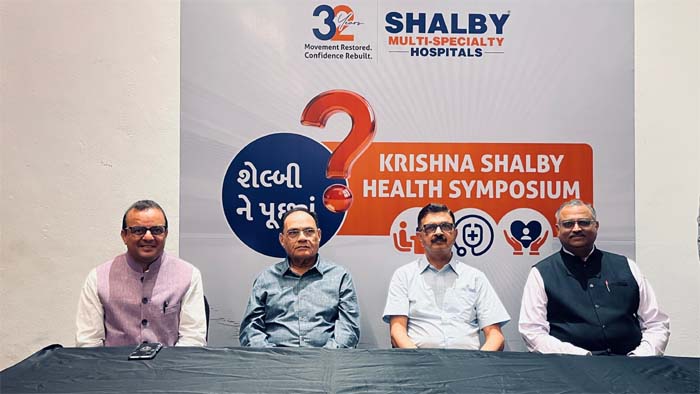
- 1,000+ residents attend Krishna Shalby Health Symposium at AUDA Auditorium, Shela
- Hospital positions itself as comprehensive multispeciality healthcare destination for rapidly expanding region
- Dr Vikram Shah stresses ‘golden hour’ access to save precious lives through proximity to advanced care
- AI, robotics and advanced diagnostics to be complemented by Ayushman Bharat support for cancer and cardiac treatment
- Orthopaedics, oncology, cardiology, transplants, neurology and critical care among key specialities under one roof
- Interactive symposium seeks to bridge gap between growing population and awareness of specialist healthcare
R MANICKAVASAGAM
AHMEDABAD, OCT 5
As Ghuma, Bopal and Shela race ahead as some of Ahmedabad’s fastest-growing residential corridors, a critical question is emerging: can healthcare infrastructure keep pace with the region’s expanding population and increasingly complex medical needs? More than 1,000 residents got an opportunity to explore that question at the Krishna Shalby Health Symposium at the AUDA Auditorium, Shela, where specialists interacted with residents and discussed access to advanced, comprehensive healthcare closer to home.
Hosted by Krishna Shalby Hospital, the symposium sought to strengthen the healthcare connect with residents of Ghuma, Bopal, Shela and neighbouring communities, while highlighting the hospital’s growing role as a multispeciality healthcare destination in South-West Ahmedabad.
The event brought together experienced medical specialists and residents for an interactive discussion on symptoms, treatment options, specialist consultations and the importance of timely medical intervention.
‘Golden hour’ advantage could save precious lives
With the region witnessing rapid residential expansion, the location of advanced healthcare facilities assumes particular significance, especially in emergencies where every minute can matter.
Dr Vikram Shah, Founder and Director, Shalby Hospitals, said, “With the region comprising Ghuma, Bopal and Shela witnessing rapid residential growth, Krishna Shalby Hospital is emerging as a comprehensive corporate multispeciality healthcare destination, bringing together a wide range of medical and surgical specialities, advanced diagnostics, specialist consultations and modern treatment facilities under one roof.”
Highlighting the importance of proximity during medical emergencies, he added:
“Owing to its proximity and location, patients can reach us during ‘golden hour’ save precious lives.”
The emphasis on proximity is particularly relevant for a rapidly urbanising belt where increasing residential density is creating demand not only for routine healthcare but also for specialised and emergency medical services.
Can advanced technology become accessible beyond the affluent?
One of the key questions surrounding modern healthcare is whether technologies such as artificial intelligence, robotics and advanced diagnostics can reach beyond premium healthcare segments and become accessible to middle-class and economically weaker patients.
Shalby, which has built a strong reputation in joint replacement and multispeciality care, has increasingly adopted technology-driven approaches in diagnosis and treatment.
Asked how advanced procedures and robotic/technology-driven care could be made accessible to the middle class and economically weaker sections, Dr Vikram Shah said:
“We have Ayshman Bharat Yojana for cancer and cardiac care to take care of the treatment cost of all.”
The reference to Ayushman Bharat also highlights the role of public health-financing mechanisms in widening access to specialised treatment for eligible beneficiaries, particularly in high-cost areas such as cancer and cardiac care.
A ‘one-roof’ model for a growing urban population
Krishna Shalby Hospital’s multispeciality model brings together a broad range of medical and surgical disciplines, including orthopaedics, oncology, cardiology and cardiac surgery, neurology, liver and kidney transplant care, bariatric and metabolic surgery, gastroenterology, obstetrics and gynaecology, general and laparoscopic surgery and critical care.
The hospital is also supported by advanced diagnostics, specialist consultations, modern medical infrastructure and multidisciplinary teams.
For residents of Ghuma, Bopal, Shela and adjoining areas, the model is aimed at reducing the need to travel to different parts of Ahmedabad for specialist consultations and treatment.
Dr Shah said the hospital’s objective was to create a comprehensive healthcare destination capable of addressing a wide spectrum of medical needs.
“South-West Ahmedabad has evolved into a significant residential community, and its healthcare needs are evolving with it. Our endeavour at Krishna Shalby is to provide comprehensive healthcare at one destination, bringing together specialists, advanced medical technology and a wide range of treatment options so that patients and families can access the care they need closer to home,” he said.
From awareness to timely intervention
The symposium also focused on an often-overlooked component of healthcare — awareness.
Residents had the opportunity to directly interact with doctors, understand warning symptoms, discuss treatment options and learn when specialist medical attention may be required.
Such interactions can help bridge the gap between patients and specialised healthcare, particularly in rapidly developing residential communities where awareness of available medical facilities may not always keep pace with physical infrastructure.
The event also reinforced the importance of having multiple specialities, advanced diagnostics and treatment capabilities within a single healthcare ecosystem.
For South-West Ahmedabad, where residential development has transformed Ghuma-Bopal-Shela into a major urban growth corridor, the emergence of comprehensive healthcare infrastructure could become an important part of the region’s next phase of development.
The symposium concluded with an engaging interaction between doctors and residents, strengthening Krishna Shalby Hospital’s stated focus on health awareness, timely intervention and access to comprehensive multispeciality care closer to the communities it serves.