
NE BUSINESS BUREAU
HYDERABAD, OCT 5
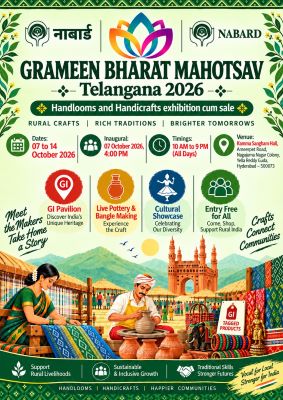
Can putting artisans and consumers face-to-face do what years of traditional marketing channels have failed to achieve—give India’s handloom and handicraft communities better market access, fairer opportunities and a stronger reason to preserve endangered traditional skills? This question will be at the heart of Grameen Bharat Mahotsav (GBM) Hyderabad 2026, an exhibition-cum-sale being organised by the National Bank for Agriculture and Rural Development (NABARD), Telangana Regional Office, from Wednesday.
- Hyderabad to host nationwide showcase of handloom and handicrafts from October 7
- Telangana Governor Shiv Pratap Shukla to inaugurate Grameen Bharat Mahotsav 2026
- NABARD platform aims to take artisans and weavers closer to consumers and bulk buyers
- Direct sales model seeks to reduce middlemen dependence and strengthen rural livelihoods
- Consumer feedback, new designs and market intelligence to shape future product offerings
Shiv Pratap Shukla, Governor of Telangana, will be the Chief Guest at the inaugural ceremony of the Grameen Bharat Mahotsav at 4 pm on October 7 at Kamma Sangham, Ameerpet, Hyderabad.
The Mahotsav will bring together handloom and handicraft products from across India, creating a marketplace where artisans, weavers and other rural producers can showcase and sell their products directly to consumers.
Taking the middleman out of the equation
At a time when traditional artisans often struggle to translate craftsmanship into sustainable incomes, NABARD’s GBM model seeks to address one of the most persistent challenges—market access.
NABARD organises Grameen Bharat Mahotsavs every year to provide artisans and weavers a platform to sell directly to consumers, “without interference of middlemen”, with the larger objective of safeguarding traditional livelihoods and preventing indigenous skills and crafts from slipping into extinction.
The direct-sales approach can potentially enable producers to understand what consumers are actually looking for while allowing buyers to discover products and craftsmanship that may otherwise remain confined to rural production clusters.
From rural craft to urban consumer
The Hyderabad edition is expected to serve as a bridge between India’s rural production communities and an urban consumer base.
The GBMs provide producers an opportunity to interact directly with customers and understand their choices, preferences and expectations. Such interactions can offer valuable market intelligence to artisans who traditionally have limited access to end consumers.
The exposure could also help producers identify opportunities to improve product presentation, designs and product ranges without losing the traditional character of their crafts.
Can consumer feedback reshape traditional crafts?
For India’s handloom and handicraft sector, preserving heritage does not necessarily mean keeping products frozen in time.
NABARD says exposure to up-market shops and consumers helps beneficiaries identify new product designs that they can emulate and use to expand their product range. Such market exposure could be particularly significant for younger generations of artisans, for whom the viability of traditional skills is increasingly linked to their ability to respond to contemporary demand.
The Mahotsav therefore seeks to create a two-way exchange: consumers get access to traditional products, while producers gain insights into what the market wants.
Beyond retail: opening doors to bulk buyers
The GBM model is also designed to go beyond individual retail transactions.
According to NABARD, interaction at the Mahotsavs can help beneficiaries link up with bulk buyers, potentially opening new channels of business and providing artisans and weavers an opportunity to move from occasional sales towards more sustained market relationships.
Such linkages could be particularly valuable for self-help group (SHG) women and small producers who lack the scale, marketing infrastructure and networks required to independently reach institutional or larger buyers.
NABARD’s support to rural producers
NABARD’s Regional Offices support artisans, weavers and SHG women participating in Grameen Bharat Mahotsavs through grant support in the States where the events are organised.
The initiative consequently combines exhibition and sales with a broader rural-development objective—strengthening local economies, supporting traditional skills and enhancing public awareness of India’s diverse cultural heritage.
For Hyderabad’s consumers, the Mahotsav will offer an opportunity to buy directly from producers. For the participating rural communities, however, the larger proposition is potentially more significant: a chance to understand the market, build consumer relationships, explore new designs and discover new avenues for selling their products.
The success of the model may ultimately be measured not merely by the number of products sold during the Mahotsav, but by whether artisans return to their communities with new customers, new designs, new market linkages and a stronger economic incentive to keep traditional skills alive.
EVENT DETAILS
Event: Grameen Bharat Mahotsav Hyderabad 2026
Organiser: NABARD, Telangana Regional Office
Inauguration: Wednesday, October 7, 2026
Time: 4 pm
Chief Guest: Shiv Pratap Shukla, Governor of Telangana
Venue: Kamma Sangham, Ameerpet, Hyderabad
Format: Exhibition-cum-sale of handloom and handicraft products from across India