
- IIT Gandhinagar-led study reveals how active enzymes in the fluid around cells can accelerate molecular movement and boost cellular uptake
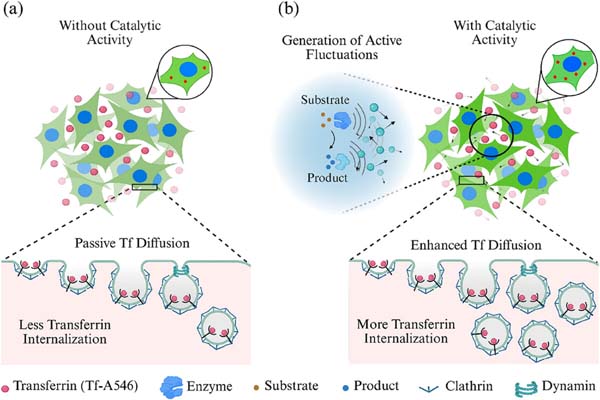
- Transferrin travelled about 50% faster when enzymes were active, while cellular uptake rose by nearly 17%
- Experiments show enzyme-generated mechanical fluctuations—not changes in the cell or cargo—drive the enhanced molecular transport
- Research involving IIT Jodhpur, IISER Kolkata and University of Pennsylvania offers a fresh window into how cells interact with their surroundings
- Finding could point towards new strategies for controlling molecular transport and, potentially, therapeutic delivery—but applications remain to be tested
NE SCIENCE & TECHNOLOGY BUREAU
GANDHINAGAR, OCT 6
What if the fluid surrounding a living cell is not merely a passive space through which molecules drift, but an active molecular highway capable of giving them an unexpected speed boost? A collaborative team led by researchers at the Indian Institute of Technology Gandhinagar (IITGN), with scientists from IIT Jodhpur, IISER Kolkata and the University of Pennsylvania, has found evidence that active enzymes outside a cell can do precisely that—accelerate the movement of molecules and increase their uptake by cells.
Published in Small, the study shows that chemical reactions taking place in the fluid surrounding a cell can influence how efficiently molecules reach and enter the cell. Remarkably, the enzymes responsible for the effect do not have to enter the cell or chemically alter the cargo they help move.
The researchers demonstrated the phenomenon using transferrin, an iron-carrying protein that cells normally take up through a well-characterised process called clathrin-mediated endocytosis.
The finding opens an intriguing question for cell biology: can the chemistry happening outside a cell influence the physical movement of molecules strongly enough to change what happens inside it?
The team’s experiments suggest the answer is yes.
When enzymes become molecular stirrers
Dr Krishna Kanti Dey, corresponding author of the study and Associate Professor in the Department of Physics at IITGN, said the agents behind the change are enzymes—protein machines that drive a vast range of reactions in the body.
“The agents of that change are enzymes, the protein machines that drive a vast range of reactions in the body, and, remarkably, they do it without entering the cell or altering the cargo at all,” explained Dr Dey, who leads IITGN’s Soft and Living Matter Laboratory.
The phenomenon can be visualised through a simple analogy. Imagine a pond containing a tennis ball. In still water, the ball would move only with whatever faint currents exist. But fill the pond with countless tiny swimmers, each continuously moving and disturbing the water, and the ball would begin travelling more widely and reaching the pond’s edge more frequently.
In the cellular experiments, the enzymes effectively play the role of those tiny swimmers.
Their activity generates mechanical fluctuations in the surrounding fluid, increasing the movement of nearby transferrin molecules and making it more likely that they will encounter receptors on the cell surface.
Those receptors then capture transferrin and draw it inside through clathrin-mediated endocytosis.
The 50% speed-up that caught the researchers’ eye
The researchers used fluorescently labelled transferrin to monitor how much of the protein was taken up by cells in the presence and absence of active enzymes.
The result was striking.
Cells exposed to working enzymes took up roughly 17% more transferrin.
But the researchers wanted to know what was happening before the transferrin entered the cell.
Using Total Internal Reflection Fluorescence (TIRF) microscopy, they observed molecular movement close to the cell surface—the critical zone where transferrin encounters its receptors.
The transferrin moved approximately 50% faster when the enzymes were active.
A second technique, fluorescence correlation spectroscopy, independently indicated increases in transferrin diffusivity of approximately 40% with urease and 44% with alkaline phosphatase.
Dr Dhiraj Bhatia, corresponding author and Associate Professor at IITGN’s Department of Biological Sciences and Engineering, explained why transferrin was selected for the study.
“We chose transferrin because its journey into the cell has been mapped in fine detail over decades, so we knew exactly what ordinary uptake should look like. Against that well-established baseline, any change the enzymes produced would stand out clearly rather than get lost in the noise. And because we saw the same pattern with two very different enzyme–substrate systems, we are confident the effect is not a quirk of one particular reaction,” said Dr Bhatia.
The cell was not the culprit—the fluid was
The researchers then had to establish whether the enzymes were changing the cell membrane, altering receptor behaviour or modifying transferrin itself.
Their experiments pointed elsewhere.
“Our experiments noted that the increased uptake is not influenced by changes in the cells, or the cargo’s chemistry, but rather by the fact that the busy enzymes are, in effect, stirring the extracellular fluid, which makes the cargo’s movement faster,” added Nividha, first author of the study and a PhD Scholar in IITGN’s Department of Physics.
The team next used optical tweezers, in which a tightly focused laser beam can hold and measure tiny objects and forces, to determine whether enzyme activity actually generated the predicted physical disturbance.
Both enzyme systems produced forces in the piconewton range while actively catalysing their reactions.
The researchers also tested whether merely having enzymes, substrates or reaction products present could explain the phenomenon.
“We observed that it could not. The effect appeared to depend on active enzyme catalysis, not merely on the ingredients of the reaction,” said Nividha.
Why faster molecules did not mean 50% more uptake
An intriguing puzzle remained.
If transferrin was moving about 50% faster, why did cellular uptake increase by only around 17%?
The researchers addressed the apparent mismatch using a computational model of transferrin binding to its receptor and subsequent internalisation.
The model suggested that cells have a built-in limitation: they possess only a finite number of transferrin receptors.
Faster-moving molecules can find available receptors more quickly. But once those receptors become occupied, additional speed produces diminishing returns.
The researchers observed the same ceiling when they increased the amount of transferrin available to the cells. Uptake increased initially but eventually flattened as receptors became saturated.
In other words, enzyme-driven molecular stirring can accelerate the delivery of cargo to a cell only as far as the cell’s receptor capacity allows.
A molecular transport lever for the future?
The findings could have significance beyond understanding how molecules move around cells.
Drug delivery is fundamentally a transport problem. A therapeutic molecule must navigate the crowded environment outside a cell, encounter its intended target and, in many cases, cross the cell membrane.
Much research has focused on modifying the cargo itself—through nanoparticles, targeting molecules and other delivery technologies.
The IITGN-led study raises a different possibility: could the environment around the cell itself be engineered to help move therapeutic cargo more efficiently?
Dr Dey cautioned that the idea remains at the research stage.
“The findings could be relevant to future efforts to control molecular transport, including the delivery of therapeutic cargoes across biological barriers. But those applications remain to be tested. The present work establishes the effect in a controlled cellular system, though therapeutic applications are yet to be demonstrated,” said Dr Dey.
That distinction is important. The research demonstrates a physical phenomenon in a controlled cellular system; it does not yet establish a new drug-delivery technology.
But it does offer a fresh way of thinking about the molecular world around cells.
The study was supported by the Anusandhan National Research Foundation (ANRF), the Ministry of Education’s STARS scheme and the Gujarat State Biotechnology Mission.
Article title: Enzyme-Regulated Non-Thermal Fluctuations Enhance Ligand Diffusion and Receptor-Mediated Endocytosis
Authors: Nividha, Arnab Maiti, Kshitiz Parihar, Rik Chakraborty, Pratibha Agarwala, Dibyendu K Sasmal, Ravi Radhakrishnan, Tanmoy Ghosh, Bidisha Sinha, Dhiraj Bhatia and Krishna K Dey.