
R ARIVANANTHAM
CHENNAI, OCT 6
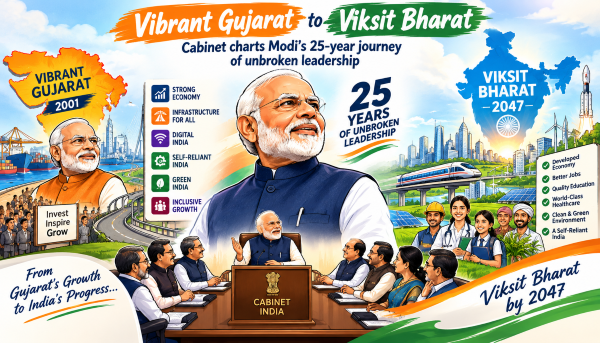
Twenty-five years after Narendra Modi first assumed the reins of government in Gujarat, the Union Cabinet has marked what it describes as an “extraordinary journey” from the State capital to the national stage—tracing a quarter-century of uninterrupted leadership through the themes of development, welfare, reform, technology, national security, diplomacy and cultural confidence.
The Cabinet on Tuesday passed a resolution congratulating Prime Minister Narendra Modi on completing 25 years of continuous leadership as head of government, first as Gujarat Chief Minister and subsequently as Prime Minister of India. The resolution says the journey has been guided by the principles of “Nation First and Citizen First” and points to three successive mandates in Gujarat and three consecutive Lok Sabha victories as evidence of sustained public support.
- From Gujarat to New Delhi, Cabinet resolution traces 25 years of Narendra Modi’s uninterrupted tenure as head of government
- ‘Nation First, Citizen First’ identified as the guiding thread linking Gujarat initiatives with national-scale governance
- Resolution highlights welfare expansion, women’s empowerment, infrastructure, technology, reforms and self-reliance
- Surgical strikes, Balakot and Operation Sindoor cited alongside Article 370, OROP and CDS as milestones in national security
- G20, BRICS, Global South outreach and Vaccine Maitri highlighted in account of India’s expanding international engagement
- Cabinet connects development with cultural heritage, environmental responsibility and the vision of a developed India by 2047
Rather than treating the occasion merely as a commemorative milestone, the resolution presents 10 defining themes that, in the Cabinet’s assessment, connect Modi’s Gujarat years with his tenure at the Centre.
1. FROM GUJARAT’S LABORATORY TO NATIONAL SCALE
The resolution begins with the transition from Gujarat to the national stage, citing initiatives such as SWAGAT, through which Modi personally reviewed citizens’ grievances, and which received the United Nations Public Service Award in 2010.
It says the experience later informed PRAGATI, the technology-driven platform used to review stalled projects and resolve implementation bottlenecks across governments.
Similarly, the Gujarat experience with Jyotigram, including separate electricity feeders for agricultural requirements, is presented as an example of a State-level intervention that informed the broader national approach to infrastructure and development.
The Cabinet’s narrative is therefore built around a recurring theme: ideas tested at the State level were subsequently expanded into national programmes.
2. FROM POVERTY TO DIGNITY
The resolution places welfare and poverty reduction at the centre of the leadership journey, linking Modi’s sensitivity towards deprivation to experiences from his early life and travels.
It highlights the expansion of access to housing, water, banking and healthcare, citing nearly 60 crore Jan Dhan accounts, more than 4 crore homes and the Government’s assessment that 25 crore people have moved out of poverty.
The resolution portrays these interventions not merely as delivery of benefits but as an attempt to convert basic entitlements into dignity and greater participation in the formal economy.
3. EMPOWERMENT BECOMES THE NEXT FRONTIER
Women, farmers, youth and vulnerable communities occupy a prominent place in the Cabinet’s account of the 25-year journey.
The resolution cites approximately 3.5 crore women becoming Lakhpati Didis, the Nari Shakti Vandan Adhiniyam, expansion of startups and skills initiatives and education reforms.
It also highlights PM-KISAN transfers exceeding ₹4 lakh crore and PM-JANMAN, aimed at particularly vulnerable tribal groups.
The common thread identified by the Cabinet is empowerment—moving beneficiaries from receiving assistance towards greater economic and social agency.
4. REFORM AS A CONTINUING POLITICAL CHOICE
The resolution places reforms among the defining features of Modi’s tenure, citing GST, welfare-delivery reforms and the replacement of colonial-era laws.
It also refers to campaigns around cleanliness, digital payments and local products, arguing that these initiatives sought to turn citizens into participants in the process of change.
The Cabinet describes reform as a continuing commitment involving political conviction, public participation and national purpose.
5. BUILDING THE ECONOMIC AND INDUSTRIAL FOUNDATIONS
The resolution points to a sharp increase in public capital expenditure—from around ₹2 lakh crore to more than ₹12 lakh crore—alongside expansion of highways and railway electrification.
It cites the growth of electronics production from around ₹2 lakh crore to more than ₹13 lakh crore, while pointing to developments in defence production and semiconductor manufacturing as further evidence of the push towards greater domestic capacity.
The larger objective, according to the Cabinet narrative, is the creation of a more self-reliant Indian production ecosystem.
6. TECHNOLOGY FROM CITIZEN SERVICES TO SPACE
Technology occupies another major chapter in the Cabinet’s account.
The resolution highlights the Jan Dhan-Aadhaar-Mobile architecture, UPI and digital delivery of public services, alongside India’s development of COVID-19 vaccines and the Chandrayaan-3 landing near the Moon’s south pole.
It also points to growing private-sector participation in space and emerging work in artificial intelligence, quantum technology and biotechnology.
The stated vision is not technology for its own sake, but technology that simultaneously improves everyday public services and expands India’s scientific and strategic capabilities.
7. STEERING INDIA THROUGH TURBULENT TIMES
The Cabinet resolution also places considerable emphasis on crisis management.
It cites the COVID-19 pandemic, including domestic vaccine development and vaccination, and the West Asia crisis, highlighting measures related to energy security.
The resolution presents these episodes as examples of leadership combining immediate crisis response with longer-term investments in national resilience.
8. NATIONAL SECURITY AND STRATEGIC ASSERTIVENESS
The resolution identifies 2016 surgical strikes, the 2019 Balakot air strikes and 2025 Operation Sindoor among the defining national-security actions of the period.
It places these alongside the removal of Article 370, One Rank One Pension and creation of the post of Chief of Defence Staff.
The Cabinet also cites action against Maoist violence and peace efforts in the Northeast, presenting national security as a combination of strategic response, stability and development.
9. INDIA’S DIPLOMATIC FOOTPRINT EXPANDS
The resolution turns next to India’s changing role in global affairs.
It highlights India’s work in securing consensus during the G20 and BRICS processes, advocacy for the Global South, and support for the African Union’s inclusion in the G20.
Vaccine Maitri is cited as an example of India’s capacity being deployed beyond its borders.
The resolution also points to honours conferred on Modi by 36 countries, presenting them as an indicator of the international recognition accompanying India’s expanding engagement. These are claims and characterisations made in the Cabinet resolution itself.
10. DEVELOPMENT WITH HERITAGE AND RESPONSIBILITY
The final theme attempts to bring together the economic, cultural and environmental strands of the 25-year narrative.
The resolution cites the evolution from Gujarat’s dedicated climate initiatives to wider expansion of renewable energy and international climate partnerships.
At the same time, it highlights Yoga, millets, the Kashi Vishwanath Dham redevelopment and the consecration of Ram Lalla as expressions of India’s cultural heritage.
The Cabinet resolution ultimately connects these strands to the stated national objective of building a prosperous, self-reliant and developed India by 2047.
A QUARTER-CENTURY, AND A NEW BENCHMARK
The Cabinet’s October 6 resolution comes after an earlier Cabinet resolution in June marking Modi’s achievement as the longest-serving elected Prime Minister for consecutive terms, recording 4,399 continuous days as an elected PM and noting that he had then been approaching the 25-year mark as head of government.
The latest resolution therefore places the June milestone within a much longer political arc—from Gujarat in 2001 to the Prime Minister’s Office and three successive Lok Sabha mandates.
The significance of the silver-jubilee milestone, as framed by the Cabinet, lies not simply in longevity but in the continuity of a governing narrative built around “Nation First and Citizen First”, development, welfare, reform, technology, security, global engagement and the goal of a Viksit Bharat by 2047.