
NE DEFENCE BUREAU
NEW DELHI, OCT 6
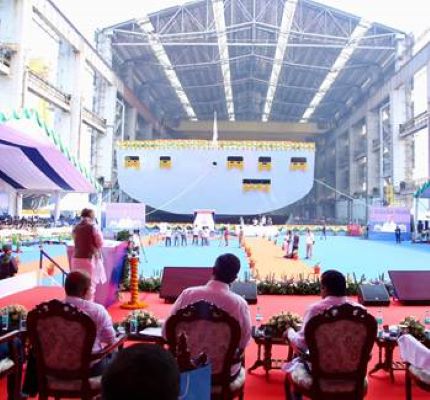
India’s maritime ambitions received a powerful industrial push on Tuesday as Defence Minister Rajnath Singh launched ‘Surya’, the country’s first indigenous Fleet Support Ship, laid the keel for the fifth vessel in the series and commissioned major infrastructure upgrades at Hindustan Shipyard Limited in Visakhapatnam—while setting the shipyard an uncompromising new benchmark: design better, build faster and deliver on time.
The three-pronged milestone—launch of FSS-1, keel laying of FSS-5 and inauguration of upgraded Slipway-4 and a 300-tonne Goliath Crane—was described by Rajnath Singh as more than a series of individual achievements. Together, he said, they reflected India’s growing ability to design, build and sustain increasingly sophisticated maritime platforms within the country.
- Defence Minister launches ‘Surya’, India’s first indigenous Fleet Support Ship, and lays keel for fifth vessel at Hindustan Shipyard
- “Launch of FSS1 is a symbol of achievement, keel laying of FSS5 is a symbol of resolve and the new Slipway is a symbol of our growing capability”
- Upgraded Slipway-4 and 300-tonne Goliath Crane to equip HSL to build and launch ships up to 45,000 DWT
- Rajnath Singh calls for HSL to become benchmark for “Quality, Productivity and Timely Delivery” and move beyond self-reliance to global competitiveness
- Visakhapatnam urged to emerge as a major Maritime Industrial Hub by integrating Navy, shipyards, MSMEs, startups, academia and technology
- Fleet Support Ships to strengthen Indian Navy’s reach, endurance and sustained operations across the Indian Ocean Region
“The launch of FSS1 is a symbol of achievement, keel laying of FSS5 is a symbol of resolve and the new Slipway is a symbol of our growing capability,” Defence Minister said, underlining the strategic significance of the three milestones.
He also issued a clear challenge to HSL and the wider Indian shipbuilding ecosystem: “We must make HSL a benchmark for Quality, Productivity and Timely Delivery.”
‘SURYA’ TO POWER NAVY’S REACH AND ENDURANCE
The Fleet Support Ship programme is designed to strengthen the Indian Navy’s ability to operate for prolonged periods far from its home bases.
Rajnath Singh emphasised that sustained naval operations in distant maritime areas require much more than frontline warships. Logistics, replenishment, maintenance, sustained support and operational endurance are equally critical to maintaining a credible maritime presence.
Fleet Support Ships provide that vital logistical backbone through at-sea replenishment and sustained support to naval operations, enabling frontline ships to remain operational for longer periods.
Named ‘Surya’, FSS-1 was launched after the traditional honours performed by Laila Swaminathan, President, Navy Wives Wellness Association (NWWA). The vessel entered the waters of the Bay of Bengal amid cheers from the gathering.
Designed and built indigenously by HSL, the Fleet Support Ships will feature enhanced cargo and fluid capacity, onboard first-line maintenance workshops, a helicopter deck for Multi-Role Helicopter operations and self-defence systems.
The launch of FSS-1 and keel laying of FSS-5 therefore mark important steps towards enhancing the Indian Navy’s reach, endurance and operational effectiveness in the Indian Ocean Region.
HSL GETS MUSCLE TO BUILD BIGGER SHIPS
The second major milestone was the inauguration of the upgraded Slipway-4, which has been extended and strengthened to enable HSL to build and launch ships of up to 45,000 DWT.
The shipyard has also added a 300-tonne Goliath Crane spanning Slipways 3 and 4. Designed and manufactured by L&T Geostructure with Konecranes under the Make in India initiative, the crane incorporates PLC controls, Variable Frequency Drives, tandem lifting, remote diagnostics and condition monitoring.
The infrastructure is expected to enable faster and more precise movement of heavier ship blocks and strengthen HSL’s capacity for modern block construction and larger, more complex shipbuilding programmes.
Rajnath Singh recalled the launch of ‘Jala Usha’ in Visakhapatnam in 1948, the first ship built in independent India, to underline the country’s longstanding maritime connection.
He described HSL as a custodian of India’s national maritime capability and acknowledged its contribution to the country’s maritime and defence requirements over more than eight decades.
HSL’s attainment of Miniratna Category-I status in 2025, after coming under the Ministry of Defence, was also highlighted as an important milestone in the shipyard’s transformation.
FROM SELF-RELIANCE TO GLOBAL COMPETITIVENESS
Defence Minister stressed that self-reliance is no longer the final destination for India’s defence manufacturing sector.
“Self-reliance is an important milestone, but global competitiveness is the next big leap,” he said, calling upon Indian shipyards to compete with the world’s leading yards on quality, cost, technology, delivery and reliability.
He outlined an ambitious roadmap for HSL, including stronger indigenous design capability, timely delivery, improved productivity, resilient supply chains, skilled manpower and greater cost competitiveness.
He also urged HSL to learn from leading global shipyards, forge stronger partnerships with MSMEs and startups, and develop comprehensive lifecycle capabilities covering shipbuilding, maintenance and support.
His most pointed operational message was:
“Our goal should be simple and clear- Design better. Build faster. Deliver on time. Operate efficiently and do Maintenance effectively.”
Defence Minister also stressed the need for closer coordination between the Indian Navy and shipyards so that operational requirements, design capabilities and delivery schedules are aligned more effectively.
VISAKHAPATNAM’S MARITIME MOMENT
Rajnath Singh called for Visakhapatnam to be developed as a major Maritime Industrial Hub, arguing that the city already possesses many of the ingredients required to build an integrated maritime ecosystem.
The presence of the Eastern Naval Command, Naval Dockyard, HSL and Visakhapatnam Port, he said, provides a strong foundation for such an ecosystem.
“Visakhapatnam should be developed as a major Maritime Industrial Hub,” he said.
The proposed ecosystem would bring together naval expertise, shipbuilding, engineering, port infrastructure, logistics, research, technology and skilled manpower.
He also called for deeper participation by Andhra Pradesh’s MSMEs, universities, technology companies and startups, with MSMEs supplying components, universities contributing to research and skill development, technology companies supporting digital shipbuilding and startups developing maritime technologies.
The Defence Minister underlined that the country’s maritime capability cannot be built by a single institution.
“India’s maritime strength cannot be built by the Navy or shipyards alone,” he said, calling for greater integration among the Navy, HSL, DRDO, academia, industry, MSMEs and startups.
He further stressed that Indian shipyards should eventually look beyond domestic requirements and aspire to serve friendly nations and international markets, building India’s global presence in maritime technology, ship repair and maintenance services and engineering expertise.
The events were attended by Admiral Krishna Swaminathan, Chief of the Naval Staff; Janardhan Reddy, Minister of Roads, Buildings, Infrastructure & Development, Government of Andhra Pradesh; Sribharat Mathukumilli, Member of Parliament, Visakhapatnam; Sanjeev Kumar, Secretary (Defence Production); Vice Admiral Sanjay Bhalla, Flag Officer Commanding-in-Chief, Eastern Naval Command; Additional Director General Donny Michael, Coast Guard Commander, Eastern Seaboard; Rear Admiral C Raghuram (Retd), Chairman & Managing Director, HSL, and senior officers of the Indian Navy and Ministry of Defence.