
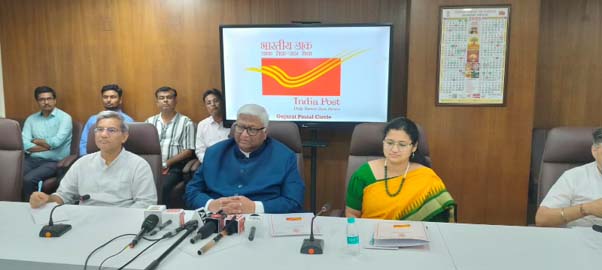
- ‘One Postal Network, Endless Possibilities’: Gujarat Postal Circle launches National Postal Week 2026 celebrations
- Chief Postmaster General Ganesh V. Sawaleshwarkar appeals to citizens to revive the fading art of handwritten letters
- Gujarat Police, Postal Department sign MoU for ‘digiPost’ to deliver traffic e-challans to citizens’ doorsteps
- 8,877 post offices handle 45 lakh parcels and 3.72 crore postal articles in a year
- From digital commerce and financial inclusion to remote villages, India Post expands its citizen-centric footprint
NE BUSINESS BUREAU
AHMEDABAD, OCT 10
In an age when a message travels across the world in seconds, Gujarat’s postal network is making a compelling case for the enduring power of a handwritten letter even as it embraces digital technology to deliver government services to citizens’ doorsteps. The Gujarat Postal Circle on Friday launched its World Post Day and National Postal Week 2026 celebrations under the theme, “One Postal Network, Endless Possibilities”, blending the emotional legacy of letter writing with technology-driven public service delivery.
A significant highlight of the launch was the signing of a memorandum of understanding (MoU) between Gujarat Police and the Department of Posts for the ‘digiPost’ initiative, under which traffic e-challans will be transmitted digitally to India Post, printed and physically delivered to citizens with acknowledgement. The initiative exemplifies a growing phygital approach that combines digital communication with the reach and reliability of physical postal delivery.
A handwritten letter: An enduring expression of affection
Extending greetings to citizens, customers and the postal fraternity, Ganesh V. Sawaleshwarkar, Chief Postmaster General, Gujarat Circle, underscored the institution’s continuing relevance in a rapidly changing world.
“Indian Post is an unwavering symbol of trust, service, and connection. Equipped with innovative technology, we are committed to delivering progress and prosperity to every household through fast and reliable services,” he said.
Making a heartfelt appeal to revive the tradition of letter writing, Sawaleshwarkar urged citizens to rediscover the personal warmth of putting pen to paper.
“Express your heartfelt emotions by writing letters to your loved ones. A handwritten letter carries the personal touch, warmth, and unique affection of the writer. Letters can be preserved for years as memories, deepen relationships, clarify thoughts, and develop language as well as expression skills,” he said.
His appeal seeks to preserve a cherished form of communication even as instant messaging and social media increasingly dominate personal interactions. A handwritten letter, unlike a fleeting digital notification, can become a lasting keepsake of relationships, memories and emotions.
National Postal Week: Celebrating a network that connects India
World Post Day is observed every year on October 9 to commemorate the establishment of the Universal Postal Union (UPU) in 1874. In India, National Postal Week is celebrated from October 9 to 15 to highlight the evolving role of the Department of Posts in communication, financial inclusion, e-commerce, technological innovation and citizen-centric governance.
Gujarat Postal Circle has planned public awareness campaigns, philately events, financial inclusion camps, customer outreach programmes, professional interactions, technology exhibitions and a national-level Postathon Walk/Run as part of the week-long celebrations.
The activities are intended to familiarise citizens with the expanding range of postal services while showcasing the department’s contribution to social and economic development.
8,877 post offices: The strength of Gujarat’s postal network
The scale of the network is reflected in its reach and operational performance. Gujarat Postal Circle operates 8,877 post offices, comprising 32 Head Post Offices, 1,182 Sub Post Offices and 7,663 Branch Post Offices, serving Gujarat and the Union Territory of Dadra and Nagar Haveli and Daman and Diu.
During the financial year 2025–26, the circle handled more than 45 lakh parcels, 3.72 crore postal articles and nearly two lakh international articles.
These figures underline the continuing importance of the postal system as a communication and logistics network supporting households, businesses, e-commerce and public services.
Financial inclusion: Banking and insurance at the grassroots
Beyond letters and parcels, the postal network remains a major channel for financial inclusion and social security.
More than 1.63 crore Post Office Savings Bank accounts are operational in Gujarat. India Post Payments Bank (IPPB) has opened over 46 lakh accounts, with deposits of approximately ₹728 crore. Nearly nine lakh beneficiaries receive Direct Benefit Transfer (DBT) payments through IPPB.
Postal Life Insurance (PLI) and Rural Postal Life Insurance (RPLI) also contribute to the circle’s social-security outreach. During the last financial year, Gujarat Postal Circle managed 2.17 lakh policies, collected ₹13.93 crore in premiums and settled 56,838 claims.
The figures reflect the postal department’s role in extending savings, insurance and benefit-delivery services to people across urban, rural and remote communities.
Digital commerce opens new markets for farmers
Gujarat Postal Circle is also strengthening its role in digital commerce through the Open Network for Digital Commerce (ONDC). It has onboarded seven Farmer Producer Organisations (FPOs) and facilitated the movement of more than 60,000 shipments, helping farmers and small producers connect with wider markets.
The department is supporting government programmes through Aadhaar enrolment and update services, National Food Security Act (NFSA) e-KYC verification and Pradhan Mantri Employment Generation Programme (PMEGP) verification. More than 18.98 lakh Aadhaar-related transactions were processed during the period cited by the circle.
Postal franchise and insurance agency programmes are creating livelihood opportunities, while philately exhibitions such as VADOPEX 2026 and PATANPEX 2026 are helping preserve postal heritage and encourage public engagement.
From campuses to border villages, the network expands
In a bid to connect with younger audiences and Generation Z, post offices at institutions such as IIM Ahmedabad, IIT Gandhinagar and SVNIT Surat have been renovated using designs and graffiti created by students.
The circle has also opened 11 new Branch Post Offices and eight Sub Post Offices in unbanked and remote areas, including a western-border village with a population of just 90 people.
Another milestone is the opening of a new post office and allocation of a new PIN code at the large Renewable Energy Park being developed at Khavda in Kutch, reflecting the postal network’s expansion alongside emerging economic and infrastructure hubs.
‘digiPost’: Digital transmission, physical delivery
The MoU between Gujarat Police and the Department of Posts marks a new application of postal infrastructure in public administration.
Under the ‘digiPost’ initiative, traffic e-challans issued by Gujarat Police will be sent digitally to India Post, printed and delivered physically to citizens against acknowledgement. The service seeks to combine the speed of digital transmission with the traceability and reach of the postal delivery system.
The possibility of enabling traffic-challan payments at post offices is also being considered for the coming days.
As National Postal Week unfolds, Gujarat Postal Circle’s message is clear: technology may transform how people communicate and transact, but a trusted postal network continues to connect citizens with essential services. From the intimacy of a handwritten letter to the formal delivery of a traffic challan, India Post is seeking to make its vast network relevant to the needs of a changing society.