
R ARIVANANTHAM
CHENNAI, OCT 10
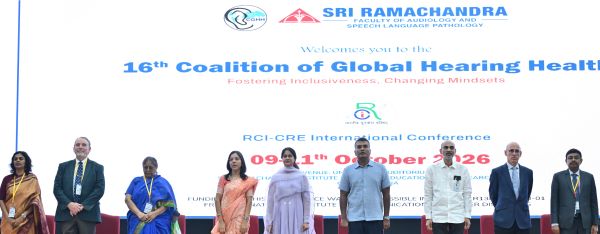
Hearing loss may be invisible, but its consequences can silence conversations, constrain education and employment, and deepen social exclusion. In a landmark first for India, Chennai has brought the global hearing-health community together to confront this challenge, with nearly 250 delegates from 27 countries assembling at Sri Ramachandra Institute of Higher Education and Research (SRIHER) for the 16th International Conference of the Coalition for Global Hearing Health (CGHH).
The three-day conference, which began on Saturday, marks the first time this international gathering has been held in India. It brings together clinicians, researchers, public-health specialists, advocates, people with hearing loss, non-governmental organisations and innovators to examine how hearing healthcare can become more accessible, affordable and inclusive—particularly in low- and middle-income countries.
- Nearly 250 delegates from 27 countries converge in Chennai for the 16th Coalition for Global Hearing Health conference
- Tamil Nadu showcases cochlear implants for more than 4,000 children under its Chief Minister’s Comprehensive Health Insurance Scheme
- WHO expert Dr Shelly Chadha calls for accessible ear and hearing care at the community level
- From preventable childhood hearing loss to workplace noise and unsafe earphone use, conference puts early intervention in focus
- Researchers, clinicians, people with hearing loss and start-ups explore affordable technologies and inclusive rehabilitation
The conference was inaugurated by Dr Darez Ahamed, Secretary to the Government of Tamil Nadu. Dr Shelly Chadha, Technical Lead for Ear and Hearing Care at the World Health Organization (WHO), attended as Guest of Honour.
Addressing the gathering, Dr Ahamed highlighted the scale of the global challenge and the importance of prevention, early diagnosis and affordable treatment. More than 430 million people worldwide require rehabilitation for disabling hearing loss, while nearly 60% of childhood hearing loss is preventable, he said.
“For a young adult, the risk may come from earphones. For workers in our factories and on construction sites, prolonged exposure to noise year after year can lead to hearing loss,” Dr Ahamed said, underlining how risks extend from everyday listening habits to occupational environments.
Tamil Nadu’s intervention model
Dr Ahamed highlighted the state government’s initiatives to make advanced hearing interventions accessible to children from economically disadvantaged families.
Under the Chief Minister’s Comprehensive Health Insurance Scheme, the government has funded cochlear implants for children whose families might otherwise have been unable to afford them. More than 4,000 children have received the intervention, with nearly 500 children benefiting every year, he said. The scheme has also covered hearing aids for more than a decade.
The state is also exploring ways to take screening and diagnosis closer to communities. Village health workers can screen children for hearing problems, while audiologists can assess a baby’s hearing remotely through a village health van equipped with satellite connectivity.
Inviting industries and researchers to collaborate with the government, Dr Ahamed said, “I invite industries and researchers present here to join us in working towards these solutions and making hearing healthcare more accessible to all.”
WHO calls for community-level care
Dr Shelly Chadha emphasised India’s contribution to public-health approaches for hearing care, citing the National Programme for Prevention and Control of Deafness (NPPCD) and efforts to integrate ear and hearing services into primary healthcare.
“The Government of India has been a pioneer in establishing the National Programme for Prevention and Control of Deafness (NPPCD),” she said, adding that Tamil Nadu had also been at the forefront of implementing the national programme and developing innovative public-private partnership models.
Dr Chadha said nearly 60% of ear- and hearing-related problems could be addressed at the community level by trained non-specialists, with the remaining 40% requiring specialist care.
“The key is to ensure that these services actually become available at the community level, making ear and hearing care more accessible to everyone,” she said.
Her message placed the spotlight on a central challenge for health systems: medical knowledge and effective interventions can make a difference only when people can access them in time and close to where they live.
From research to real-world solutions
The conference programme spans screening and outcomes across the lifespan, public-sector planning, community services, health-system economics, clinical care and emerging technologies. Plenary sessions feature speakers from India, Thailand and the United Kingdom, while researchers from across the world are presenting oral and poster papers.
People who are deaf or hard of hearing are also sharing their lived experiences, highlighting barriers to diagnosis, treatment, rehabilitation, communication and social participation. The focus extends beyond clinical intervention to education, literacy, family support and inclusion.
Pre-conference workshops addressed rehabilitation models for hearing, communication, education and literacy; family empowerment, including stigma and safety; and specialised clinical topics such as frequency-specific auditory brainstem response (ABR), temporal bone laboratory work and management of aural atresia.
Start-ups exploring low-cost technologies for detection and intervention are participating alongside organisations such as Hear the World and Listening Together, reflecting the role of innovation and civil-society partnerships in strengthening hearing-care services.
A global agenda with a local imperative
The Coalition for Global Hearing Health is an international network of clinicians, researchers, advocates and people with hearing loss working to make hearing health a global priority, with particular attention to resource-constrained settings.
The conference’s first Indian edition gives Chennai a platform to connect global research and policy discussions with practical challenges facing communities—from childhood screening and affordable hearing aids to cochlear implants, occupational noise protection and accessible rehabilitation.
Its larger test will be whether the exchange of evidence and experience translates into stronger community services, wider access to early diagnosis and better outcomes for people living with hearing loss.