
R ARIVANANTHAM
CHENNAI, OCT 11
Can a metro line do more than move commuters? Can better roads, modern ports and stronger railway links turn a city’s infrastructure into an engine of industrial growth, employment and economic opportunity? Prime Minister Narendra Modi’s ₹13,000-crore-plus development package for Tamil Nadu seeks to connect these dots, placing urban mobility, manufacturing, trade and scientific research within a broader development push.
Unveiling a series of projects spanning metro rail, highways, railways, ports, petroleum and education in Chennai on Sunday, Modi delivered a message that went beyond concrete and connectivity: “I have always believed that urbanisation is not a challenge, but an opportunity.”
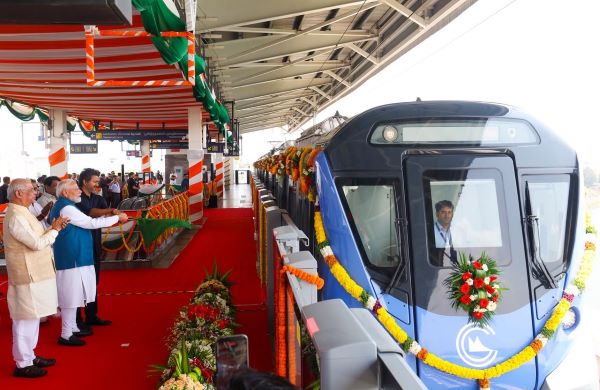
- Metro milestone: Poonamallee–Vadapalani stretch of Phase II opens, adding a 15-km corridor built at a cost of around ₹4,900 crore
- Roads, railways and ports: Projects spanning highways, railway infrastructure and maritime facilities target stronger connectivity across Tamil Nadu
- Manufacturing gets a fillip: New lubricant base oil project expected to create jobs and help reduce India’s import dependence
- Jobs beyond construction: Modi says infrastructure investment generates employment for engineers, technicians, workers and ancillary industries
- Chennai’s research ambitions: IIT Madras’ Sudha Gopalakrishnan Brain Centre dedicated to the nation
- Cooperative federalism pitch: PM reiterates commitment to Tamil Nadu’s development, saying the nation’s progress depends on the development of its states
The inauguration of the Poonamallee–Vadapalani stretch of Chennai Metro Rail Phase II was the centrepiece of the infrastructure programme, which also included highway works worth around ₹3,700 crore, railway projects exceeding ₹750 crore, port infrastructure initiatives and the dedication of the Sudha Gopalakrishnan Brain Centre at IIT Madras. The projects aim to improve mobility, strengthen industrial logistics and create fresh employment opportunities across Tamil Nadu.
Metro expansion: A new connectivity link for Chennai
The new Poonamallee–Vadapalani stretch of Chennai Metro Phase II, built at a cost of approximately ₹4,900 crore, marks a significant addition to the city’s urban transport network. The 15-km section has 11 stations and includes a distinctive 3.7-km double-decker structure. Advanced signalling systems have been designed to support driverless operations.
Modi flagged off the metro service and travelled on the train with Tamil Nadu Chief Minister C. Joseph Vijay. He also bought a metro ticket using the Unified Payments Interface (UPI), highlighting the integration of digital payments into everyday public transport.
The Prime Minister said the expansion was intended to make journeys easier for ordinary citizens, working families, students and senior citizens, while helping them save time.
“Merely widening roads is not enough to create better transportation,” he said, making the case for a comprehensive approach to urban infrastructure.
He also cited the expansion of India’s metro network as evidence of the transformation underway in urban mobility. According to his address, metro services, which operated in five cities in 2014, now cover 25 cities, while the country’s network has grown from approximately 250 km to more than 1,100 km.
For Chennai, the new stretch represents an additional transport option as the metropolitan region expands and commuting demands intensify.
Roads and railways: Connectivity as an economic multiplier

The development package also places considerable emphasis on strengthening road and rail connectivity beyond the state capital.
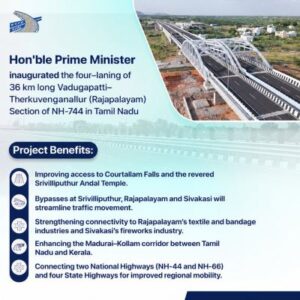
National Highway projects worth around ₹3,700 crore include the four-laning of the Vadugapatti–Therkuvenganallur section of NH-744, the Madurai Ring Road section of NH-744A and the development of the Thiruvarur bypass on NH-83.
Railway initiatives include the Karaikal–Peralam railway line, three railway flyovers in and around Coimbatore and the inauguration of five redeveloped Amrit Bharat stations at Palani, Vellore Cantonment, Ambasamudram, Paramakkudi and Namakkal.
Modi argued that infrastructure investment creates employment at several stages, from construction to the operation of businesses that benefit from improved connectivity.
“When construction takes place, engineers get work, technicians get work, workers get work, everyone gets employment,” he said.
He added that companies supplying cement, steel and equipment, along with smaller ancillary businesses, also benefit during construction. Once projects are completed, improved transport links can help industries and services expand.
The underlying proposition is that infrastructure spending can generate economic activity well beyond the immediate project site. Better connectivity can reduce logistical bottlenecks, improve access to markets and strengthen links between industrial centres, commercial hubs and ports.
Ports and maritime trade: Tamil Nadu’s gateway potential
The Prime Minister also highlighted the strategic importance of port infrastructure to Tamil Nadu’s industrial and export ambitions.
He referred to the Centre’s decision to develop V.O. Chidambaranar Port at Thoothukudi into a major container and green-energy hub, backed by an investment of around ₹17,000 crore. The proposed development is intended to accommodate ultra-large container vessels and strengthen the state’s role in international trade and transportation.
The broader programme includes infrastructure initiatives at Chennai Port, Kamarajar Port and V.O. Chidambaranar Port.
Modi said improvements in port efficiency had helped reduce ship turnaround time, enabling Indian goods to reach international markets faster.
He also underlined the importance of the fisheries sector, citing support for fishing harbours, landing centres, cold-chain facilities and transport arrangements to preserve the freshness of fish.
Initiatives under the PM Matsya Sampada Yojana and other schemes, he said, were intended to strengthen the livelihoods of fishing communities and improve the value chain from catch to market.
The message was clear: modern ports and maritime infrastructure are not merely transport assets; they can also support manufacturing, exports, energy-related activities and coastal livelihoods.
Manufacturing push: From industrial investment to job creation
The infrastructure programme also included the foundation stone for an advanced lubricant base oil project, which Modi said would create employment opportunities and help reduce India’s import dependence.
He linked the initiative to the Centre’s broader manufacturing agenda, including Make in India and Vocal for Local, while acknowledging Tamil Nadu’s contribution to the country’s industrial development.
“Today, from components to technology and finished products, the central government is strengthening the entire product chain in every state,” he said.
Citing national-level indicators, Modi said India’s electronics exports had increased elevenfold since 2014 and defence exports had risen fiftyfold. He also pointed to growth in engineering exports and mobile-phone manufacturing.
His argument was that a stronger manufacturing ecosystem requires more than factories alone. Roads, railways, ports and reliable supply chains are essential to moving raw materials and finished goods efficiently.
The new lubricant base oil project, together with transport and port investments, is intended to reinforce that relationship between infrastructure and industrial activity.
IIT Madras Brain Centre: Science joins the development agenda
The Chennai visit also brought scientific research into focus. Modi dedicated the Sudha Gopalakrishnan Brain Centre at IIT Madras to the nation, following a visit to the facility.
In his address, he said research in brain science could create new opportunities in public health. The Centre’s work adds a research and innovation dimension to a programme otherwise dominated by transport, trade and industrial infrastructure.
The inclusion of a specialised research facility alongside metro, road, rail and port projects reflects a wider development approach in which scientific capability and infrastructure are treated as complementary drivers of progress.
‘Development of the nation comes through development of states’
Modi placed the project announcements within his broader argument for cooperative federalism, saying his experience as Gujarat Chief Minister had shaped his understanding of the aspirations of states.
“I have always followed the mantra that the development of the nation comes through the development of the states,” he said.
Recalling his interactions with successive Tamil Nadu leaders, he maintained that changes in government had not altered his commitment to the state’s development.
“Governments changed, but my commitment to the development of Tamil Nadu and service to its people always remained unwavering,” he said.
He added that the Centre would continue to extend support to Tamil Nadu’s development efforts, calling for the state and the Union government to work together towards a developed India.
The emphasis on cooperation is particularly relevant to large infrastructure programmes, which require coordination among central ministries, state agencies, local authorities and implementing bodies.
The bigger question: Will connectivity translate into everyday benefits?
The scale of the announcements is substantial, but the ultimate measure of infrastructure is the difference it makes to people’s lives.
For Chennai’s commuters, the new metro stretch offers another option for urban travel. For industries, better roads, railways and port facilities can improve access to markets and supply chains. For young people, the promise lies in whether these investments translate into sustained jobs, new enterprises and wider economic opportunities.
Modi’s central message was that urbanisation should be seen as an opportunity rather than a problem to be managed. The challenge ahead is to ensure that infrastructure development delivers measurable improvements in commuting, logistics, employment and the quality of urban life.
From metro tracks to manufacturing floors, from port terminals to laboratories, Chennai’s latest development package brings together the physical and scientific infrastructure needed for growth. Its lasting success will depend not only on projects inaugurated, but on the opportunities they create for the people of Tamil Nadu.