
R ARIVANANTHAM
CHENNAI, OCT 14
What happens when a seemingly ordinary fall turns a holiday into a fight for the ability to walk, move one’s limbs and perform everyday tasks? For a 65-year-old Chennai resident, a fall on snow during a February 2026 vacation in Shimla led to a severe spinal cord injury and quadriparesis. Months of uncertainty gave way to a remarkable recovery after a specialised spine surgery, critical care and intensive rehabilitation at Dr. Mehta’s Hospitals in Chennai.
- Holiday turns traumatic: A fall on snow in Shimla leaves Chennai resident unable to move all four limbs
- Hidden spinal threat: Undiagnosed cervical OPLL had narrowed the spinal canal, making the neck vulnerable to injury
- High-risk surgery: Dr. Ganesh Kumar’s team performs a three-hour C2–C6 decompression and stabilisation procedure
- Technology at work: Intraoperative neuromonitoring helps the surgical team monitor nerve function during the operation
- Recovery beyond the operating theatre: Intensive care, multidisciplinary treatment and structured rehabilitation aid improvement
- Back on his feet: Patient regains independent walking and fine motor skills, including the ability to use his mobile phone
The patient, who had been experiencing chronic neck pain but had not sought further evaluation, suffered a neck injury after slipping on snow. He subsequently lost the ability to walk and move all four limbs.
Initially treated at a hospital in Shimla, he later travelled by train for a couple of days to Chennai for further treatment. His family approached several hospitals, but the severity of his condition and the risks associated with surgery raised concerns. They were warned that his condition could deteriorate, potentially requiring ventilator support and leaving him unable to breathe independently. With nearly a week having elapsed since the injury, the prospects of recovery were also considered uncertain.
Refusing to abandon hope, the family brought him to Dr. Mehta’s Hospitals at Velappanchavadi for further evaluation.
The hidden condition behind a devastating fall
A detailed assessment by the treating team, headed by Dr. Ganesh Kumar, Consultant Spine Surgeon, revealed Cervical Ossification of the Posterior Longitudinal Ligament (OPLL), a condition in which a ligament running along the back of the spinal canal gradually becomes hardened through abnormal bone formation.
As the ligament ossifies, it can narrow the spinal canal and compress the spinal cord. In this patient, the pre-existing narrowing had left the spinal cord particularly vulnerable to trauma. The fall aggravated the underlying condition, resulting in severe neurological impairment affecting all four limbs, along with bladder and bowel dysfunction. What might otherwise have appeared to be a relatively minor accident thus became a life-altering medical emergency.
The case highlights how persistent neck pain can sometimes be associated with significant underlying spinal disease, although chronic neck pain alone does not necessarily indicate OPLL or predict a severe injury.
Three-hour surgery to relieve spinal cord pressure
After initial stabilisation, Dr. Ganesh Kumar and his team performed a complex cervical spine operation under total intravenous anaesthesia.
The procedure involved C2–C6 posterior decompression through laminectomy, intended to relieve pressure on the spinal cord, followed by lateral mass screw fixation to stabilise the affected spinal segments.
Given the high-risk nature of the procedure, the team employed intraoperative neuromonitoring (IONM), a technology that helps monitor nerve pathways and neurological function during surgery. The operation lasted approximately three hours.
Following surgery, the patient was closely monitored in the intensive care unit. As his condition stabilised, he was gradually weaned off ventilator support.
The operation was only one part of the treatment. His subsequent recovery depended on coordinated postoperative management and a structured rehabilitation programme.
Rehabilitation helps restore mobility
The patient underwent multidisciplinary care that included gait training, limb-strengthening exercises and breathing exercises. With continued treatment and rehabilitation, he demonstrated steady neurological and functional improvement.
After five days of hospitalisation, he was discharged in stable condition with advice to continue rehabilitation and physiotherapy on an outpatient basis.
His subsequent progress has been encouraging. According to the hospital, he is now walking independently without assistance and has regained fine motor skills, enabling him to use his mobile phone comfortably and return to routine daily activities.
His recovery underscores the importance of combining appropriate surgical intervention with critical care and sustained rehabilitation in the management of severe spinal cord injuries. Outcomes, however, vary according to the nature and extent of the injury and the patient’s underlying condition.
‘A ticking time bomb’ — the surgeon’s warning
Explaining the clinical significance of the case, Dr. Ganesh Kumar, Consultant Spine Surgeon, Dr. Mehta’s Hospitals, said:
“This case highlights the immense danger of ignoring chronic neck pain and undiagnosed, rare spinal conditions like OPLL, which can act as a ‘ticking time bomb’ inside the body. Because of this pre-existing narrowing, a relatively minor trauma—like a slip on the snow—caused a devastating, immediate spinal cord injury. Early identification and prompt, precise surgical management are crucial in these scenarios.”
On the role of technology in complex spine surgery, he added:
“Furthermore, I want to reassure the public that with the advent of recent technologies like Intraoperative Neuromonitoring, spine surgeries today are very safe. The risk of complications is now close to zero. By combining these advanced techniques with our multidisciplinary critical care and structured rehabilitation, we were able to perform a high-risk surgery with maximum safety and help this patient walk again.”
The surgeon’s comments highlight the potential value of advanced monitoring in complex procedures. However, IONM does not eliminate surgical risks; outcomes depend on multiple clinical factors, including the patient’s condition, the procedure and postoperative care.
Integrated care for complex spinal injuries
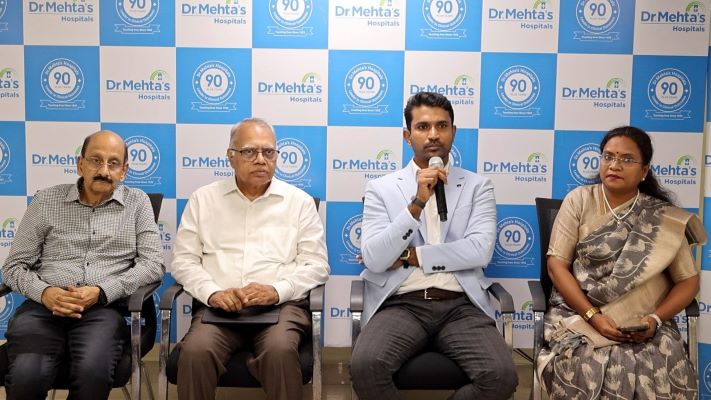
Dr. S. Ramesh Babu, Medical Director, Dr. Mehta’s Hospitals, Velappanchavadi, Chennai, said the case demonstrated the importance of an integrated approach to complex medical and surgical conditions.
“At Dr. Mehta’s Hospitals, we are equipped to manage complex medical and surgical conditions through an integrated approach that brings together advanced surgical capabilities, critical care infrastructure and multidisciplinary expertise. Cases involving severe spinal cord injuries require not only precise surgical intervention but also coordinated postoperative care and structured rehabilitation to support functional recovery. Our focus remains on delivering comprehensive, patient-centred care at every stage of treatment, supported by the expertise of our clinical teams and the hospital’s facilities.”
The patient’s return to independent walking offers an encouraging account of recovery after a severe spinal injury. It also carries a broader message: persistent neck pain deserves appropriate medical assessment, particularly when accompanied by weakness, numbness, balance difficulties or other neurological symptoms. Following a fall or neck injury, new weakness or loss of movement requires emergency medical attention.