
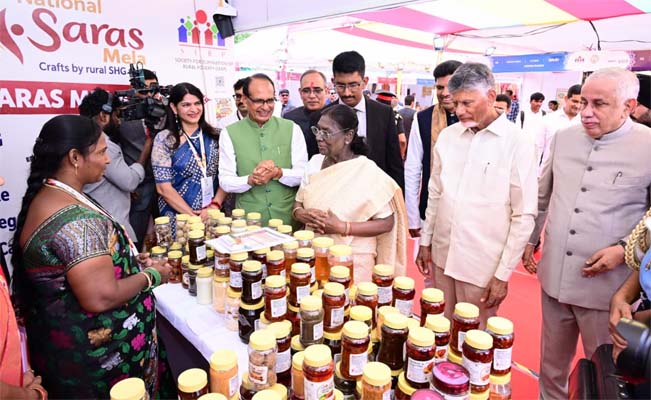
- Vijayawada Mela brings together 1,500 women entrepreneurs from 34 States and Union Territories
- More than 650 stalls showcase rural products, traditional crafts and women-led enterprises
- Lakhpati Didi initiative seeks sustainable annual household incomes of at least ₹1 lakh
- Access to finance, digital commerce and wider markets key to scaling grassroots businesses
- From local livelihoods to global brands, rural women aspire to build commercially successful enterprises
NE FEATURES BUREAU
VIJAYAWADA, OCTOBER 18
India’s rural women are looking beyond local markets and traditional livelihoods, aspiring to transform self-help group enterprises into thriving businesses and home-grown products into nationally and globally recognised brands. The National SARAS Aajeevika Mela in Vijayawada, Andhra Pradesh, offers a glimpse of this ambition, bringing together women entrepreneurs from across the country to showcase their products, reach new customers and explore opportunities for growth.
The journey from Self-Help Group (SHG) member to entrepreneur, from Lakhpati Didi to aspiring Crorepati entrepreneur, captures a larger vision of rural economic transformation—one in which women are not merely participants in development but creators of wealth, employment and sustainable livelihoods.
Organised by the Union Ministry of Rural Development in collaboration with the Andhra Pradesh government, the Mela provides a marketplace for women-led enterprises to display and sell their products while exploring avenues to expand their businesses.
President Droupadi Murmu graced the event on October 15, underscoring the significance of rural entrepreneurship and women’s participation in India’s economic progress.
According to the official government release, approximately 1,500 women SHG entrepreneurs and Lakhpati Didis from 34 States and Union Territories are participating through more than 650 stalls.
From self-help groups to business enterprises
Self-Help Groups have emerged as an important platform for organising rural women, strengthening financial inclusion and developing livelihood opportunities. Access to credit, collective enterprise, skill development and market exposure can help members move from small-scale economic activity towards more sustainable businesses.
SARAS provides an opportunity for these entrepreneurs to take their products beyond familiar local markets and present them directly to consumers. Handlooms, handicrafts, traditional foods, textiles and indigenous products showcase not only India’s cultural diversity but also the commercial potential of rural skills and knowledge.
The challenge is to convert this exposure into lasting business relationships, repeat orders and dependable income. Participation in an exhibition can open doors, but sustained growth depends on product quality, competitive pricing, effective promotion and access to wider distribution networks.
The Lakhpati Didi to crorepati ambition
The Lakhpati Didi initiative seeks to enable women associated with SHGs to achieve sustainable annual household incomes of at least ₹1 lakh. The next aspiration is to help successful entrepreneurs expand their operations, establish recognisable brands and compete in larger markets.
The Crorepati ambition represents a higher entrepreneurial horizon, rather than an assured outcome of participation in a government programme. Reaching that scale requires business planning, working capital, consistent production, professional packaging, digital marketing and efficient supply chains.
Equally important is access to institutional buyers, organised retail networks, e-commerce platforms and export-oriented businesses. Women entrepreneurs also need timely credit, mentoring and practical support in pricing, accounting, compliance and product development.
From local craftsmanship to global branding
India’s rural enterprises possess considerable potential in handloom textiles, traditional crafts, regional foods and other products rooted in local knowledge. With appropriate quality standards, attractive packaging, product innovation and reliable logistics, selected enterprises could build a presence beyond domestic markets.
Digital commerce can help bridge the distance between rural producers and urban or international customers. However, access to online platforms alone is not enough. Entrepreneurs also need the capacity to fulfil orders, maintain consistent quality, protect product identity and compete on price and service.
The next step for initiatives such as SARAS is to build stronger connections between grassroots producers and e-commerce platforms, exporters, institutional purchasers and international exhibitions. Such linkages can help turn temporary exhibition sales into enduring commercial opportunities.
Women’s economic empowerment must translate into market power
The Vijayawada Mela is more than a showcase of rural products. It highlights the opportunity to transform grassroots skills into viable enterprises and collective organisation into individual economic agency.
For this promise to translate into lasting change, market access must be accompanied by finance, technology, business training and sustained institutional support. Women entrepreneurs must be able to grow not only their sales but also their control over income, business decisions and future investment.
The larger vision is to help SHG members build independent enterprises, enable Lakhpati Didis to scale towards their Crorepati aspirations and create opportunities for rural women to establish brands that can compete across India and, where commercially viable, in global markets.
The ultimate measure of success will not be the number of stalls at a fair, but the number of rural women who return home with lasting customers, growing businesses and greater economic independence.