
NE BUSINESS BUREAU
NEW DELHI / MUMBAI, OCT 26
India’s drive for defence self-reliance is increasingly being shaped by capabilities extending beyond
shipyards and weapons systems to the specialised materials that make modern warships possible.
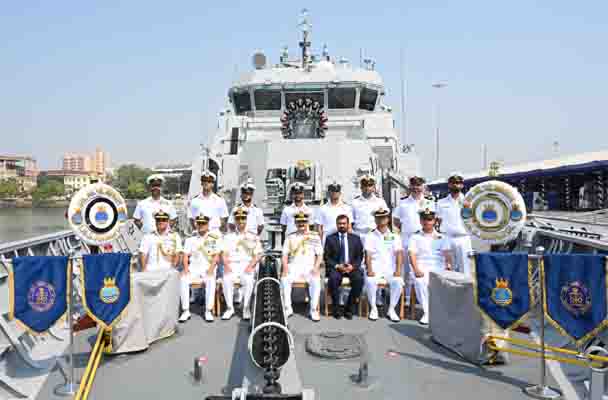
INS Mangrol, the Indian Navy’s latest addition to its coastal anti-submarine warfare fleet, brings
this strategic connection into focus.
Commissioned on October 12, 2026, at Naval Dockyard, Mumbai, the third Mahe-class Anti-
Submarine Warfare Shallow Water Craft (ASW-SWC) has been built using 100% specialised steel
supplied by ArcelorMittal Nippon Steel India (AM/NS India).
The development highlights the growing role of domestic steelmaking in India's naval modernisation
programme, linking industrial capability with the operational requirements of maritime security.
Ranjan Dhar, Director and Vice President – Sales and Marketing at AM/NS India, said: “The
commissioning of INS Mangrol marks another important milestone in India's journey towards
defence self-reliance. Advanced naval platforms require specialised steel produced to the highest
standards of quality and reliability. We are proud that AM/NS India steel continues to support the
Indian Navy's modernisation while showcasing the strength of India's manufacturing capabilities.”
The underwater threat: Why shallow-water warfare matters
Designed for operations in coastal and shallow waters, INS Mangrol is intended to strengthen the
Indian Navy’s ability to detect and respond to underwater threats closer to the coastline.
Its operational roles include anti-submarine warfare, underwater surveillance, low-intensity
maritime operations and mine warfare-related tasks. Advanced sensors, sonar and weapon systems
are designed to help the vessel detect, track and counter underwater threats.
Such capabilities are significant for a country with an extensive coastline, busy commercial ports and
vital maritime trade routes. Effective coastal surveillance and anti-submarine operations form an
important part of protecting maritime approaches and responding to emerging security challenges.
The vessel's commissioning adds to the Indian Navy's efforts to build specialised platforms suited to
the operational demands of India’s coastal waters.
More than 80% indigenous content: The shipbuilding dimension
Built by Cochin Shipyard Limited, INS Mangrol incorporates more than 80% indigenous content,
according to the supplied information.
The programme reflects the objectives of Aatmanirbhar Bharat and Make in India, with domestic
capabilities contributing to warship construction, specialised materials and systems integration.
Indigenous content is strategically important because a stronger domestic manufacturing base can
help reduce dependence on overseas suppliers, strengthen industrial supply chains and support the
development of specialised engineering expertise.
The naval shipbuilding programme also demonstrates how major defence projects can create
demand for capabilities across multiple industrial sectors, including steel, engineering, electronics
and ship construction.
Eight vessels, one specialised-steel commitment
AM/NS India is supplying 100% of the specialised steel required for the Indian Navy's programme to
build eight Anti-Submarine Warfare Shallow Water Craft.
The company's contribution extends beyond INS Mangrol. It has also supplied specialised steel for
major naval platforms, including INS Visakhapatnam, INS Surat and INS Malvan.
These projects underline the importance of specialised steel in defence manufacturing, where
material quality and reliability are critical considerations.
For India's steel industry, participation in naval programmes represents a strategically important
application of advanced manufacturing capabilities. For the country's defence sector, domestic
supply chains can strengthen the industrial foundations on which long-term modernisation depends.
From warships to landmark infrastructure
AM/NS India's contribution to strategic national projects also extends beyond defence. The company
has supplied steel for major infrastructure developments, including the Chenab Railway Bridge, Anji
Khad Railway Bridge and Bogibeel Bridge.
Together, these projects illustrate the role of advanced steelmaking in supporting applications that
demand specialised materials, engineering expertise and dependable industrial supply chains.
The common thread is the importance of domestic manufacturing capabilities in projects linked to
national connectivity, infrastructure development and security.
Mangrol: Gujarat's maritime heritage meets modern naval ambition
The vessel takes its name from Mangrol, a prominent coastal town in Gujarat's Junagadh district,
connecting the warship with the state's longstanding maritime heritage.
The name also recalls the erstwhile INS Mangrol, which served the Indian Navy until 2004.