
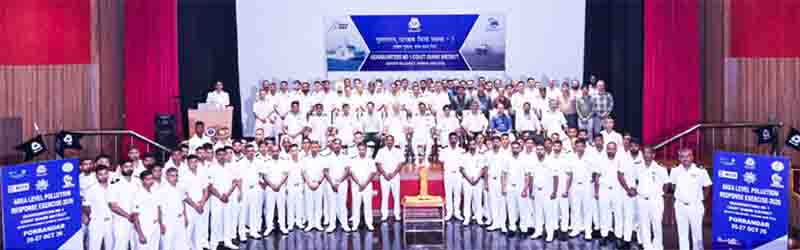
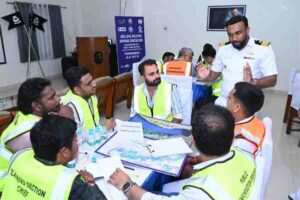
- TWO-DAY MARITIME READINESS DRIVE: Indian Coast Guard conducts Area Level Pollution Response Exercise-25 at Porbandar on October 26–27
- BOOMS, SKIMMERS AND SHIPBORNE ASSETS IN ACTION: Realistic operational scenarios demonstrate capabilities to contain and recover marine oil pollution
- MULTI-AGENCY COORDINATION GETS A BOOST: Gujarat Maritime Board and leading marine science and environmental agencies participate in joint preparedness efforts
- PROTECTING GUJARAT’S ECOLOGICALLY SENSITIVE COAST: Exercise reinforces preparedness under the National Oil Spill Disaster Contingency Plan
NE ENVIRONMENT BUREAU
PORBANDAR, OCT 29
An oil spill at sea can spread faster than the response to contain it—and every hour of delay can threaten marine life, coastal livelihoods and fragile ecosystems. Against this risk, the Indian Coast Guard has tested its operational preparedness and inter-agency coordination through a two-day pollution response exercise at Porbandar, strengthening the collective ability to respond to marine environmental emergencies along Gujarat’s coastline.
Coast Guard District Headquarters No. 1 (South Gujarat, Daman & Diu), under the aegis of Coast Guard Region (North West), conducted Area Level Pollution Response Exercise-25 (ALPRE-25) on October 26 and 27, 2026.
Sagar Modi, Mayor of Porbandar Municipal Corporation, attended the exercise as Chief Guest on October 27.
Designed around realistic pollution scenarios, the exercise involved Indian Coast Guard surface assets and demonstrated operational procedures for responding to marine oil pollution. The drills focused on the coordinated deployment of containment booms and skimmers, equipment used to contain floating oil and recover it from the water.
Booms and skimmers: Containing the threat at sea
Marine oil pollution can have serious consequences for coastal ecosystems, fisheries and communities dependent on the sea. Effective response therefore requires trained personnel, appropriate equipment, timely decisions and coordinated action.
During the exercise, Coast Guard personnel demonstrated the deployment of booms and skimmers as part of an integrated pollution response.
Containment booms help restrict the spread of floating oil, while skimmers collect oil from the water’s surface. Their effective use depends on prevailing sea conditions, the nature of the spill and the speed of mobilisation.
The exercise provided an opportunity to test operational procedures and reinforce preparedness for pollution incidents that could threaten the marine environment.
Scientific agencies and maritime stakeholders join hands
The exercise brought together key regional stakeholders, including the Gujarat Maritime Board, Ministry of Earth Sciences (MoES), ESSO-Indian National Centre for Ocean Information Services (INCOIS), Centre for Marine Living Resources and Ecology (CMLRE), and National Centre for Coastal Research (NCCR).
Their participation highlighted the importance of cooperation among maritime authorities, operational responders and scientific institutions in preparing for marine pollution emergencies.
Strategic planning sessions and practical demonstrations offered opportunities to strengthen joint response mechanisms and improve coordination among participating agencies.
For Gujarat, which has an extensive and economically significant coastline, such cooperation is important to protecting marine habitats, coastal infrastructure and communities whose livelihoods depend on healthy coastal waters.
National oil spill plan: Preparedness beyond the exercise
The Indian Coast Guard is the designated national authority for oil spill response under India’s National Oil Spill Disaster Contingency Plan (NOSDCP).
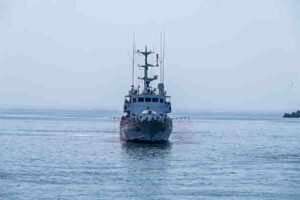
Area-level exercises form part of the wider effort to strengthen preparedness, clarify operational responsibilities and improve coordination among agencies that may be called upon during an actual pollution incident.
While drills cannot replicate every challenge posed by a real spill, they provide an opportunity to identify operational gaps, practise response procedures and reinforce cooperation before an emergency occurs.
The Porbandar exercise reaffirmed the Coast Guard’s commitment to marine environmental protection, stakeholder preparedness and the resilience of coastal communities.
Its guiding motto, “Vayam Rakshamah”—We Protect—underscores the service’s commitment to safeguarding India’s maritime interests and marine environment.