
NE DEFENCE BUREAU
CHENNAI, OCT 31
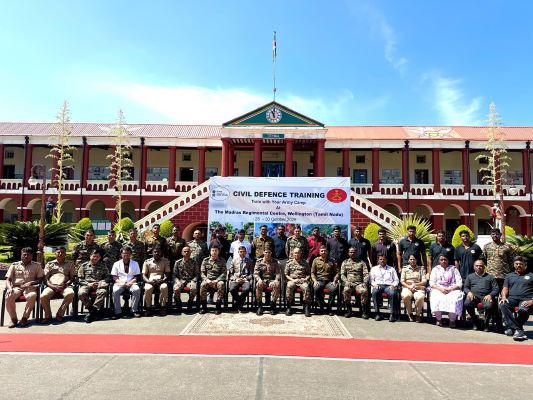
When emergencies strike, preparedness can make the difference between chaos and coordinated action. Bringing military expertise into civilian emergency planning, the Madras Regimental Centre (MRC), Wellington, is conducting a three-day specialised training programme for Civil Defence personnel from October 28 to 30, 2026, under the joint initiative ‘Train with Your Army’. The programme concludes today, with a focus on strengthening civil preparedness, enhancing crisis-response capabilities and improving civil-military coordination.
- Three-day specialised programme: Madras Regimental Centre, Wellington, trains Civil Defence personnel from October 28 to 30
- Threats beyond the battlefield: Training covers hybrid warfare, drone awareness, air raids and critical infrastructure protection
- Life-saving skills: Fire safety, CBRN awareness, casualty management, search and rescue and emergency communications feature on the agenda
- Whole-of-nation approach: ‘Train with Your Army’ initiative aims to strengthen civil preparedness, inter-agency coordination and crisis response
The programme seeks to strengthen civil preparedness and civil-military coordination by equipping Civil Defence Master Trainers with specialised skills to train volunteers in their respective areas.
Aligned with the Government of India’s vision of a vibrant and future-ready Civil Defence force, the initiative brings stakeholders together to promote wider participation in national security, improve synergy and interoperability, and facilitate coordinated responses to crises.
Three pillars of preparedness
The training focuses on three key domains: Threat Awareness; Protection and Emergency Response; and Communication and Coordination.
Participants are being familiarised with emerging security challenges, including modern and hybrid warfare, drone-related threats and air raids. The programme also addresses the protection of critical infrastructure and the importance of preparedness for emergencies that can disrupt essential services and public safety.
From hazard awareness to life-saving action
The curriculum extends beyond threat identification to practical emergency preparedness. Key areas include fire safety, Chemical, Biological, Radiological and Nuclear (CBRN) awareness, casualty management, search and rescue, emergency communication, cyber hygiene and incident response command.
These capabilities are intended to strengthen the ability of Civil Defence trainers to prepare volunteers for a range of contingencies, from security-related incidents to natural disasters and man-made emergencies.
Army expertise for a whole-of-nation response
The initiative leverages the Indian Army’s operational expertise to strengthen institutional preparedness and promote a ‘Whole of Nation Approach’ (WoNA) to national security.
By bringing military personnel and civilian stakeholders onto a common platform, the programme seeks to improve coordination, strengthen interoperability and encourage a more unified response to emerging threats.
The emphasis on training master trainers also creates an avenue for transferring specialised knowledge to Civil Defence volunteers at the grassroots level, extending the benefits of the programme beyond the training venue.
As security challenges become increasingly diverse, the initiative underscores the importance of preparedness, communication and coordinated action in building a resilient civil defence framework.