

- TRIBUTE BEFORE TAKE-OFF: Air Chief Marshal Ashutosh Dixit pays homage to fallen heroes at the National War Memorial before assuming charge as the IAF’s 29th Chief of the Air Staff
- FOUR PILLARS, ONE VISION: VAYU sets out Vigilance, Victory and Readiness; Aatmanirbharta; Yukti; and Unity of Effort as strategic priorities
- INDIGENOUS AIR POWER: New leadership underscores home-grown platforms, sensors, weapons and technologies to strengthen operational self-reliance
- FUTURE-READY FORCE: Innovation, AI-enabled command and control, counter-drone capabilities and joint operations take centre stage
NE DEFENCE BUREAU
NEW DELHI, NOV 1
Can India’s air power become more combat-ready, technologically self-reliant and seamlessly integrated across the armed forces? Air Chief Marshal Ashutosh Dixit has outlined his answer in four letters — VAYU — unveiling a guiding vision intended to shape the Indian Air Force’s operational priorities and future trajectory.
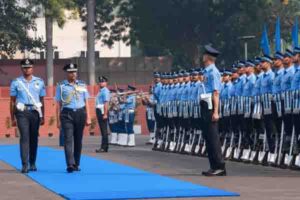
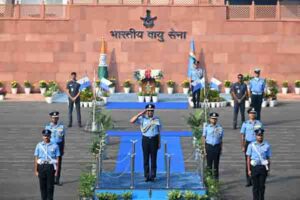
Beginning his tenure as the 29th Chief of the Air Staff, Air Chief Marshal Dixit, PVSM, AVSM, VM, VSM, paid homage on Sunday to the bravehearts who made the supreme sacrifice in service of the nation at the National War Memorial. He subsequently accepted a ceremonial Guard of Honour at Air Force Station New Delhi, marking the commencement of his tenure.
His opening address set out the broad direction for an Indian Air Force expected to remain operationally prepared while adapting to rapidly changing technologies, emerging threats and the demands of joint warfare.
V — Vigilance, victory and readiness
The first pillar places operational preparedness at the heart of the IAF’s priorities. It calls for maintaining the highest state of readiness across formations while restoring combat strength to sanctioned levels.
The emphasis is on ensuring that the force remains prepared to respond to emerging contingencies and safeguard national interests. In an increasingly complex security environment, readiness requires not only trained personnel and operational platforms but also the ability to respond swiftly and sustain combat effectiveness.
A — Aatmanirbharta: Building indigenous air power
The second pillar focuses on accelerating indigenous capabilities across platforms, sensors, weapons and technologies.
The objective is to strengthen operational self-reliance and sustain combat capability through greater domestic technological capacity. Indigenous development and manufacturing are central to reducing external dependencies while building systems suited to India’s operational requirements.
The thrust also aligns defence preparedness with the broader national emphasis on self-reliance, technological advancement and innovation.
Y — Yukti: Innovation for the next battlespace
The third pillar highlights ingenuity and innovation in doctrine, technology and operational procedures.
Among the priorities identified are AI-enabled command and control, counter-drone capabilities, resilience and preparedness for emerging operational domains.
As the character of warfare evolves, the ability to integrate new technologies, adapt tactics and anticipate threats will be crucial. The Yukti pillar seeks to place innovation at the centre of the IAF’s continuing transformation.
U — Unity of effort: Strength through jointness
The fourth pillar calls for stronger coordination with the Indian Army, Indian Navy and national agencies.
This approach is framed within the national vision of JAI — Jointness, Aatmanirbharta and Innovation. Closer integration among the services and relevant agencies is intended to strengthen coordination, improve operational effectiveness and enable a more unified response to security challenges.
The emphasis on jointness reflects the growing importance of integrated planning and coordinated capabilities across the defence establishment.
A vision for a technologically advanced IAF
Through VAYU, the Chief of the Air Staff has outlined a direction centred on operational readiness, technological advancement, indigenous capability and joint operations.
The vision seeks to combine combat preparedness with innovation and self-reliance, while strengthening cooperation across the armed forces and national agencies.
For the Indian Air Force, the challenge will be to translate these four pillars into sustained operational capability and measurable progress. The stated objective is clear: to safeguard India’s interests and deter conflict through credible air power.