
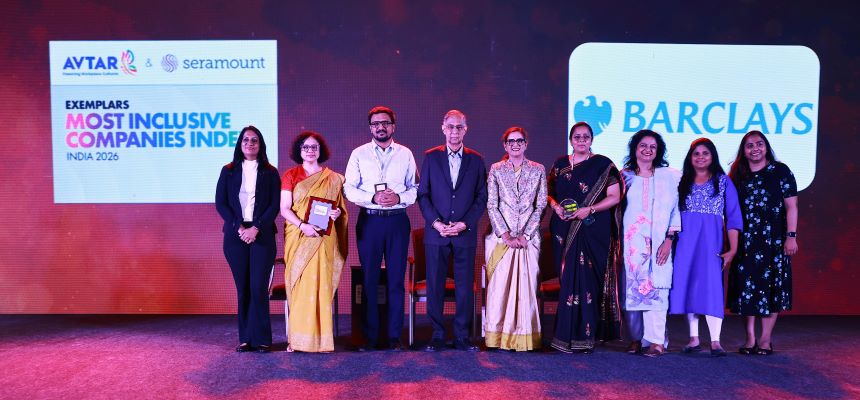
BEYOND AWARDS AND BENCHMARKS: Avtar and Seramount launch Circle of Inclusive Cultures at Chennai’s Best of Best 2026, turning workplace inclusion into a collective business movement where companies share successes, learn from failures and build a fairer future for talent.
NE BUSINESS BUREAU
CHENNAI, NOV 5
In the evolving corporate landscape, an organisation’s greatest competitive advantage may lie not merely in its financial capital, technology or market share, but in the culture it creates for its people. Championing this powerful proposition, Avtar Career Creators Limited and Seramount have unveiled a collaborative platform to help businesses transform workplace inclusion from an individual corporate commitment into a collective, industry-wide movement.
- Avtar and Seramount unveil Circle of Inclusive Cultures to foster cross-industry collaboration and workplace inclusion
- Best of Best Conference & Awards 2026 champions ‘Culture as Capital’ as a strategic business imperative
- Barclays India among the Top 10 Best Companies for Women in India; new Workplace Wellness benchmark introduced
- Industry leaders underline the business case for diversity, equity, women’s leadership and employee well-being
- Tata Starbucks’ Sudhakar Dokare bags Male Ally Legacy Award for championing inclusive workplaces
The Circle of Inclusive Cultures (CIC) was launched on Wednesday at the Best of Best (BoB) Conference & Awards 2026, hosted at ITC Grand Chola, Chennai. The corporate membership initiative seeks to bring organisations together to exchange experiences, share proven practices and collectively raise the bar on workplace culture and inclusion.
The annual BoB conference celebrates organisations recognised through Avtar and Seramount’s Best Companies for Women in India (BCWI), Most Inclusive Companies Index (MICI) and Best Companies for ESG (BCESG). This year, the recognition framework also expanded to include a new benchmark, Best Companies for Workplace Wellness (BCWW), reflecting the growing importance of employee well-being in corporate performance.
While benchmarking enables organisations to assess their progress against established standards, CIC seeks to take the conversation beyond rankings by creating a sustained platform for peer learning and cross-industry collaboration.
The initiative was virtually launched by Dr S. Vijayakumar, IAS, Additional Chief Secretary to the Government of Tamil Nadu, Industries Department, who attended the conference as Chief Guest.
Emphasising the need to make inclusive growth an integral part of Tamil Nadu’s industrial expansion, he said, “Tamil Nadu has always believed that economic growth must create opportunities for everyone. As we expand into new sectors, women must be active participants in this growth. Government can create policies and companies can build good workplaces, but real change requires all of us to work together. The Circle of Inclusive Cultures brings organisations together to share what works, learn from one another and raise standards across industries. I appreciate Avtar for taking this important initiative forward.”
Explaining the philosophy behind CIC, Dr Saundarya Rajesh, Managing Director, Avtar Career Creators Limited, said the initiative would complement more than a decade of benchmarking work by translating organisational learning into practical, sustained action.
“For over a decade, our benchmarking studies have helped organisations understand where they stand on inclusion and learn from those setting higher standards. The Circle of Inclusive Cultures complements this work by taking that learning further, creating opportunities for organisations to exchange practical insights throughout the year. After all, every organisation is at a different stage in its inclusion journey. Some have found practices that work well, while others are still figuring out what needs to change. There is much we can learn from one another. CIC is designed to make these conversations happen. Our goal is simple: to help every participating organisation grow stronger and create a ripple effect of lasting change across industries,” she said.
CIC will facilitate dedicated peer-learning circles for CEOs, Chief Human Resources Officers (CHROs), inclusion leaders and other key stakeholders. Significantly, membership will remain open to organisations irrespective of whether they have participated in Avtar and Seramount’s benchmarking studies.
Welcoming the initiative, Subha V. Barry, President, Seramount, highlighted the enormous value of sharing corporate experiences rather than allowing successful inclusion practices to remain confined to individual organisations.
“Think about the collective knowledge that exists across companies in India. Some organizations have made extraordinary progress advancing women into leadership. Others have developed innovative approaches to supporting working parents. Why shouldn’t others benefit from those lessons? Yes, we compete for customers, talent, and market share. That’s business. But when it comes to creating workplaces where everyone has a fair opportunity to succeed, why should we keep our best ideas to ourselves? And let’s not just share our successes. Some of the most valuable lessons come from what didn’t work,” she said.
The launch resonated strongly with this year’s BoB theme, ‘Culture as Capital’, which positioned workplace culture as a strategic business asset rather than merely an organisational value statement.
The conference featured panel discussions and expert presentations examining the business case for environmental, social and governance (ESG) practices, inclusion as a catalyst for leadership in the artificial intelligence era, and the role of organisational culture as essential business infrastructure.
R. Seshasayee, Chairman, Asian Paints, former Chairman of Infosys and IndusInd Bank, and former Executive Vice Chairman of Ashok Leyland, attended as Chief Guest and presented awards to the winning organisations at the evening ceremony.
“Culture shapes how decisions are made, how people work together and, ultimately, how businesses perform. Building such a culture calls for humane leadership and accountability. This is also why benchmarking matters as it helps organisations measure progress, and Avtar’s Best of the Best platform has been instrumental in driving this conversation. Let us turn these learnings into action and make culture count in every decision,” he said.
Singai G. Ramachandran, Chairman, StartupTN, who attended as Guest of Honour, underlined the importance of inclusive workplaces in strengthening Tamil Nadu’s industrial competitiveness.
“Tamil Nadu’s industrial strength lies not only in its infrastructure or investments, but also in its people. And inclusive workplaces make the state more competitive. Every organisation must therefore invest in building a culture of trust and fairness. It is equally important to measure your progress through leading benchmarking studies such as Avtar & Seramount’s ‘Best Companies for Women in India’. By doing so, you are contributing to Tamil Nadu’s continued growth and also strengthening your own long-term success,” he said.
Celebrating men who champion inclusion
The conference also spotlighted the vital role of male leadership in advancing gender equity through the Male Ally Legacy Award (MALA), instituted to recognise men who actively champion inclusive workplaces and create greater opportunities for women.
This year’s award went to Sudhakar Dokare, Regional Director, Tata Starbucks Private Limited. Jaison Thomas, Managing Director – India, Encore Capital Group Inc., and Sibasish Guha, Head of Department – Digital Office, HDFC ERGO, received the Jury’s Choice awards.
The larger message emerging from BoB 2026 was unmistakable: inclusion cannot remain the responsibility of individual HR departments or isolated corporate initiatives. It must become an organisation-wide commitment, reinforced by leadership, measurable benchmarks and the willingness to learn collectively. In an increasingly competitive business environment, companies that invest in people and build cultures of fairness, trust and belonging could well be building their most enduring capital.