
- Two experimental compounds target TTK, a protein that helps regulate cell division, to undermine the survival mechanisms of aggressive glioblastoma cells
- SPK17 weakened cancer cells’ ability to manage DNA damage, while its analogue SPK17b also impaired their capacity to spread
- Laboratory tests showed substantially lower concentrations of the compounds were associated with reduced cell viability than the commonly used chemotherapy drug temozolomide
- Researchers report distinct mechanisms of action, including disruption of cell-cycle checkpoints and an increase in damaging reactive oxygen species
- Animal studies are under way to assess the compounds’ efficacy and establish whether the laboratory findings can translate into future therapeutic possibilities
NE SCIENCE & TECHNOLOGY BUREAU
GANDHINAGAR, NOV 6
What if the biological safeguards that help cancer cells survive their chaotic multiplication could be turned against them? Researchers at the Indian Institute of Technology Gandhinagar (IITGN) are exploring precisely this possibility through two experimental compounds that have shown encouraging results against glioblastoma—an aggressive form of brain cancer known for its resistance to treatment.
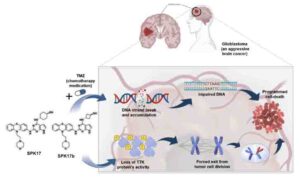
The studies identify two promising candidates, SPK17 and SPK17b, which target tyrosine-threonine kinase (TTK), also known as Mps1, a protein that plays a critical role in regulating cell division. By interfering with this protein, the compounds weakened the ability of glioblastoma cells to survive and multiply in laboratory experiments. One compound disrupted the cells’ response to DNA damage, while the other also impaired their ability to spread.
The findings, published in the Journal of Biological Chemistry and RSC Medicinal Chemistry, offer a new research direction in the search for ways to tackle drug-resistant glioblastoma.
Turning a cellular checkpoint into a vulnerability
The challenge in treating glioblastoma is that tumour cells can adapt and evade the effects of existing therapies. Temozolomide (TMZ), a commonly used chemotherapy drug, remains part of standard treatment, but resistance can make the disease particularly difficult to control.
The IITGN researchers focused on TTK, a protein that functions as a quality-control inspector during cell division. It helps ensure that chromosomes are correctly distributed between daughter cells. When an error is detected, TTK activates a checkpoint, temporarily pausing division to allow the problem to be addressed.
Cancer cells, which often divide rapidly and under considerable cellular stress, rely on such mechanisms to manage the consequences of their abnormal growth. The researchers investigated whether disrupting this checkpoint could leave glioblastoma cells less capable of coping with DNA damage, reducing their viability and potentially increasing their sensitivity to treatments such as radiotherapy.
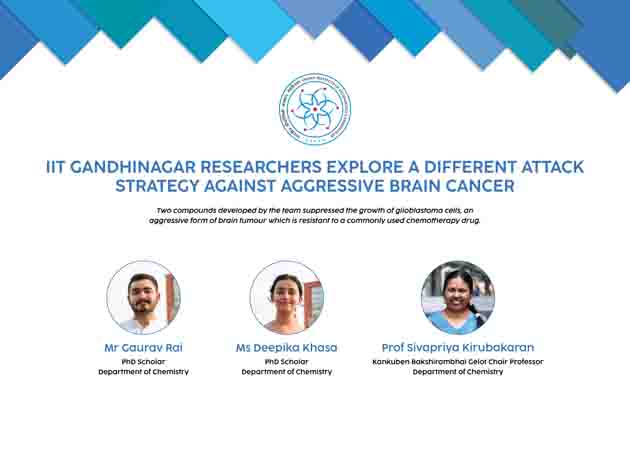
Gaurav Rai, a PhD student in IITGN’s Department of Chemistry and a recipient of the Prime Minister’s Research Fellowship, explained the motivation behind the work:
“Earlier studies have linked TTK’s involvement in resistance to TMZ, a commonly used chemotherapy drug. We wanted to explore whether modifying a candidate from one of our previous studies, J54 (a selective inhibitor of TTK), could help us target TTK more effectively and guide further research into ways of tackling drug-resistant glioblastoma.”
Two compounds, two routes to disrupting cancer cells
In one study, SPK17—identified as G17 in the research paper—emerged as the standout candidate among more than 10 compounds developed by the team.
In laboratory tests involving two human glioblastoma cell lines, LN229 and U87MG, the concentration of SPK17 associated with a 50% reduction in cell viability (IC50) was approximately 176 times lower than that of TMZ in LN229 cells and 85 times lower in U87MG cells.
The results were also notable in LN229-TMZ-R cells, which had developed resistance to temozolomide under experimental conditions. At a concentration of 10 micromolar, SPK17 produced approximately eight times the cell-death signal observed with 200 micromolar TMZ.
A companion study identified SPK17b, referred to as G17b in the paper, as the most prominent among five compounds examined. Its IC50 was approximately 81 times lower than that of TMZ in LN229 cells and 59 times lower in U87MG cells.
In the TMZ-resistant LN229-TMZ-R cells, SPK17b produced a cell-death signal at a concentration at least 59 times lower than the 200 micromolar TMZ comparison, when tested at 10 micromolar.
These laboratory findings suggest that substantially lower concentrations of the experimental compounds were associated with reduced cancer-cell viability than the comparator drug. However, such cell-based results do not establish clinical effectiveness or safety in patients.
Deepika, the second author of the SPK17b study and also a PhD student in IITGN’s Department of Chemistry, highlighted another dimension of the findings:
“We also realised that SPK17b appeared to do more than slow the growth of glioblastoma cells. The treated cells showed an impaired ability to metastasise or spread, one of the hallmarks of cancer.”
How the compounds attack the cancer cells
Although both compounds target TTK, the studies explored different consequences of blocking the protein.
Gaurav explained the distinction:
“Both compounds act on the same protein, TTK, but the two studies followed different consequences of blocking it. SPK17 removes a built-in pause that normally gives a dividing cell time to mend its damaged DNA. The cell is pushed through division with the damage unrepaired, and it accumulates until the cell dies. SPK17b instead causes a build-up of reactive oxygen species, toxic by-products of the cell’s own metabolism, until the cell’s defences are overwhelmed and it self-destructs, while also leaving surviving cells less able to move and invade surrounding tissue.”
The findings indicate that targeting a single protein may open up different biological pathways for weakening tumour cells—by disrupting their ability to manage DNA damage, increasing oxidative stress and reducing their capacity to move and invade surrounding tissue.
From laboratory promise to the next research checkpoint
Despite the encouraging results, the researchers emphasise that drug discovery is a process involving several stages. Demonstrating activity against a biological target is only the beginning; further studies must establish efficacy, safety and the balance between potential benefits and risks in increasingly complex biological systems.
Prof Sivapriya Kirubakaran, Kankuben Bakshirambhai Gelot Chair Professor in IITGN’s Department of Chemistry and head of the Institute’s Cancer Chemical Biology lab, said:
“When you are working on a disease as aggressive as glioblastoma, you are aware of how urgently better treatment options are needed. Findings like those from our study can bring us closer to asking the right questions to improve understanding of difficult diseases. Our two compounds give us a mechanism-based therapeutic strategy to investigate how we might target drug-resistant tumour cells. Future studies to understand the efficacy of the molecules in animal studies are ongoing.”
The ongoing animal studies will be an important next step in determining whether the compounds’ laboratory performance can translate into meaningful therapeutic potential. Much remains to be established before either candidate can be considered for clinical use.
The research also resonates with United Nations Sustainable Development Goal 3, particularly target 3.B, which calls for support for research and development of medicines for non-communicable diseases. In India, the work aligns with the broader objective of strengthening cancer research and care under the National Programme for Prevention and Control of Non-Communicable Diseases.
For now, the IITGN findings offer a promising scientific lead: rather than simply attacking tumour cells through conventional chemotherapy, researchers are investigating whether disrupting the molecular systems that help these cells survive could expose a different route to tackling one of the most challenging forms of brain cancer