
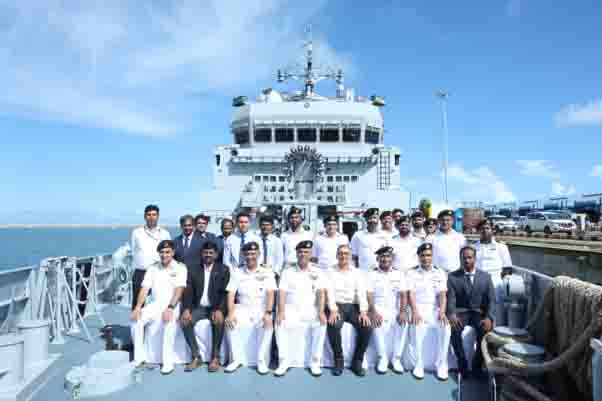
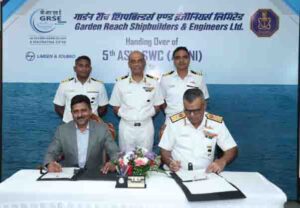
- GRSE-built shallow-water combatant delivered to Indian Navy, reinforcing coastal defence preparedness
- Over 80% indigenous content underscores India’s growing self-reliance in warship construction
- Advanced sonars, lightweight torpedoes and indigenous rocket launchers equip vessel to tackle underwater threats
- Waterjet propulsion makes Amini one of the largest Indian naval warships of its kind
- Lakshadweep island lends its name to the latest addition, reviving a distinguished naval legacy
NE DEFENCE BUREAU
NEW DELHI, NOV 6
India’s maritime defence capabilities have received another indigenous boost with the delivery of Amini, an Anti-Submarine Warfare Shallow Water Craft (ASW SWC), to the Indian Navy. Designed and built by Kolkata-based Garden Reach Shipbuilders and Engineers (GRSE), the vessel represents a significant stride in strengthening coastal security while advancing the country’s quest for self-reliance in defence manufacturing.
The ship was formally handed over to the Indian Navy on Thursday, marking another milestone in India’s indigenous warship-building programme.
Designed and constructed by GRSE in accordance with the classification rules of the Indian Register of Shipping (IRS), Amini belongs to the ASW SWC series developed to address the growing requirements of underwater threat detection and coastal maritime security.
Among the largest Indian Naval warships propelled by waterjets, the vessel is equipped with an advanced suite of weapons and sensors, including state-of-the-art lightweight torpedoes, indigenous rocket launchers and sonars. These sophisticated systems will enable it to detect, track and engage underwater threats effectively.
Beyond its anti-submarine warfare role, the vessel is expected to strengthen the Navy’s coastal surveillance and mine-laying capabilities, adding operational depth to India’s maritime security architecture.
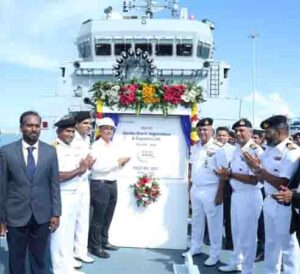
A name that revives Naval legacy
Amini derives its name from Amini Island in the Union Territory of Lakshadweep. The vessel also revives the legacy of the erstwhile INS Amini, a Petya III-class Anti-Submarine Warfare Corvette that was decommissioned in 2002. The continuity of the name reflects the Indian Navy’s tradition of preserving distinguished identities across generations of warships.
Over 80% indigenous content
The delivery of Amini marks yet another milestone in the Indian Navy’s pursuit of indigenous shipbuilding, in keeping with the Government’s vision of Aatmanirbhar Bharat.
With more than 80% indigenous content, the warship stands as a compelling testament to the expanding capabilities of India’s domestic defence manufacturing ecosystem. It also underscores the country’s determined effort to reduce dependence on imported defence equipment while strengthening indigenous design, engineering and production capabilities.
As India sharpens its focus on maritime preparedness and indigenous defence production, Amini adds more than another warship to the fleet: it represents the growing technological confidence of the nation’s shipbuilding industry.