
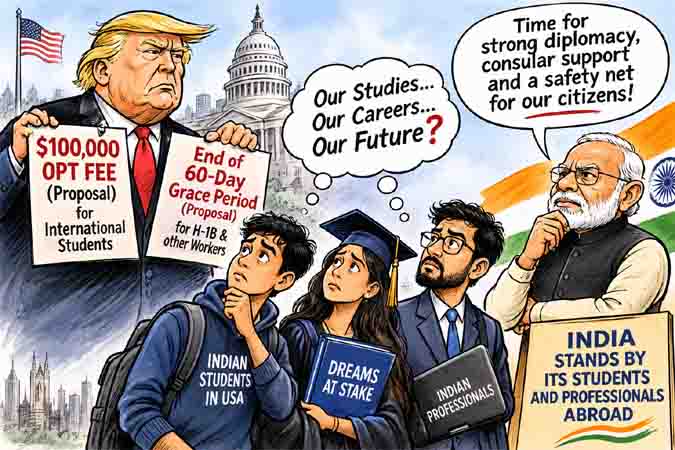
- Modi government faces a diplomatic and consular challenge as US proposes $100,000 OPT charges and withdrawal of the 60-day job-loss safety net
NE EDUCATION BUREAU
WASHINGTON, NOV 11
Can an Indian student who invests years of study and substantial family savings in an American university be denied a realistic opportunity to gain work experience after graduation? Can an Indian technology professional who suddenly loses a job be left with little time to find another employer and protect the immigration status of the entire family?
These are no longer distant questions for thousands of Indian students, researchers, engineers and technology professionals in the United States. Two proposed immigration changes by the Donald Trump administration have brought their academic futures, career prospects and family security into sharp focus — and placed a fresh responsibility on Prime Minister Narendra Modi’s government to protect India’s interests through sustained diplomacy, consular intervention and practical support.
A California-led coalition of state attorneys general has challenged the proposed US plan to make universities pay up to $100,000 for an international student’s participation in Optional Practical Training (OPT). Separately, a proposal to withdraw the existing discretionary 60-day grace period for foreign workers who lose their jobs has attracted more than 31,000 public comments.
For India, the stakes are substantial. Indians account for the largest share of H-1B beneficiaries, while Indian students form a significant part of the international academic community in American universities. The two proposals could affect not only individual careers but also families, university enrolments, research collaborations and the movement of skilled talent between the world’s two major democracies.
$100,000 OPT proposal: A potential roadblock after graduation
California Attorney General Rob Bonta announced on November 9 that a multistate coalition had formally urged the US Department of Homeland Security (DHS) to withdraw its proposed OPT charges.
Under the proposal published on October 8, educational institutions would have to pay $70,000 when initially recommending an F-1 student for OPT and another $30,000 for a subsequent recommendation. The latter could include an eligible extension under the Science, Technology, Engineering and Mathematics (STEM) category.
An important distinction is that the proposed charges are linked to an institution’s OPT recommendation, not to a particular employer or merely to a change of employer. They would apply to OPT participation, including pre-completion and post-completion training.
Although universities would formally make the payments to DHS, the proposal would allow them to seek reimbursement from students or employers. The financial burden could therefore reach graduates and businesses.
Bonta said the proposal threatened students, universities and the American economy.
“We have already fought and won against this Administration’s attempt to impose an unauthorised $100,000 tax on H-1B visas, yet it continues to pursue unlawful overreach at the expense of our students, universities, and economy,” he said.
The coalition argues that DHS lacks congressional authority to impose what it describes as a tax disguised as a fee. It has also raised objections under the Immigration and Nationality Act and the Administrative Procedure Act, questioning the department’s assessment of the economic consequences and the adequacy of the 30-day public consultation period.
More than 294,000 international students participated in OPT nationwide during the 2024–25 academic year. Maintaining participation at that level under the proposed charges could cost educational institutions an estimated $12.9 billion annually.
Bonta cited California’s experience, where international students contributed $6.3 billion to the economy and supported more than 52,000 jobs during the same academic year.
H-1B professionals: Will job loss mean an abrupt end to the American dream?
The second proposal could have an immediate human impact on Indian professionals already employed in the United States.
Published on September 11, the DHS proposal seeks to eliminate the discretionary grace period of up to 60 days currently available to certain foreign workers, including those on H-1B, L-1 and O-1 visas, after their employment ends.
Under the existing provision, eligible workers can generally remain in the country for up to 60 days after losing their jobs, or until their authorised stay expires, whichever comes first. The period provides time to seek another employer, explore a change of immigration status or prepare to leave the country.
If the proposal becomes final, that regulatory protection would disappear. Workers could face the prospect of having to leave the United States unless they obtain separate authorisation to remain. Their dependants could also be affected.
DHS maintains that immigration status should remain directly linked to the employment for which a foreign worker was admitted. It argues that the grace period “is not mandated by statute” and creates additional administrative work.
The department estimates that an average of 65,752 foreign workers annually lost or changed jobs between fiscal years 2021 and 2025, based on revoked employment petitions. About 3,795 had new employer petitions filed within the grace period each year.
DHS has acknowledged that eliminating the provision could result in loss of income, relocation expenses and possible immigration proceedings for affected workers.
The proposal had attracted 31,383 posted public comments by Tuesday night, November 10, according to the figures cited in the available reporting. The volume demonstrates substantial public engagement, although it does not establish how many respondents support or oppose the measure.
Indian diaspora’s concerns: A talent partnership at stake
The implications are particularly significant for the Indian diaspora. According to USCIS figures cited in its fiscal 2025 report to Congress, approximately 70 per cent of 406,348 approved H-1B petitions involved beneficiaries born in India. China accounted for around 12 per cent.
Indian professionals have contributed to American technology, healthcare, research, education and entrepreneurship. Their participation in the US workforce has also strengthened economic and people-to-people ties between the two countries.
Indiaspora, a global Indian diaspora organisation, has warned that proposed immigration restrictions and rising costs could make it harder for American employers to recruit skilled professionals, including Indians in technology, healthcare and education.
Indiaspora Executive Director Sanjeev Joshipura said: “H-1B workers from India have helped make America the world’s innovation leader.”
The organisation has also cautioned that the consequences could extend beyond technology companies to hospitals and educational institutions that depend on international professionals.
For Indian families, the concern is not simply about a visa category. It is about the uncertainty that could follow a sudden lay-off, the possibility of having to relocate at short notice, the disruption of children’s education and the financial commitments made to pursue higher education or build a career overseas.
The proposed OPT charges also raise difficult questions for students and parents in India who calculate the cost of an American degree on the expectation that graduates may gain relevant practical experience after completing their studies.
What should the Modi Government do now?
The Government of India has previously acknowledged the humanitarian implications of US immigration changes. In September 2025, following the announcement of a $100,000 charge on certain new H-1B petitions, the Ministry of External Affairs said that the measure could disrupt families and expressed hope that the US authorities would address such consequences suitably.
In a February 2026 reply to a Rajya Sabha question on the impact of H-1B policies, the Ministry reiterated that skilled talent mobility contributes to technology development, innovation, economic growth and wealth creation in both countries. It also stated that visa-related decisions are sovereign matters.
Against the backdrop of the latest proposals, New Delhi could now consider a more focused and time-bound response:
- Make an urgent diplomatic representation to Washington: The Prime Minister’s Office and the Ministry of External Affairs should ensure that the concerns of Indian students and professionals are taken up at the highest appropriate diplomatic level. The Indian Embassy in Washington and consulates should seek detailed consultations with the US State Department and DHS, highlighting the implications for Indian nationals, families, universities and businesses.
- Submit India’s own detailed representation on the proposed rules: The Government should consider placing its concerns formally before the relevant US authorities, supported by evidence from Indian students, universities, technology companies and diaspora organisations. It should seek withdrawal or substantial modification of measures that could impose disproportionate financial or immigration hardships.
- Establish a dedicated student and professional assistance mechanism: Indian missions should have a clearly identified point of contact for F-1 students, OPT applicants and H-1B workers facing sudden employment termination or visa-related difficulties. A rapid-response system could provide verified legal information, referrals to qualified immigration lawyers and guidance on maintaining lawful status.
- Strengthen consular outreach and grievance redressal: The existing MADAD portal, mission contacts and emergency assistance channels should be widely publicised among Indian students and professionals. Missions could organise regular online consultations with student associations, university representatives and diaspora groups, with special attention to those facing urgent job-loss or status-related difficulties.
- Build a national database and an early-warning network: The voluntary registration of Indian students abroad should be actively encouraged, while Indian professional associations and diaspora organisations could help identify emerging difficulties. A reliable database would enable the government to communicate verified advisories and respond more effectively during emergencies.
- Prepare an employment and research reintegration pathway in India: For professionals who may have to return, the government could work with NASSCOM, technology companies, Global Capability Centres, universities, research institutions and start-ups to identify opportunities matching their skills. A structured returnee-support mechanism could help retain valuable international experience within India’s innovation and manufacturing ecosystem.
These are proposed interventions, not a claim that the government has already announced such a package. They would complement the assistance channels that the Ministry of External Affairs has told Parliament are already available to Indians abroad.
India must protect its people while preserving the US partnership
The challenge for New Delhi is to protect Indian nationals without turning a bilateral immigration disagreement into a wider diplomatic confrontation. The United States has the sovereign authority to frame its immigration laws, while India has a legitimate responsibility to represent the interests and welfare of its citizens.
The two countries also have substantial shared interests in technology, research, innovation, education, investment and skilled talent mobility. A predictable visa framework serves not only Indian professionals but also American universities, employers and industries that benefit from international expertise.
The OPT proposal had received 8,947 posted comments by Tuesday night, with its public comment period ending on November 9. A separate proposal to change the practice of generally deferring to earlier USCIS approvals in certain extension cases had received 686 comments, with submissions due on November 13.
Neither the OPT fee proposal nor the proposal to eliminate the 60-day grace period should be treated as an implemented rule. DHS must consider the public submissions before deciding whether to issue final regulations, and any final rule would specify its effective date.
For India’s students and professionals, however, waiting until the proposals become final would be a costly approach. Timely diplomacy, accessible consular support and a credible employment safety net at home could make a meaningful difference.
The larger question confronting India is this: as the country aspires to become a global knowledge and technology powerhouse, can it afford to leave its students, researchers and skilled professionals without a coordinated support system when overseas policy changes put their futures at risk?