
NE NEWS SERVICE
CHENNAI, NOV 14
With a developing weather system over the Bay of Bengal threatening to intensify into a cyclonic storm, disaster preparedness has moved into high gear, with coastal State governments, maritime authorities and the Indian Coast Guard stepping up preventive measures to protect lives, safeguard fishing communities and minimise potential damage. The emerging challenge calls for a coordinated response spanning early warnings, fishing restrictions, evacuation preparedness, search and rescue, emergency relief and post-disaster rehabilitation.
- IMD forecasts possible cyclonic storm over central Bay around November 16; fishermen warned to return by November 15
- Tamil Nadu Chief Minister orders coordinated Coast Guard, Navy and maritime police response to protect fishermen
- Indian Coast Guard places ships, aircraft and disaster response teams on heightened operational alert along eastern seaboard
- Odisha alerts coastal and southern district collectors; rainfall, evacuation and emergency preparedness take centre stage
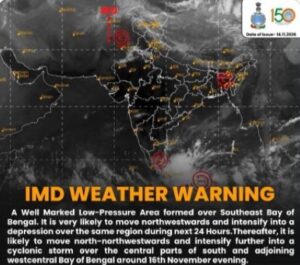
The India Meteorological Department (IMD), in its latest bulletin on Saturday, said the low-pressure area over the South-East Bay of Bengal had intensified into a well-marked low-pressure area. It is very likely to develop into a depression within the next 24 hours and subsequently intensify further into a cyclonic storm over the central parts of the south and adjoining west-central Bay of Bengal around the evening of November 16.
The system, which developed under the influence of an upper-air cyclonic circulation over the central Andaman Sea and adjoining Andaman and Nicobar Islands, is expected to move northwestwards initially before taking a north-northwestward track.
The IMD’s forecast underscores the urgency of preparedness across vulnerable coastal regions, although the system’s eventual track and potential landfall implications will depend on subsequent meteorological assessments.
Fishermen warned; coastal states intensify precautions
The IMD has advised fishermen already at sea to return to the coast by November 15 and prohibited fishing in several vulnerable stretches of the Bay of Bengal.
The restrictions cover the Andaman Sea and adjoining Andaman and Nicobar Islands until November 17, the South-East Bay of Bengal until November 17, the South-West Bay of Bengal from November 15 to 18 and the central Bay of Bengal from November 16 to 19.
Sea conditions are expected to deteriorate from rough to very rough, becoming high in parts of the South-West and central Bay of Bengal. Wind speeds could reach 65–80 kmph in some affected areas, with stronger gusts.
The IMD has also forecast fairly widespread to widespread rainfall across Tamil Nadu, Puducherry and Karaikal on November 15, followed by isolated to scattered rainfall during November 16–19. Coastal Andhra Pradesh and Yanam are likely to receive rainfall during November 14–19, with isolated heavy rainfall forecast on November 18 and 19.
In Tamil Nadu, isolated rainfall is expected in Western Ghats districts, including the Nilgiris, Coimbatore, Theni, Dindigul, Tiruppur and Tenkasi, besides parts of southern and northern coastal Tamil Nadu.
Chennai is likely to experience partly cloudy skies and intermittent showers, with weather conditions requiring continued monitoring as the system develops.
Tamil Nadu CM orders coordinated maritime response
Tamil Nadu has stepped up its preparedness, with Chief Minister C Joseph Vijay directing the Coast Guard, Navy and State maritime police to ensure coordinated search and rescue operations for fishermen in view of the developing weather threat.
Chairing a high-level review meeting at the Secretariat, the Chief Minister stressed the need to strengthen vessel-tracking technologies and upgrade communication equipment on deep-sea fishing boats, particularly during the Northeast monsoon.
He also directed officials to ensure that fishing boats and their engines were seaworthy before being permitted to venture into the sea and called for strict enforcement of marine laws.
The Fisheries Department has prohibited fishermen in Thoothukudi district from venturing into the sea until further notice. Authorities are broadcasting weather warnings and asking deep-sea fishing vessels still operating at sea to return to shore immediately.
The emphasis is on preventing fishermen from being stranded in rough seas and ensuring that maritime agencies can respond swiftly if vessels encounter distress.
Odisha alerts district collectors; administrations put on guard
The Odisha Government has alerted district collectors in the coastal and southern regions following the IMD’s forecast of a possible cyclonic storm.
Disaster Management Minister Suresh Pujari said precautionary measures had already been initiated even though the IMD had not yet provided a specific assessment of the system’s potential impact on Odisha.
“Though the IMD has not made any prediction, we have already taken precautionary measures and informed the district collectors of northern, southern and coastal regions to remain prepared and vigilant about the system brewing in the sea,” Pujari told reporters.
The Minister was also scheduled to hold a review meeting with senior officials to assess the evolving situation and preparedness.
The Meteorological Centre in Bhubaneswar has issued a yellow alert for heavy rainfall in Kendrapara and Jagatsinghpur districts on November 18 and 19. Further rainfall alerts have been issued for parts of southern Odisha on November 19 and 20.
Fishermen have been advised against venturing into the sea along and off the south Odisha coast on November 17, when squally winds and rough to very rough sea conditions are expected.
Indian Coast Guard mobilises ships, aircraft and disaster response teams
The Indian Coast Guard (ICG) has significantly heightened its operational preparedness along the eastern seaboard, placing ships and aircraft on alert for immediate deployment.
Coast Guard Radar Stations are maintaining continuous surveillance of the developing weather system, while maritime patrols are being intensified to disseminate timely weather warnings and safety advisories to fishermen, merchant vessels and other mariners.
Remote Operating Stations at Chennai and other locations are broadcasting weather warnings and advisories in regional languages through Very High Frequency (VHF) communication channels to ensure that critical information reaches the maritime community.
Vessels at anchorage are being cautioned, while port authorities are being kept informed to facilitate appropriate preventive measures.
The Coast Guard has also constituted Disaster Response Teams along the Tamil Nadu, Puducherry and Andhra Pradesh coasts for immediate mobilisation and reinforcement in the event of an emergency.
All ICG ships and aircraft are maintaining a high state of readiness to undertake Search and Rescue (SAR), evacuation and Humanitarian Assistance and Disaster Relief (HADR) operations at short notice.
The force is maintaining close coordination with civil administrations, port authorities and other maritime stakeholders to ensure an integrated response to any emerging contingency.
NDRF, Defence Forces and relief-rehabilitation readiness
The evolving situation also places a premium on coordination between the National Disaster Response Force (NDRF), State Disaster Response Forces (SDRFs), district administrations and the Armed Forces.
The NDRF’s specialised search-and-rescue capabilities, including flood rescue, evacuation, medical assistance and emergency response, are crucial to reinforcing State-level operations wherever required. Specific deployment numbers for the present weather system have not been established in the latest updates reviewed.
The Tamil Nadu Chief Minister’s directive for coordinated action involving the Navy and Coast Guard highlights the importance of integrating maritime surveillance, vessel tracking and rescue capabilities with State disaster-management machinery.
The Indian Armed Forces, including the Army, Navy and Air Force, can provide essential assistance to civil authorities in large-scale emergencies through rescue teams, helicopters, transport aircraft, medical support, engineering assistance and the movement of relief materials, depending on operational requirements.
The preventive and preparedness measures extend beyond immediate rescue operations. State administrations and district authorities need to ensure the readiness of cyclone shelters and evacuation centres, adequate stocks of food, drinking water, medicines and essential supplies, uninterrupted emergency communications, power restoration arrangements and medical facilities.
Particular attention is required for vulnerable coastal settlements, elderly people, children, persons with disabilities, livestock and families dependent on fishing and allied activities.
Equally important is the post-impact phase. Rapid damage assessment, restoration of electricity, roads, drinking water and communication networks, distribution of relief materials, livelihood assistance to affected fishing communities and rehabilitation of damaged houses and public infrastructure will be critical wherever the storm causes damage.
With the weather system still evolving, the priority remains timely warnings, coordinated preventive action and a response framework that places human safety above all other considerations.
Rainfall and sea conditions require continuous vigilance
In the 24 hours ending at 8.30 am on Friday, Mambazhathuraiyar in Kanniyakumari district recorded six cm of rainfall, the highest reported in Tamil Nadu during the period.
The IMD has cautioned that the developing system could bring further rainfall and deteriorating sea conditions across several coastal stretches over the coming days.
The coming 48–72 hours will therefore be crucial for coastal administrations and disaster-response agencies as they monitor the system’s movement and intensification.
The overarching objective is to ensure that early warnings translate into timely action, minimise loss of life and property, and enable swift relief and rehabilitation wherever necessary.