
-
A six-hour surgical triumph at 25 weeks of pregnancy opens a new frontier in India’s advanced foetal medicine, offering hope of protecting vulnerable lives before birth
-
The neurosurgical component was led by Dr Deepak Gupta, while the maternal-foetal medicine and obstetric teams were led by Dr Neena Malhotra and Dr K Aparna Sharma.
NE HEALTH BUREAU
NEW DELHI, NOV 15
In a landmark triumph that takes Indian medicine into an extraordinary new frontier, doctors at the All India Institute of Medical Sciences (AIIMS), New Delhi, have successfully operated on an unborn baby to repair a life-threatening spinal defect even before birth. The country’s first open foetal surgery of its kind was performed at 25 weeks of pregnancy, marking a significant advance in foetal medicine and paediatric neurosurgery and offering hope of limiting neurological damage that could otherwise result in lifelong disabilities.
The complex, approximately six-hour operation, performed on November 12 at the AIIMS Neurosciences Centre, involved repairing a severe congenital condition known as lumbosacral myelomeningocele — the most severe form of spina bifida. The condition occurs when an opening in the developing spine allows the spinal cord and its protective coverings to protrude, exposing delicate nerve tissue to damage and causing cerebrospinal fluid to leak.
In this pioneering intervention, specialists accessed the unborn baby while it was still inside the mother’s uterus and surgically repaired the defect, seeking to prevent further injury to the developing spinal cord during the remaining period of pregnancy.
Five weeks of meticulous preparation culminate in a six-hour surgical milestone
The unprecedented intervention followed more than five weeks of intensive multidisciplinary preparation, including detailed foetal imaging, parental counselling, anaesthetic planning and surgical simulation.
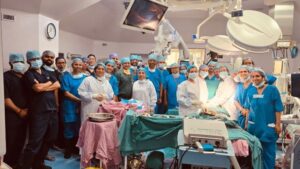
More than 30 doctors, specialists and nursing professionals from several departments participated in the procedure. The team brought together expertise in neurosurgery, obstetrics and gynaecology, maternal-foetal medicine, obstetric and neuroanaesthesia, plastic surgery, radiodiagnosis and neonatology.
The neurosurgical component was led by Dr Deepak Gupta, while the maternal-foetal medicine and obstetric teams were led by Dr Neena Malhotra and Dr K Aparna Sharma.
The operation was performed using advanced microscopy and continuous ultrasonography assistance, enabling the specialists to carry out the delicate repair with precision.
An intervention aimed at preventing lifelong neurological complications
Myelomeningocele is an open neural tube defect in which the spinal cord and its protective membranes protrude through an opening in the backbone. Children affected by this condition can develop paralysis, impaired bladder and bowel function, hydrocephalus (abnormal accumulation of fluid in the brain) and other lifelong neurological complications.
Traditionally, surgical correction of this defect is undertaken after birth. However, prenatal repair in carefully selected pregnancies seeks to protect the exposed spinal cord from continuing damage before delivery.
Dr Gupta underlined the significance as well as the limitations of the intervention, stating: “This is not a cure, and the child may still need long-term neurosurgical, urological, orthopaedic and rehabilitation care.”
He added that international evidence, including the landmark Management of Myelomeningocele Study (MOMS), showed that prenatal repair could reduce the need for treatment of hydrocephalus and improve early motor outcomes in carefully selected babies.
Over 30 healthcare professionals unite across specialities
The success of the operation underscores the importance of coordinated expertise rather than an isolated surgical achievement. The procedure required close collaboration among specialists responsible for the mother, the unborn child, anaesthesia, surgical repair and newborn care.
Dr Gupta emphasised that “fetal surgery cannot be treated as a single operation.” It requires a comprehensive maternal-foetal care programme, rigorous patient selection, informed counselling, ethical oversight, emergency preparedness and long-term follow-up.
The mother and foetus will remain under close multidisciplinary medical supervision through the remainder of pregnancy, delivery and the newborn period.
International evidence offers promise, but surgery carries significant risks
The medical rationale for prenatal intervention is supported by the landmark MOMS trial, which compared prenatal surgery with conventional repair after birth.
According to the study findings, 40% of children who underwent prenatal repair required a cerebrospinal-fluid shunt by 12 months, compared with 82% of those who underwent postnatal repair. Prenatal surgery was also associated with improved motor outcomes and reduced Chiari II hindbrain herniation.
However, foetal surgery is not without risks. These include premature delivery and complications associated with the uterine incision and scar, which can also affect future pregnancies. Consequently, the procedure is recommended only for carefully selected cases at highly specialised medical centres.
A public healthcare milestone with a powerful message on prevention
The pioneering surgery was provided free of cost to the family under the Government of India’s Janani Shishu Suraksha Karyakram (JSSK), highlighting the potential of advanced medical interventions within the public healthcare system.
AIIMS said the achievement represented the culmination of a long-standing institutional effort to develop expertise in foetal spinal surgery.
Recalling the journey, the institute observed: “Fourteen years ago, we spoke of the possibility of foetal spinal surgery at AIIMS. Today, that possibility has become a reality. Our next responsibility is to make it safe and accessible to the Indian families who may benefit from it.”
Doctors have also stressed that foetal surgery is a treatment option for selected pregnancies, not a substitute for prevention. The neural tube, which develops into the brain and spinal cord, normally closes around 28 days after conception — often before a woman realises that she is pregnant.
Pre-conception counselling, adequate folic-acid supplementation around conception, evidence-based food fortification and stronger national surveillance are therefore crucial to reducing the incidence of neural tube defects.
The AIIMS breakthrough is thus more than a remarkable surgical accomplishment. It represents a new possibility for Indian families confronting serious congenital conditions — bringing specialised medical intervention into the earliest stages of life, while reinforcing the need for prevention, informed choices and sustained care.