
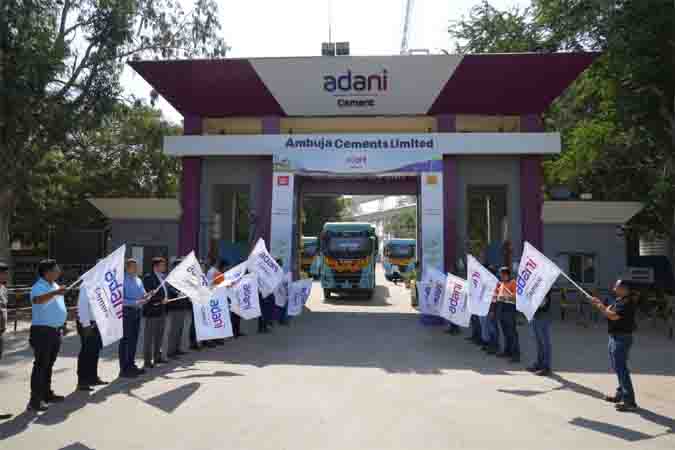
- Sanghi Plant in Gujarat flags off first-ever heavy-duty electric truck deployment, marking a decisive shift in cement transportation
- 410 EV trucks to hit the roads by March 2027, targeting annual reduction of over 25,000 tonnes of CO₂ emissions
- Fleet expansion to 2,000-plus electric trucks envisaged by 2030, covering 10% of road logistics volume
- Renewable energy-powered fleet aims to eliminate freight-related emissions and accelerate Scope 3 decarbonisation
- Adani Cement sees a strategic opportunity to combine logistics cost competitiveness with its net-zero ambitions
NE BUSINESS BUREAU
AHMEDABAD, NOV 18
The road to India’s green industrial future may well begin with a decisive turn away from diesel. In a significant push to decarbonise one of the country’s most energy- and logistics-intensive industries, Adani Cement has rolled out its first fleet of heavy-duty electric trucks, signalling that the transition to cleaner transportation is moving beyond pilot projects towards large-scale commercial deployment.
The initiative was formally flagged off at the company’s Sanghi Plant in Gujarat, marking a landmark step in Adani Cement’s sustainability and green logistics journey. The company plans to deploy 410 electric trucks by March 2027 in the first phase for transporting clinker and cement, with an ambitious roadmap to expand the fleet across its manufacturing facilities and logistics corridors.
The 410-truck deployment is projected to reduce more than 25,000 tonnes of carbon dioxide emissions annually, while displacing the equivalent of approximately 11 million litres of diesel every year.
The longer-term ambition is even more significant: Adani Cement is targeting more than 2,000 electric vehicles by 2030, with the objective of shifting 10% of its road logistics volume to electric transportation.
‘Smart sustainability’ that benefits people, planet and balance sheet
Vinod Bahety, CEO – Cement Business, Adani Group, described the Sanghi deployment as the beginning of a wider transformation across the company’s transportation network.
“The deployment at Sanghi is just the beginning. We have identified multiple routes across India for EV-based transport of clinker and cement. Every truck we electrify reduces our carbon footprint and insulates our logistics cost base from diesel price volatility. This is smart sustainability — it benefits the people, planet and the balance sheet. This is our commitment in action — to build a greener, more competitive cement company that serves India’s growth while protecting its future,” he said.
The company intends to progressively identify additional routes where electric heavy-duty transportation can deliver both environmental and commercial benefits.
Diesel economics meet the electric advantage
The transition comes at a time when the economics of heavy-duty electric mobility are becoming increasingly compelling.
According to the company, diesel prices have increased by 60% over the past decade, while lithium-ion battery pack costs have declined by approximately 70% and solar tariffs by 47%.
This convergence of rising conventional fuel costs and falling clean-energy technology costs is creating fresh opportunities for industrial companies to rethink their logistics models.
For cement manufacturers, where the transportation of raw materials, clinker and finished products involves extensive road networks and substantial fuel consumption, electrification could become an important lever for controlling operating costs while reducing environmental impact.
25,000 tonnes of CO₂ savings; scope 3 in sharp focus
The environmental implications extend beyond the company’s manufacturing facilities.
Diesel-powered trucks emit approximately 0.7375 kg of CO₂ per kilometre, according to the figures cited by Adani Cement. Electric trucks powered by renewable energy can eliminate up to 100% of these freight-related emissions, depending on the energy source and operating conditions.
The proposed 410-truck fleet is projected to prevent more than 25,000 tonnes of CO₂ emissions annually, equivalent to displacing around 11 million litres of diesel consumption.
The initiative is particularly relevant to Scope 3 emissions, which cover indirect emissions across a company’s value chain, including transportation and distribution by third parties and other logistics-related activities.
By transitioning freight movement towards renewable-powered electric vehicles, Adani Cement aims to address a significant component of its indirect carbon footprint and advance its broader net-zero ambitions.
From Sanghi to a 2,000-plus electric fleet by 2030
The Sanghi Plant deployment is envisaged as the launchpad for a much wider electrification programme.
With 410 electric trucks targeted by March 2027 and more than 2,000 vehicles envisaged by 2030, the company is looking to progressively integrate electric transportation into its clinker and cement supply chains.
The targeted 10% share of road logistics volume through EV trucks by 2030 would represent a significant shift in the transportation strategy of a major building materials producer.
India, the world’s second-largest cement producer, depends on extensive logistics networks to move limestone, clinker and finished cement across manufacturing locations, distribution centres and construction markets.
While this transportation backbone is indispensable to the country’s infrastructure and construction growth, it also carries a substantial carbon footprint.
Adani Cement’s electric truck initiative seeks to address this challenge by bringing together renewable energy, battery technology and industrial-scale freight operations.
The real test will lie in translating the initial deployment into a commercially sustainable, scalable logistics model across diverse routes and operating conditions. If successful, the initiative could provide an important demonstration of how heavy industries can align business competitiveness with India’s wider clean-energy transition.