
Ultimately, the judgment raises a larger question for a country aspiring to remain the world’s research and innovation powerhouse: can global scientific talent flourish under immigration rules that impose arbitrary deadlines on academic dreams? The Massachusetts court has delivered a powerful answer — educational opportunity cannot be undermined by regulatory overreach.
NE EDUCATION BUREAU
WASHINGTON, NOV 17
In a significant victory for international education and academic mobility, a US federal court has dismantled a controversial immigration rule that threatened to put rigid time limits on the academic journeys of international students, researchers and exchange visitors. For thousands of Indians pursuing higher education, doctoral research and scientific careers in the United States, the ruling brings substantial relief, while the Indian diaspora has hailed it as a vital safeguard for America’s scientific, technological and research leadership.
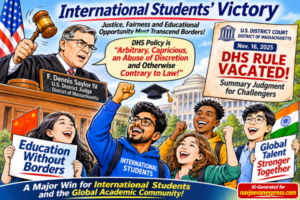
The US District Court for the District of Massachusetts, presided over by Judge F. Dennis Saylor IV, on November 16 granted summary judgment in favour of the organisations challenging the Department of Homeland Security’s (DHS) final rule, vacating it in its entirety. The judge held that the policy was arbitrary, capricious, an abuse of discretion and otherwise contrary to law.
The decision preserves the longstanding Duration of Status (D/S) framework for eligible international students and exchange visitors, subject to compliance with their authorised academic or exchange programmes. It follows a September 14 preliminary injunction that had prevented the controversial rule from coming into force.
Indian Diaspora hails victory for global talent and American innovation
The Foundation for India and Indian Diaspora Studies (FIIDS) welcomed the judgment, describing it as a major intervention in protecting international students and the future of American research and innovation.
“Once again, the Court has come to the rescue of international students — and, in doing so, has helped protect the future of American science, technology, research, and innovation,” FIIDS President Khanderao Kand said.
Kand underlined that international students contribute far beyond university classrooms, playing an increasingly important role in America’s research ecosystem, entrepreneurial ventures and industrial competitiveness.
“International students are not merely pursuing degrees in America; they are contributing to its universities, laboratories, research institutions, startups, industries, and technological leadership. Their contributions strengthen America’s global competitiveness and help drive its scientific and economic progress,” he said.
Describing the judgment as a source of enormous relief for the international academic community, Kand added:
“This decision brings tremendous relief to thousands of international students, researchers, scholars, and their families who have been living with uncertainty about their academic futures.”
Four-year cap and extension requirements: What the struck-down rule sought to change
The DHS rule, published in July 2026, sought to replace the existing Duration of Status arrangement with fixed admission periods linked to the programme completion dates recorded in students’ immigration documents, subject to a maximum of four years.
Students and exchange visitors requiring additional time would have had to apply for extensions of stay, introducing another layer of federal approval and administrative uncertainty.
The proposed restrictions also sought to limit changes in educational objectives, transfers between institutions and enrolment in additional programmes of study.
The measure covered F-1 international students, J-1 exchange visitors, including researchers, professors and instructors, and I-visa foreign media representatives.
For students pursuing lengthy doctoral programmes, interdisciplinary research, joint degrees or changes in academic specialisation, the proposed restrictions could have disrupted carefully planned academic and professional trajectories.
Court questions DHS authority: ‘prevent or discourage’ educational opportunities
In a particularly significant observation, Judge Saylor questioned the department’s attempt to impose restrictions that could undermine the very educational opportunities the US Congress intended to encourage.
“Put bluntly, DHS is seeking to prevent or discourage the very activity — providing educational opportunities for foreign students in the United States — that Congress sought to permit and encourage,” the judge observed.
He further stated: “The statute simply does not grant DHS such broad and open-ended authority to undermine the F-1 visa programme.”
The court also found that DHS had failed to adequately consider less burdensome alternatives to the proposed restrictions, particularly existing monitoring and enforcement mechanisms under the Student and Exchange Visitor Information System (SEVIS).
The system already enables authorities to monitor students’ academic records, institutional enrolment and immigration compliance through reporting obligations imposed on educational institutions.
The judgment held that DHS had not sufficiently weighed the costs and benefits of abandoning the existing framework or demonstrated why enhanced use of SEVIS would not adequately address its stated concerns.
FIIDS immigration expert flags threat to doctoral research and academic mobility
FIIDS representative Neeraj Bhatia, an immigration lawyer and expert, highlighted the importance of the judgment for students whose academic pursuits cannot always be confined to rigid timelines.
“The Court rightly recognised that the restrictive rule could undermine legitimate academic journeys, including doctoral research, joint degrees, changes in academic concentration, and other educational opportunities,” Bhatia said.
The observation carries particular significance for research scholars working on complex scientific and technological projects, where experimentation, testing, validation and publication can extend beyond conventional academic schedules.
The court specifically examined how the proposed restrictions could affect PhD programmes, joint graduate degrees and changes in academic concentration, finding that these limitations were not reasonably related to the purpose of the F-1 student visa programme.
NAFSA and Higher Education Coalition welcome decisive judicial intervention
The legal challenge was brought by a coalition led by NAFSA: Association of International Educators and the Presidents’ Alliance on Higher Education and Immigration, along with higher education institutions, academic and labour organisations.
Miriam Feldblum, President and CEO of the Presidents’ Alliance on Higher Education and Immigration, described the ruling as a significant victory for international students, scholars and the institutions that welcome them.
She warned that the administration’s policy actions had already contributed to declining international student enrolment and interest in studying in the United States.
Fanta Aw, Executive Director and CEO of NAFSA, said: “With this ruling, the judge has sent an unequivocal and resounding message: the longstanding Duration of Status policy is retained.”
She emphasised that international students and scholars deserved predictability in pursuing their ambitions and that their contributions, alongside domestic talent, strengthened the United States.
FIIDS urges clear implementation guidelines; government retains right to appeal
Welcoming the judicial intervention, FIIDS has urged the Department of Homeland Security and US Citizenship and Immigration Services to align their policies and implementation procedures with the judgment and issue clear guidance to universities, students and other affected stakeholders.
The ruling is a final district court decision on the merits, rather than merely an interim suspension. However, the legal battle may not be over, as the US government retains the option of appealing the final judgment and seeking a stay.
According to NAFSA, the government had already appealed the September preliminary injunction before the US Court of Appeals for the First Circuit. That appeal may now be affected by the subsequent final judgment.
For Indian students, researchers, scholars and their families, the decision represents an important reprieve from the uncertainty surrounding academic continuity in the United States.