
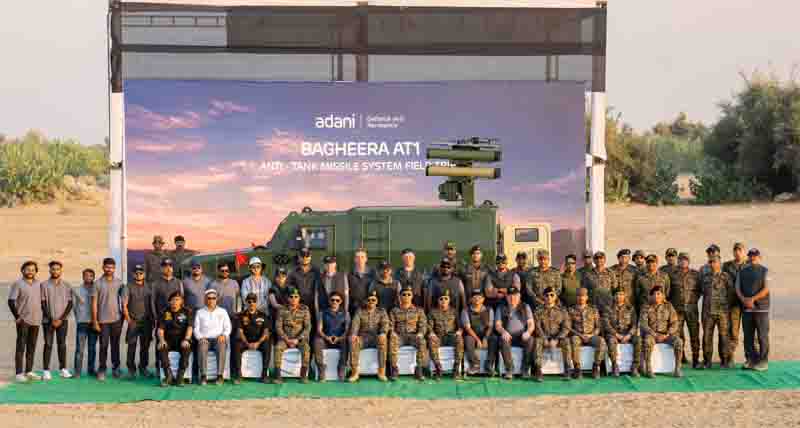
- Adani Defence & Aerospace successfully demonstrates its vehicle-mounted anti-tank guided missile system at Pokhran, with senior Army and Defence Ministry representatives witnessing the trials
- Four missiles fired during the demonstration, validating day-and-night engagements, tandem salvo capability and an extended-range aerial-target engagement
- Laser beam-riding guidance offers high resistance to electronic jamming; two-missile salvo is designed to overcome tanks equipped with active protection systems
- Customised over 18 months for Indian operational requirements, the 4×4 combat platform carries four ready-to-fire missiles and eight onboard reloads
- With an 8-km demonstrated anti-tank engagement range and a wider missile architecture capable of guided engagements up to 10 km, the system strengthens India’s indigenous defence manufacturing ambitions
NE DEFENCE BUREAU
POKHRAN (RAJASTHAN), NOV 21
Four successful missile firings at the Pokhran Field Firing Ranges have given India’s private defence manufacturing sector a significant battlefield technology milestone, with Adani Defence & Aerospace demonstrating an indigenous-configured, vehicle-mounted anti-tank guided missile system designed to strike armoured targets at extended ranges while countering increasingly sophisticated battlefield defences.
The company’s Bagheera AT1 system underwent a No Cost No Commitment (NCNC) demonstration on November 20, witnessed by senior representatives of the Indian Army, Department of Military Affairs and Ministry of Defence. The trials validated day-and-night engagements, a two-missile tandem firing along a single laser beam against an armoured-vehicle target and an aerial-target engagement at extended range. The demonstration was followed by a static display of the complete combat system.
The achievement is significant not merely for the successful missile firings but for the integration of the missile, automated launcher, advanced sighting systems and a high-mobility armoured vehicle into a single combat platform customised for India’s operational requirements.
18 months of development, built around India’s battlefield
Bagheera AT1 is the outcome of 18 months of design and development by Adani Defence & Aerospace, the Adani Group’s flagship defence and aerospace company.
The development programme focused on adapting the complete missile system to Indian terrain, climatic conditions and operational requirements. The resulting platform integrates the missile system, automated launcher, day-and-night sights and an Adani Defence-designed 4×4 high-mobility armoured vehicle.
Unlike a standalone missile, the integrated platform is designed to provide mobile anti-armour firepower, allowing troops to engage targets from a distance and relocate quickly to reduce exposure to retaliatory fire.
8-km reach, laser guidance and a two-missile assault
One of Bagheera AT1’s principal capabilities is its demonstrated anti-tank engagement range of up to 8 km, while its wider missile architecture is capable of supporting guided engagements extending up to 10 km.
Its laser beam-riding guidance system is another important feature. Rather than relying on a conventional radio-frequency command link, the missile follows a laser beam directed towards the target, offering high resistance to electronic jamming.
The system’s two-missile salvo capability is particularly noteworthy in an era when modern armoured vehicles increasingly deploy Active Protection Systems (APS) to detect and intercept incoming threats.
Under this firing concept, two missiles can be launched in quick succession along the same laser beam against a single target. The first is intended to engage the tank’s active protection system, while the second is designed to penetrate its defences and strike the armoured vehicle.
This capability seeks to address one of the most challenging aspects of contemporary anti-armour warfare: overcoming protective systems before the main weapon reaches its target.
12 missiles on one mobile platform
Bagheera AT1 combines firepower, mobility and automated targeting in a compact combat configuration.
Its key operational features include:
- Four ready-to-fire missiles: The automated launcher carries four missiles, with eight additional reloads onboard, taking the total ammunition capacity to 12 per vehicle.
- Day-and-night operations: Integrated television and thermal-imaging sights support target acquisition in different visibility conditions.
- Automated target tracking: The sighting system incorporates automated tracking to support target engagement.
- Shoot-and-move capability: The vehicle-mounted system is designed to engage from a protected position and relocate rapidly, reducing the crew’s exposure to enemy fire.
- Extended-range versatility: The demonstration also validated engagement of an aerial target at extended range, indicating a broader target-engagement capability.
Together, these features position Bagheera AT1 as a mobile anti-armour platform intended to offer sustained engagement capability rather than a single-shot missile solution.
India’s anti-tank modernisation gets another dimension
India’s requirement for modern anti-tank guided missile systems remains an important component of its Army modernisation programme. The existing inventory includes second-generation Milan-2T and Konkurs-M systems, alongside the induction of more advanced Spike missiles to address operational requirements. India has also pursued the acquisition of Javelin systems.
The changing character of warfare, particularly the growing use of drones, electronic warfare, active protection systems and increasingly sophisticated armoured platforms, has placed a premium on longer engagement ranges, mobility, precision and the ability to overcome layered defences.
Recent conflicts have also demonstrated that anti-armour operations increasingly demand integrated systems capable of combining surveillance, target acquisition, precision engagement and rapid relocation.
Bagheera AT1 offers the Indian Army another potential long-range, mobile ground-based anti-armour capability alongside existing man-portable and helicopter-launched missile systems. Its operational suitability and performance will ultimately be determined through the Army’s evaluation and acquisition processes.
Private industry’s growing role in defence self-reliance
The Pokhran demonstration also reflects the expanding role of India’s private defence industry in developing sophisticated military systems tailored to the requirements of the Armed Forces.
India’s defence production reached a record ₹1.78 lakh crore in FY 2025-26, with private industry accounting for approximately 24% or ₹42,000 crore. Defence exports also touched a record ₹38,424 crore, according to the figures cited in the programme background.
For Adani Defence, Bagheera AT1 represents an effort to develop, integrate and test a complete combat system rather than simply manufacture an individual component.
The larger objective is to build domestic capabilities in system integration, manufacturing, maintenance and progressively greater indigenisation of advanced anti-armour technologies, reducing dependence on emergency overseas procurement.
The successful Pokhran demonstration is an important step in that direction. The next milestone will be translating the demonstrated capabilities into operational evaluation, user acceptance and, potentially, a place in India’s evolving anti-armour arsenal.